Projection stereographic and second fundamental form

Click For Summary

Discussion Overview

The discussion revolves around the computation of the second fundamental form for a given mapping from R² to R³, specifically in the context of projection stereographic and its geometric implications. Participants explore methods for finding the unit normal vector and discuss related geometric concepts.

Discussion Character

  • Technical explanation
  • Conceptual clarification
  • Debate/contested

Main Points Raised

  • One participant expresses difficulty in finding a shortcut for computing the second fundamental form and mentions using the normal vector along with first and second derivatives, resulting in an impossible outcome.
  • Another participant suggests thinking geometrically about the vectors that are orthogonal to the surface of the sphere.
  • A participant reflects on their initial perception of the problem's difficulty, indicating a change in confidence after receiving input.
  • There is a question regarding whether the approach is similar for an ellipsoid, with a proposed normal vector based on its parametric equations.
  • One participant directly responds with a "No" to the ellipsoid question, indicating disagreement or a correction without further elaboration.

Areas of Agreement / Disagreement

The discussion contains multiple competing views, particularly regarding the computation methods and the applicability of concepts to different surfaces, such as the sphere and ellipsoid. No consensus is reached on the correct approach or the validity of the proposed normal vector for the ellipsoid.

Contextual Notes

Participants have not fully resolved the assumptions regarding the normal vector's computation or the specific methods applicable to different geometric shapes, leading to uncertainty in the discussion.

Simone Furcas
Messages
10
Reaction score
0
Let r:R2 →R3 be given by the formula

rac{2u}{u^2%20+v^2%20+1},%20\frac{2v}{u^2%20+v^2%20+1},%20\frac{-1+u^2%20+v^2}{u^2%20+v^2%20+1}).gif
Compute the second fundamental form with respect to this basis (Hint: There’s a shortcut to computing the unit normal n).

I can't find thi shortcut, does anyone help me? I'm solving it with normal vector and first and second derivate, but I obtained impossibile result... The solve is too long to write down here... I use I used
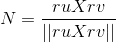
gif.latex?N=\frac{ruXrv}{||ruXrv||}.gif
 
Physics news on Phys.org
Think geometrically: what vectors are orthogonal to the surface of the sphere?
 
I was thinking it was very difficult... Now I think to be a bit silly! :) thx
 
Is it the same with an ellipsoid (a*cos(x)*sen(y),b*sen(x)*sen(y),c*cos(y)) ? N is (a*cos(x)*sen(y),b*sen(x)*sen(y),c*cos(y)) ?
 
No.
 

Similar threads

  • · Replies 13 ·
Replies
13
Views
3K
  • · Replies 8 ·
Replies
8
Views
6K
  • · Replies 2 ·
Replies
2
Views
2K
  • · Replies 1 ·
Replies
1
Views
3K
  • · Replies 16 ·
Replies
16
Views
6K
Replies
1
Views
1K
  • · Replies 2 ·
Replies
2
Views
2K
  • · Replies 2 ·
Replies
2
Views
2K
  • · Replies 1 ·
Replies
1
Views
2K
  • · Replies 6 ·
Replies
6
Views
4K