Proof by mathematical induction

Click For Summary
SUMMARY

The discussion focuses on proving the equation (n 0) + (n 1) + (n 2) + ... + (n n) = 2^n using mathematical induction, where (n n) represents a falling factorial. Participants clarify the definitions of binomial coefficients and falling factorials, noting that the proof for the equation is not valid under the falling factorial definition. The consensus is that the equation holds true for binomial coefficients, but not for falling factorials, which complicates the proof process.

PREREQUISITES
  • Understanding of mathematical induction
  • Familiarity with binomial coefficients and their properties
  • Knowledge of falling factorial notation
  • Basic algebraic manipulation skills
NEXT STEPS
  • Review the principles of mathematical induction in detail
  • Study the properties and definitions of binomial coefficients
  • Learn about falling factorials and their applications
  • Explore combinatorial proofs related to binomial identities
USEFUL FOR

Mathematicians, students studying combinatorics, and anyone interested in understanding mathematical proofs involving induction and factorials.

Rainbow Cupcake
Messages
1
Reaction score
1
Summary:: prove that (n 0) + (n 1) + (n 2) + ... + (n n) = 2^n is true using mathematical induction.
note that (n n) is a falling factorial

Hello! I have trouble dealing with this problem:

Mod note: Thread moved from math technical section, so is missing the homework template.
Prove that (n 0) + (n 1) + (n 2) + ... + (n n) = 2^n is true using mathematical induction.
note that (n n) is a falling factorial. I have made some progress with this problem but I got eventually got stuck.

progress:

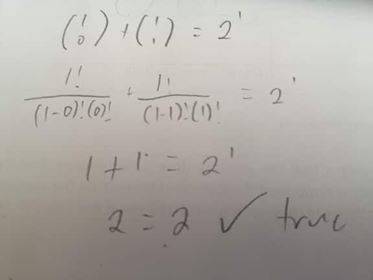
let n=1 (please see attached photo)
96234641_560053171591634_6884766591905431552_n.jpg

Therefore it is true for n=1

Then we assume that (k 0) + (k 1) + ... + (k k) = 2^k is true. This could also be written as
(k 0) + (k 1) + ... + (k k-1) + (k k) = 2^k.

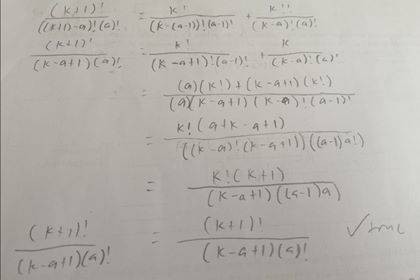
Prove that (k+1 a) = (k a-1) + (k a) (pls see attached photo for progress)
96387752_575061206470149_8286653933183565824_n.jpg


After this step, i got stuck.

Thank you!
 
Last edited by a moderator:
  • Like
Likes Delta2
Physics news on Phys.org
If you are stuck trying to show that:
$$\binom{k+1}{a} = \binom{k}{a} + \binom{k}{a-1}$$
Try adding the two terms on the right-hand side and see if you can get the term on the left-hand side.
 
  • Like
Likes Infrared and Delta2
Remember the binomial formula? It says <br /> (a+b)^{n}=a^{n}+\begin{pmatrix}<br /> n \\<br /> 1\\<br /> \end{pmatrix}a^{n-1}b+\begin{pmatrix}<br /> n \\<br /> 2\\<br /> \end{pmatrix}a^{n-2}b^{2}+...+b^{n}<br />
Now put a=1 and b=1 into that formula and see what happens.
 
  • Like
Likes WWGD
@Svein here ##\binom{n}{k}:=n(n-1)\cdots (n-(k-1))=\tfrac{n!}{(n-k)!}## is the falling factorial, the binomial formula would read (in terms of the falling factorial) ##(a+b)^n=\sum_{k=0}^n \tfrac{1}{k!}\binom{n}{k}a^{n-k}b^{k}## but this doesn't help here.

Here is a problem: @Rainbow Cupcake is using the definition of binomial coefficients ##\binom{n}{k}=\tfrac{n!}{(n-k)!k!}## in their work when it was clearly stated that ##\binom{n}{k}=\tfrac{n!}{(n-k)!}## is the falling factorial. OP clear this up: which is it ##\binom{n}{k}##, failing factorial or binomial coefficients? Then we have hope.

I did check and the thing you wanted to prove ##\binom{k+1}{a} =\binom{k}{a-1} + \binom{k}{a}## as it turns out, isn't true for falling factorials if that helps...
 
benorin said:
@Svein here ##\binom{n}{k}:=n(n-1)\cdots (n-(k-1))=\tfrac{n!}{(n-k)!}## is the falling factorial, the binomial formula would read (in terms of the falling factorial) ##(a+b)^n=\sum_{k=0}^n \tfrac{1}{k!}\binom{n}{k}a^{n-k}b^{k}## but this doesn't help here.

Here is a problem: @Rainbow Cupcake is using the definition of binomial coefficients ##\binom{n}{k}=\tfrac{n!}{(n-k)!k!}## in their work when it was clearly stated that ##\binom{n}{k}=\tfrac{n!}{(n-k)!}## is the falling factorial. OP clear this up: which is it ##\binom{n}{k}##, failing factorial or binomial coefficients? Then we have hope.

I did check and the thing you wanted to prove ##\binom{k+1}{a} =\binom{k}{a-1} + \binom{k}{a}## as it turns out, isn't true for falling factorials if that helps...
The context shown in this problem and the notation used suggest to me that this isn't about the falling factorial, but rather, binomial coefficients.

This article on the Wolfram site - https://mathworld.wolfram.com/FallingFactorial.html - show this notation for the falling factorial: ##(x)_n##, defined as ##x(x - 1)(x - 2)\dots(x - (n - 1))##.

This will be of no help in proving that ##\binom n 0 + \binom n 1 + \binom n 2 + \dots + \binom n n = 2^n##
 
  • Like
Likes berkeman and PeroK
Question: A clock's minute hand has length 4 and its hour hand has length 3. What is the distance between the tips at the moment when it is increasing most rapidly?(Putnam Exam Question) Answer: Making assumption that both the hands moves at constant angular velocities, the answer is ## \sqrt{7} .## But don't you think this assumption is somewhat doubtful and wrong?

Similar threads

  • · Replies 15 ·
Replies
15
Views
3K
  • · Replies 6 ·
Replies
6
Views
2K
  • · Replies 8 ·
Replies
8
Views
1K
  • · Replies 6 ·
Replies
6
Views
2K
  • · Replies 5 ·
Replies
5
Views
1K
  • · Replies 14 ·
Replies
14
Views
2K
  • · Replies 7 ·
Replies
7
Views
999
  • · Replies 7 ·
Replies
7
Views
2K
Replies
6
Views
2K
  • · Replies 7 ·
Replies
7
Views
2K