Proof Involving the Diagonals of Parallelogram

Click For Summary

Homework Help Overview

The discussion revolves around proving that the diagonals of a parallelogram intersect at their midpoints, as referenced in a specific textbook question. Participants are examining the geometric properties and equations related to the diagonals defined by their endpoints.

Discussion Character

  • Exploratory, Conceptual clarification, Mathematical reasoning, Problem interpretation

Approaches and Questions Raised

  • Participants discuss finding the midpoints of the diagonals and consider the equations of the lines formed by these diagonals. There are inquiries about how to derive the equations based on the coordinates provided in the diagram.

Discussion Status

The conversation is ongoing, with participants offering various insights into the geometric proof and the equations of lines. Some express confusion about setting up the problem, while others suggest reviewing foundational concepts in precalculus to aid understanding.

Contextual Notes

There are mentions of the need for a clearer homework statement and relevant equations, as well as constraints related to the original poster's background in precalculus and calculus.

nycmathguy
Homework Statement
Algebra & Geometry
Relevant Equations
Geometric Proof Using Algebra
Chapter 1, Section 1.1.
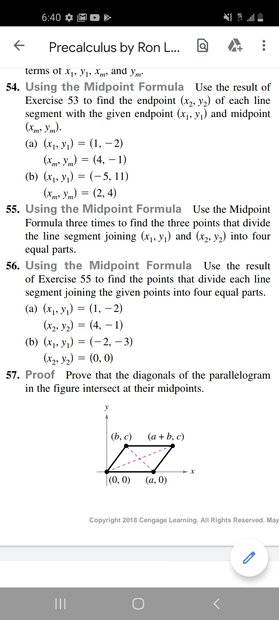
Look at the picture. Question 57.

Let me see.

To show this prove, I must find the midpoint of the diagonals. The midpoint of (b, c) and (a, 0) must be the same as the midpoint of (0, 0) and
(a + b, c).

You say?
Screenshot_20210613-184014_Drive.jpg
 
Last edited by a moderator:
  • Like
Likes   Reactions: Delta2
Physics news on Phys.org
I think it is sufficient to see in the picture as you suggest. Analytically you can consider the equation of the diagonals, for example the equation of the diagonal between ##(b,c)## and ##(a,0)## is ##y=\frac{c}{b-a}x-\frac{ca}{b-a}##. The diagonal between ##(a+b,c)## and ##(0,0)## is ##y=\frac{c}{a+b}x##. Now you can try to solve the system of both finding the intersection point ...
Ssnow
 
  • Like
Likes   Reactions: Delta2 and nycmathguy
Ssnow said:
I think it is sufficient to see in the picture as you suggest. Analytically you can consider the equation of the diagonals, for example the equation of the diagonal between ##(b,c)## and ##(a,0)## is ##y=\frac{c}{b-a}x-\frac{ca}{b-a}##. The diagonal between ##(a+b,c)## and ##(0,0)## is ##y=\frac{c}{a+b}x##. Now you can try to solve the system of both finding the intersection point ...
Ssnow
How did you come up with the two equations given in the information in the diagram?
 
nycmathguy said:
Homework Statement:: Algebra & Geometry
This is not a homework statement.
An informative homework statement would be "Show or prove that the diagonals of a parallelogram intersect at their midpoints."
nycmathguy said:
Relevant Equations:: Geometric Proof Using Algebra
Not an equation and not relevant. Relevant equations would include those for the midpoint of a line segment and possibly the equation of a line.
nycmathguy said:
Chapter 1, Section 1.1.
Not useful if we don't know which textbook you're using.
nycmathguy said:
Look at the picture. Question 57.

Let me see.
Stream of thought fluff like "let me see" is not useful. It's better to leave this out, especially since you have done this in several of your threads.
nycmathguy said:
To show this prove, I must find the midpoint of the diagonals. The midpoint of (b, c) and (a, 0) must be the same as the midpoint of (0, 0) and
(a + b, c).
Right, and here is where you could have put your calculations.
nycmathguy said:
 
nycmathguy said:
How did you come up with the two equations given in the information in the diagram?
He did it using an equation for a line, of which there are at least three. This would have been useful to include in the "Relevant Equations" section of the homework template.

The picture gives the coordinates of the endpoints of the diagonals, so it's just a matter of plugging these values in.

Here are three different equations for a straight line:
  • Slope-intercept form: ##y = mx + b## -- Use it if you know the slope of the line and its y-intercept.
  • Point-slope form: ##y - y_0 = m(x - x_0)## -- Use it if you know the slope of the line and a point on the line. This is the equation form that @Ssnow used.
  • Standard form: ##ax + by + c = 0## -- Every line, including vertical lines, can be written using this equation form.
 
  • Like
Likes   Reactions: Ssnow, Delta2 and nycmathguy
Mark44 said:
He did it using an equation for a line, of which there are at least three. This would have been useful to include in the "Relevant Equations" section of the homework template.

The picture gives the coordinates of the endpoints of the diagonals, so it's just a matter of plugging these values in.

Here are three different equations for a straight line:
  • Slope-intercept form: ##y = mx + b## -- Use it if you know the slope of the line and its y-intercept.
  • Point-slope form: ##y - y_0 = m(x - x_0)## -- Use it if you know the slope of the line and a point on the line. This is the equation form that @Ssnow used.
  • Standard form: ##ax + by + c = 0## -- Every line, including vertical lines, can be written using this equation form.

I know how to use those equations for simple questions not for anything like this thread.
 
  • Like
Likes   Reactions: Ssnow
nycmathguy said:
I know how to use those equations for simple questions not for anything like this thread.
Since your goal is to study calculus, that's why I suggested a review of precalc material. Any calculus book will assume that you understand and know how to use equations of a line, as well as a lot of other precalc topics.

If you're having trouble with the problem in this thread, that's an even stronger argument for spending time on precalculus stuff.

Despite all of my criticisms, you're doing a lot of things right, and should be commended for your goal of studying calculus. A lot of what I'm telling you is my attempt to help you get your thoughts organized so you can be successful in your goal. I'm also trying to get you to stretch out a bit and risk making mistakes.
 
  • Like
Likes   Reactions: Delta2 and berkeman
Mark44 said:
Since your goal is to study calculus, that's why I suggested a review of precalc material. Any calculus book will assume that you understand and know how to use equations of a line, as well as a lot of other precalc topics.

If you're having trouble with the problem in this thread, that's an even stronger argument for spending time on precalculus stuff.

Despite all of my criticisms, you're doing a lot of things right, and should be commended for your goal of studying calculus. A lot of what I'm telling you is my attempt to help you get your thoughts organized so you can be successful in your goal. I'm also trying to get you to stretch out a bit and risk making mistakes.
I started precalculus again back to chapter 1 or have you not noticed my precalculus questions already posted? I am going to tackle precalculus and calculus 1 at the same time but at a slower pace. I am also going to reduce the number of questions posted per week.
 
  • Like
Likes   Reactions: Delta2
nycmathguy said:
I am also going to reduce the number of questions posted per week.
No need to do that, but if you feel confident about a solution to a problem just don't post it. Some moderators say that you are not doing a good use of PF if you post easy (for them) problems.
 
  • #10
nycmathguy said:
I know how to use those equations for simple questions not for anything like this thread.
I don't understand why this is difficult for you. You're given the coordinates of all of the points, so as I said before, it's straightforward to plug them into one of the formulas for the equation of a line. Is the problem that the coordinates are given in variables like a and b rather than specified constants like 2 and 5?

nycmathguy said:
I started precalculus again back to chapter 1 or have you not noticed my precalculus questions already posted?
Of course I noticed -- I've responded to most of your threads.
 
  • Like
Likes   Reactions: Ssnow
  • #11
Maybe what @Mark44 forgot to tell you in his nice post #5 is that the slope ##m## of a line that connects points (a,b) and (c,d) is ##m=\frac{d-b}{c-a}##
 
  • Like
Likes   Reactions: Ssnow
  • #12
Mark44 said:
I don't understand why this is difficult for you. You're given the coordinates of all of the points, so as I said before, it's straightforward to plug them into one of the formulas for the equation of a line. Is the problem that the coordinates are given in variables like a and b rather than specified constants like 2 and 5?

Of course I noticed -- I've responded to most of your threads.

It is not difficult to solve. It is just difficult to set up or better yet, get started.
 
  • Like
Likes   Reactions: Delta2
  • #13
nycmathguy said:
It is not difficult to solve. It is just difficult to set up or better yet, get started.
This doesn't make sense. If one can't figure out how to set up a problem, there's no chance of solving it.
 
  • #14
Mark44 said:
This doesn't make sense. If one can't figure out how to set up a problem, there's no chance of solving it.
I am talking mainly about applications. There are certain word problems (system of equations, for example) that requires setting up equations in two and sometimes three unknowns. My thread about finding two missing numbers is a perfect example.
 

Similar threads

Replies
7
Views
4K
  • · Replies 3 ·
Replies
3
Views
2K
Replies
11
Views
3K
  • · Replies 5 ·
Replies
5
Views
3K
Replies
6
Views
2K
  • · Replies 20 ·
Replies
20
Views
3K
  • · Replies 17 ·
Replies
17
Views
2K
  • · Replies 32 ·
2
Replies
32
Views
3K
Replies
6
Views
2K
  • · Replies 2 ·
Replies
2
Views
6K