Proof of Sohrab's Proposition 2.2.39 (a) | Upper & Lower Limits

  • Context: MHB 
  • Thread starter Thread starter Math Amateur
  • Start date Start date
Click For Summary
SUMMARY

The discussion focuses on proving Proposition 2.2.39 (a) from Houshang H. Sohrab's "Basic Real Analysis" (Second Edition), specifically regarding the relationship between a lower bound \( a \) and the lower limit of a sequence \( x_n \). Participants emphasize the use of the Monotone Convergence Theorem and epsilon-delta arguments to establish that if \( u_n \) is the infimum of the sequence, then \( a \leq \underline{\lim}(x_n) \). The proof involves contradiction and careful management of limits and bounds.

PREREQUISITES
  • Understanding of limits and sequences in real analysis
  • Familiarity with the Monotone Convergence Theorem
  • Knowledge of epsilon-delta definitions in calculus
  • Ability to manipulate inequalities involving sequences
NEXT STEPS
  • Study the Monotone Convergence Theorem in detail
  • Review epsilon-delta proofs in real analysis
  • Explore properties of lower limits and upper limits of sequences
  • Practice proving inequalities involving sequences and their limits
USEFUL FOR

Students of real analysis, mathematicians focusing on sequences and limits, and educators teaching foundational concepts in calculus and analysis.

Math Amateur
Gold Member
MHB
Messages
3,920
Reaction score
48
I am reading Houshang H. Sohrab's book: "Basic Real Analysis" (Second Edition).

I am focused on Chapter 2: Sequences and Series of Real Numbers ... ...

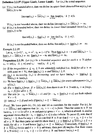
I need help with the proof of Proposition 2.2.39 (a)Proposition 2.2.39 (plus definitions of upper limit and lower limit ... ) reads as follows:
View attachment 9243

Can someone please demonstrate a formal and rigorous proof of Part (a) of Proposition 2.2.39 ...Help will be appreciated ... ...

Peter
 

Attachments

  • Sohrab - Proposition 2.2.39 ...  .png
    Sohrab - Proposition 2.2.39 ... .png
    50.2 KB · Views: 193
Physics news on Phys.org
I think I covered (a) at the end of my post
https://mathhelpboards.com/analysis-50/upper-lower-linits-lim-sup-lim-inf-sohrab-proposition-2-2-39-b-26469-new.html

where I said "This is another basic property of limits"

you just need to re-label one of the sequences to be a or b... (which is an isolated point / peculiar sequence but it doesn't change any of the intuition or epsilon management)
 
steep said:
I think I covered (a) at the end of my post
https://mathhelpboards.com/analysis-50/upper-lower-linits-lim-sup-lim-inf-sohrab-proposition-2-2-39-b-26469-new.html

where I said "This is another basic property of limits"

you just need to re-label one of the sequences to be a or b... (which is an isolated point / peculiar sequence but it doesn't change any of the intuition or epsilon management)
Hi steep ...

Thanks for the help ,,, but ... having trouble following you on this one ...

Sorry to be slow ... but can you give more details of the proof for (a) ...

Thanks again fr your help ...

Peter
 
so using $u_n$ as the inf sequence, we know

$a \leq u_n$ for all $n$ and we know (monotone convergence) that $u_n \to L_u \geq a$ I'm going to reuse that other argument almost verbatim to make a point
====
(This is another basic property of limits... if you aren't familiar, argue by contradiction that $a - L_u = c \gt 0$, now select something easy, say $\epsilon := \frac{c}{10}$ which implies there is some $N$ such that for all $n\geq N$

you have $\vert u_n - L_u\vert \lt \epsilon$ and by optional analogy with before $\vert a - a\vert =0\lt \epsilon$ but this implies $a \gt u_n$ which is a contradiction -- sketching this out is best... it implies that $u_n \lt L_u + \frac{1}{10}c \lt L_u + \frac{9}{10}c = L_u + c - \frac{1}{10}c = a- \frac{1}{10}c \lt a$

but we are told $a \leq u_n$ holds for all n
 
steep said:
so using $u_n$ as the inf sequence, we know

$a \leq u_n$ for all $n$ and we know (monotone convergence) that $u_n \to L_u \geq a$ I'm going to reuse that other argument almost verbatim to make a point
====
(This is another basic property of limits... if you aren't familiar, argue by contradiction that $a - L_u = c \gt 0$, now select something easy, say $\epsilon := \frac{c}{10}$ which implies there is some $N$ such that for all $n\geq N$

you have $\vert u_n - L_u\vert \lt \epsilon$ and by optional analogy with before $\vert a - a\vert =0\lt \epsilon$ but this implies $a \gt u_n$ which is a contradiction -- sketching this out is best... it implies that $u_n \lt L_u + \frac{1}{10}c \lt L_u + \frac{9}{10}c = L_u + c - \frac{1}{10}c = a- \frac{1}{10}c \lt a$

but we are told $a \leq u_n$ holds for all n

Thanks again for your help steep ...

After reflecting on what you have written ...

... I think the essence of your suggested proof of $$a \leq \underline{lim} (x_n)$$ is as follows ...... now ... $$u_n = \text{inf} \{ x_k \ : \ k \geq n \}$$ and $$a \leq u_n \leq b$$ ...

If we accept that $$(u_n)$$ is increasing (or at least non-decreasing) then given that $$(u_n)$$ is also bounded above by b, we then have, by the Monotone Convergence Theorem, that $$(u_n)$$ is convergent ...... that is $$(u_n) \longrightarrow L_u$$ where $$L_u$$ is some real number ... and of course $$L_u = \underline{lim} (x_n)$$Then ... to prove $$a \leq \underline{lim} (x_n)$$ ... I think you do something like the following ...

... let $$a = (a,a,a, ... ... )$$ and so given that $$a \leq u_n \ \forall \ n \in \mathbb{N}$$ we have ...

... $$\lim_{ n \to \infty } (a) \leq \lim_{ n \to \infty } (u_n )$$

$$\Longrightarrow a \leq \underline{lim} (x_n)$$ ... BUT ...... how do we justify treating a real number (viz. $$a$$) like a sequence ...

... that is how is it valid that $$a = (a,a,a, ... ... )$$
Is the above correct ...

Can you help further ... ?

Peter
 
Peter said:
...
Then ... to prove $$a \leq \underline{lim} (x_n)$$ ... I think you do something like the following ...

... let $$a = (a,a,a, ... ... )$$ and so given that $$a \leq u_n \ \forall \ n \in \mathbb{N}$$ we have ...

... $$\lim_{ n \to \infty } (a) \leq \lim_{ n \to \infty } (u_n )$$

$$\Longrightarrow a \leq \underline{lim} (x_n)$$ ... BUT ...... how do we justify treating a real number (viz. $$a$$) like a sequence ...

... that is how is it valid that $$a = (a,a,a, ... ... )$$
Is the above correct ...

Can you help further ... ?

Peter

That is the essence of it. The underlined part is what worries me because it is technically a fine question, but I inadvertently created this as an issue... because I wanted to stress that the intuition (and epsilon management) is basically the same as in your other question. Now kindly forget the fact that I made that analogy. And let's take another look at the problem.

Consider $u_n$ as a sequence. and $a$ is just some constant real number that is a lower bound on $u_n$. How do I know that $a \leq u_n$ for all n? because your book tells me this is true for the specific sequence involved.

so copying and pasting from what I wrote before, with minor adjustments (to make the point that the epsilon management is about the same) I would say:

= = = = =
argue by contradiction that $a - L_u = c \gt 0$, now select something easy, say $\epsilon := \frac{c}{10}$ which implies there is some $N$ such that for all $n\geq N$

you have $\vert u_n - L_u\vert \lt \epsilon$ but this implies that

$u_n \lt L_u + \frac{1}{10}c \lt L_u + c = a$

but we are told $a \leq u_n$ holds for all n which is a contradiction
 
Last edited:
steep said:
That is the essence of it. The underlined part is what worries me because it is technically a fine question, but I inadvertently created this as an issue... because I wanted to stress that the intuition (and epsilon management) is basically the same as in your other question. Now kindly forget the fact that I made that analogy. And let's take another look at the problem.

Consider $u_n$ as a sequence. and $a$ is just some constant real number that is a lower bound on $u_n$. How do I know that $a \leq u_n$ for all n? because your book tells me this is true for the specific sequence involved.

so copying and pasting from what I wrote before, with minor adjustments (to make the point that the epsilon management is about the same) I would say:

= = = = =
argue by contradiction that $a - L_u = c \gt 0$, now select something easy, say $\epsilon := \frac{c}{10}$ which implies there is some $N$ such that for all $n\geq N$

you have $\vert u_n - L_u\vert \lt \epsilon$ but this implies that

$u_n \lt L_u + \frac{1}{10}c \lt L_u + c = a$

but we are told $a \leq u_n$ holds for all n which is a contradiction
Thanks for all your help on this problem, steep ...

... it is is much appreciated ...

Peter
 

Similar threads

Replies
2
Views
2K
Replies
2
Views
2K
Replies
5
Views
2K
  • · Replies 3 ·
Replies
3
Views
2K
  • · Replies 2 ·
Replies
2
Views
2K
  • · Replies 2 ·
Replies
2
Views
1K
  • · Replies 4 ·
Replies
4
Views
2K
  • · Replies 2 ·
Replies
2
Views
2K
Replies
4
Views
2K
  • · Replies 2 ·
Replies
2
Views
2K