Proton Collision Feynman Diagram

Click For Summary

Discussion Overview

The discussion revolves around the representation of a relativistic proton collision using a Feynman diagram, specifically focusing on the production of a neutral pion and its subsequent decay into photons. Participants explore the accuracy of the diagram, conservation laws, and the underlying physics of proton-proton interactions.

Discussion Character

  • Technical explanation
  • Debate/contested
  • Mathematical reasoning

Main Points Raised

  • One participant describes a scenario involving a relativistic proton colliding with a stationary proton, resulting in momentum changes and pion production, but expresses uncertainty about the accuracy of their diagram.
  • Another participant highlights the need for proper time direction in particle trajectories and questions the representation of particles traveling backwards in time.
  • A different participant asserts that the drawn diagram does not conserve charge and points out an error in the representation of the neutral pion.
  • Suggestions are made to represent fundamental fermions with separate lines and to ensure arrows indicate the correct direction for antifermions.
  • Some participants argue that the proton-proton collision process depicted does not make sense, noting that a proton plus proton cannot yield a pion and a Z boson, and caution against fixing particle directions in the sketch.
  • One participant cites NASA to support the idea that high-energy proton collisions can produce neutral pions, although they acknowledge potential errors in their understanding.
  • Another participant counters that pions from proton-proton collisions are more likely to arise from the decay of high mass baryon states rather than the process depicted in the diagram.
  • There is a distinction made between the likelihood of pion production from two photons versus strong interactions, with emphasis on hadronization processes in high-energy collisions.

Areas of Agreement / Disagreement

Participants express multiple competing views regarding the accuracy of the Feynman diagram and the processes involved in pion production from proton collisions. The discussion remains unresolved, with differing opinions on the validity of the proposed interactions and representations.

Contextual Notes

Participants note limitations in the diagram's representation, including issues with charge conservation, the directionality of particle trajectories, and the assumptions regarding particle interactions in high-energy collisions.

connorp
Messages
30
Reaction score
2
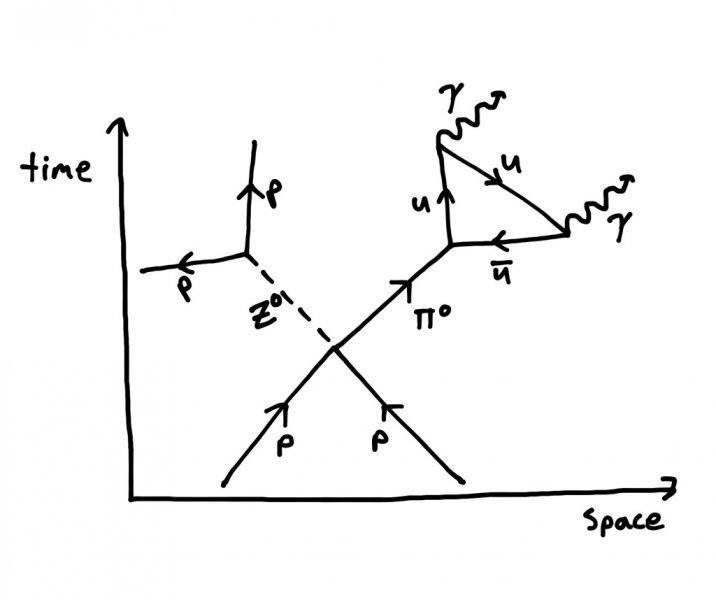
Supposed to represent a relativistic proton colliding with a stationary proton, leading to changes in the momentum of both and the production of a neutral pion. The pion then decays into two photons.

No clue if this is right. I've never drawn anything much more complicated than electron-positron annihilations. Any help is appreciated.
ImageUploadedByTapatalk1428543224.371581.jpg
 
Physics news on Phys.org
You need to make sure that your particles travel in time ... one of the product protons, for eg, travels in the -space direction and backwards in time while one of the u's appears to be stationary in the center of mass frame of the initial protons. Hmmm... don't interactions involving triangles usually sum to zero?
When you go ##u \to u + \gamma## ... are you saying that the particle spontaneously emits a photon? And why is the second u traveling backwards in time?

You are basically drawing a position-time graph ... you've been doing those since secondary school - you now how to do those.
 
I'm sorry, but what you are drawing is not a Feynman diagram. It doesn't conserve charge, and there's an arrow on the pi0.
 
Draw each fundamental fermion as a separate line with an arrow. Don't draw hadrons as single lines. Make sure the arrows point "backwards" for antifermions.

I've redrawn the π0 decay since you pretty much got it right, other than the single line for the meson itself. The oval won't be necessary on your diagram, and I didn't care for space and time axes.
 

Attachments

  • Snapshot.jpg
    Snapshot.jpg
    6.8 KB · Views: 3,808
@Simon Bridge: the pion decay is fine, apart from the drawing of the pion as mentioned before.

The proton/proton collision process does not make sense. Proton plus proton cannot give pion+Z. And the "space" axis is questionable at best. You don't know the directions the particles will fly to, and you don't want to fix it in a sketch like this.
 
Any better?
 

Attachments

  • image.jpg
    image.jpg
    27.3 KB · Views: 1,917
That is an unlikely, but possible process.
 
From NASA:
"In gamma-ray astronomy, "particle-particle collision" usually means a high-energy proton, or cosmic ray, strikes another proton or atomic nucleus. This collision produces, among other things, one or more neutral pi mesons (or pions). These are unstable particles that decay into a pair of gamma rays."
I have found several other sources as well that indicate it is not a completely rare outcome from a high energy p-p collision. Maybe I'm wrong though.
 
Pions from p-p collisions are more likely to come from the decay of high mass baryon states (deltas etc. etc.) than from the kind of process you've drawn.
 
  • #10
I did not say pion production was rare, but pion production from two photons is. A production via the strong interaction is much more likely.
DaPi said:
Pions from p-p collisions are more likely to come from the decay of high mass baryon states (deltas etc. etc.) than from the kind of process you've drawn.
If the energy is sufficient most pions come from hadronization itself, not from hadron decays afterwards.
 
  • #11
connorp said:
Any better?
??
 
  • #12
I'd go with what mfb said in his last post... it's a strong interaction that will give the pion...
 

Similar threads

  • · Replies 1 ·
Replies
1
Views
3K
  • · Replies 10 ·
Replies
10
Views
4K
  • · Replies 4 ·
Replies
4
Views
7K
  • · Replies 39 ·
2
Replies
39
Views
5K
  • · Replies 4 ·
Replies
4
Views
3K
  • · Replies 2 ·
Replies
2
Views
3K
  • · Replies 1 ·
Replies
1
Views
2K
  • · Replies 6 ·
Replies
6
Views
2K
  • · Replies 1 ·
Replies
1
Views
1K
  • · Replies 2 ·
Replies
2
Views
2K