Discussion Overview
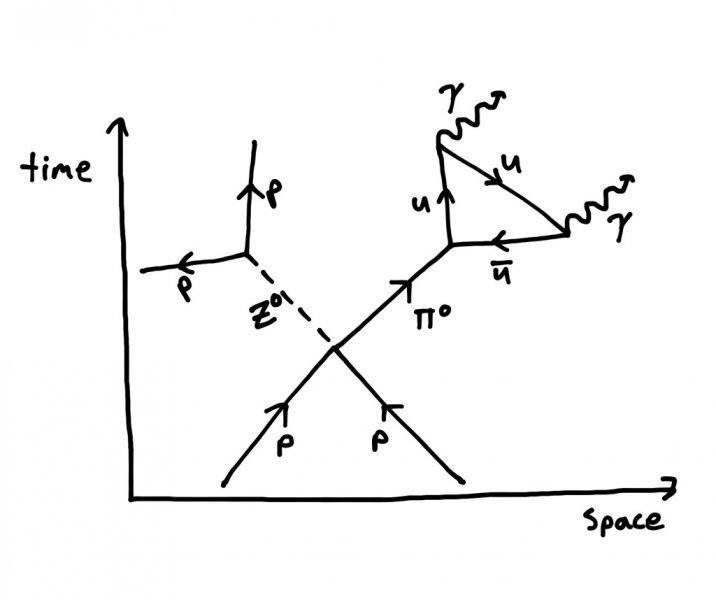
The discussion revolves around the representation of a relativistic proton collision using a Feynman diagram, specifically focusing on the production of a neutral pion and its subsequent decay into photons. Participants explore the accuracy of the diagram, conservation laws, and the underlying physics of proton-proton interactions.
Discussion Character
- Technical explanation
- Debate/contested
- Mathematical reasoning
Main Points Raised
- One participant describes a scenario involving a relativistic proton colliding with a stationary proton, resulting in momentum changes and pion production, but expresses uncertainty about the accuracy of their diagram.
- Another participant highlights the need for proper time direction in particle trajectories and questions the representation of particles traveling backwards in time.
- A different participant asserts that the drawn diagram does not conserve charge and points out an error in the representation of the neutral pion.
- Suggestions are made to represent fundamental fermions with separate lines and to ensure arrows indicate the correct direction for antifermions.
- Some participants argue that the proton-proton collision process depicted does not make sense, noting that a proton plus proton cannot yield a pion and a Z boson, and caution against fixing particle directions in the sketch.
- One participant cites NASA to support the idea that high-energy proton collisions can produce neutral pions, although they acknowledge potential errors in their understanding.
- Another participant counters that pions from proton-proton collisions are more likely to arise from the decay of high mass baryon states rather than the process depicted in the diagram.
- There is a distinction made between the likelihood of pion production from two photons versus strong interactions, with emphasis on hadronization processes in high-energy collisions.
Areas of Agreement / Disagreement
Participants express multiple competing views regarding the accuracy of the Feynman diagram and the processes involved in pion production from proton collisions. The discussion remains unresolved, with differing opinions on the validity of the proposed interactions and representations.
Contextual Notes
Participants note limitations in the diagram's representation, including issues with charge conservation, the directionality of particle trajectories, and the assumptions regarding particle interactions in high-energy collisions.