Proving an equation in a book about Periodic Structures

  • Context: Graduate 
  • Thread starter Thread starter haji-tos
  • Start date Start date
  • Tags Tags
    Book equation
Click For Summary
SUMMARY

The forum discussion centers on proving equations from the book "Periodic Structures: Mode-Matching Approach and Applications in Electromagnetic Engineering." The user seeks assistance in validating specific equations related to transverse electric (TE) and transverse magnetic (TM) modes, particularly how the electric field and magnetic field relate in these modes. Key vector identities and dyadic forms are utilized to derive results, confirming that for TE mode, the expansion coefficients V'' and I'' equal zero, while for TM mode, V' and I' equal zero due to the orthogonality of the fields involved.

PREREQUISITES
  • Understanding of vector calculus, specifically vector identities.
  • Familiarity with electromagnetic theory, particularly TE and TM modes.
  • Knowledge of dyadic representation in electromagnetic fields.
  • Proficiency in mathematical manipulation of equations involving electric and magnetic fields.
NEXT STEPS
  • Study the derivation of the wave equations for TE and TM modes in electromagnetic theory.
  • Learn about vector identities and their applications in electromagnetic field analysis.
  • Explore the concept of dyadic forms and their significance in representing electromagnetic fields.
  • Investigate the relationship between electric permittivity (ε), magnetic permeability (μ), and wave propagation in periodic structures.
USEFUL FOR

Electromagnetic engineers, physics students, and researchers focusing on wave propagation in periodic structures, particularly those interested in the mathematical foundations of TE and TM modes.

haji-tos
Messages
5
Reaction score
1
TL;DR
Proving an equation in a book
Hello everyone,

I am reading some book titled: Periodic Structures: Mode-Matching Approach and Applications in Electromagnetic Engineering.
In Chapter 2, there is an equation as follows:

equation-source1.PNG
where
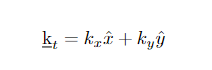
kt.PNG
. Here the electric field is along the transverse x − y plane like the propagation vector kt.

Now it is said that if we substitute the equation above in the following equation by getting rid of H_z:

equation-source2.PNG

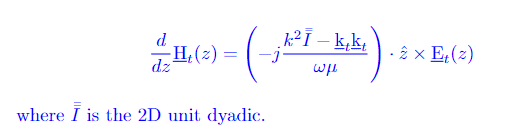
we will obtain the following:
equation-result.PNG
.

When trying to prove this, I don't get the same result. It's been a long time that I am trying to prove this. Can someone please help me prove if this is true ?

Thank you very much.
 
Physics news on Phys.org
The following two vector identities are very helpful: $$\vec A \times \left( \vec B \times \vec C \right) = \vec B\left(\vec A \cdot \vec C \right) - \vec C\left(\vec A \cdot \vec B \right)$$ $$\vec A \cdot \left( \vec B \times \vec C \right) =\vec B \cdot \left( \vec C \times \vec A \right)$$
Consider the given equation $$\frac d {dz} \hat z \times \vec H_t = j \omega \varepsilon \vec E_t + j \vec k_t \times \vec H_z$$ This can be written as $$ \hat z \times \frac {d \vec H_t} {dz} = j \omega \varepsilon \vec E_t + j \vec k_t \times \vec H_z$$ Apply ##\hat z \times## to both sides: $$ \hat z \times \left(\hat z \times \frac {d \vec H_t} {dz}\right) = j \omega \varepsilon \hat z \times \vec E_t + j \hat z \times \left(\vec k_t \times \vec H_z \right).$$ Use the first vector identity given above to show that this may be reduced to $$\frac {d \vec H_t} {dz}= -j\omega\varepsilon \hat z \times \vec E_t - j \vec k_t \left(\hat z \cdot \vec H_z \right) \,\,\,\,\,\,\,\,\, \rm Eq. 1$$

From the given equation ##\vec k_t \times \vec E_t = \omega \mu \vec H_z## we have ##\vec H_z = \frac 1 {\omega \mu} \vec k_t \times \vec E_t##. Substitute this into the last term of Eq. 1 above. Use the second vector identity to finally obtain $$\frac {d \vec H_t} {dz}= -j\omega\varepsilon \hat z \times \vec E_t + \frac j {\omega \mu} \vec k_t \left[\vec k_t \cdot \left( \hat z \times \vec E_t \right) \right]
\,\,\,\,\,\,\,\,\, \rm Eq. 2$$ This can be written in the dyadic form that is given in the first post. You will need to know how ##\varepsilon## is related to ##\omega, k## and ## \mu##.
 
  • Like
Likes   Reactions: PeroK, PhDeezNutz, haji-tos and 1 other person
Hello,

Thank you very much for the help.

I'm struggling to prove another two equations which follows the previous proof.
In the previous post it was proven that
1.PNG

where
2.PNG

The above terms are expressed in terms of the 2D dyadic (2 by 2) matrices.
The eigenvectors and the corresponding eigenvalues for each dyadic are expressed as

3.PNG


Now the two eigenvectors are perpendicular to each other and they are both perpendicular to . So the three vectors \underline α, \underline β and form a set of orthonormal basis vectors in a rectangular coordinate system, which are different from the structure coordinate system with x, y and z-axes.
The two dyadics can be expanded then as follows

4.PNG


Up to here all is fine and I've checked it. Now it is said that the 2D dyadic in equations (74) and (75) are expanded in terms of the two orthogonal bases in equations (86) and (87), and that from matrix theory, the transverse vectors in equations (74) and (75) can also be expressed in terms of the superposition of the two bases

5.PNG

where V′(z), V′′(z) are the expanding coefficients for transverse electric field, and I′(z), I′′(z) are those for transverse magnetic field. The above equations are the so-called transmission-line network representation.

Can you please help me prove equations (88) and (89) ? I got stuck here.

Thank you very much !
 
I'm not sure there's much to prove here.

The vectors ##\underline \alpha## and ##\underline \beta## are linearly independent (in fact, orthogonal) and they are both parallel to the x-y plane. So, any vector perpendicular to ##\hat z## can be expanded in terms of ##\underline \alpha## and ##\underline \beta##. The left sides of (88) and (89) are vectors that are perpendicular to ##\hat z## and functions of ##z##. So, for a given ##z##, they can be expressed as shown in (88) and (89) where ##V'(z), V''(z), I'(z)## and ##I''(z)## are the expansion coefficients.

However, if ##\underline E_t(z)## is the transverse electric field then the left side of (88) would be the transverse electric field rotated by 90 degrees around the ##\hat z## axis. So, as I see it, ##V'(z)## and ##V''(z)## are the expansion coefficients for this rotated vector rather than for ##\underline E_t(z)## itself.
 
  • Like
Likes   Reactions: haji-tos
I see, thank you very much for your quick reply.
The thing is that, later on, it is said that for TE mode: V''=0, I''=0 and for the TM mode, V'=0, I'=0. Why is that ?

Thank you again !
 
haji-tos said:
The thing is that, later on, it is said that for TE mode: V''=0, I''=0 and for the TM mode, V'=0, I'=0. Why is that ?
It's been a while since I've gone through the details of TE and TM waves. But I think the following is true.

TE mode:
The electric field lies in the transverse plane (the plane perpendicular to ##\hat z##). So, ##\underline E(z) = \underline E_t(z).##

Also, ##\underline E_t(z)## is oriented in the transverse plane such that ##\underline E_t(z)## is perpendicular to ##\underline k_t##. Thus, ##\underline E_t(z)## is parallel to ##\underline \beta##. This implies ## \hat z \times \underline E_t(z)## is parallel to ##\underline \alpha##. So, ##V'' = 0##.

##\underline H_t(z)## is perpendicular to ##\underline E_t(z)##, so ##\underline H_t(z)## must also be parallel to ##\underline \alpha##. Hence, ##I'' = 0##.

TM mode:
The analysis is similar. Then, instead of ##\underline E_t(z)## being parallel to ##\underline \beta##, we have ##\underline H_t(z)## parallel to ##\underline \beta##. So, ##I' = 0##.

##\underline E_t(z)## is perpendicular to ##\underline H_t(z)## which implies ##\underline E_t(z)## is parallel to ##\underline \alpha##. Thus, ##\hat z \times \underline E_t(z)## is parallel to ##\underline \beta.## Therefore, ##V' = 0##.
 
  • Like
Likes   Reactions: haji-tos
Great !! Thank you very much for your help ! I really appreciate it
 
  • Like
Likes   Reactions: TSny

Similar threads

  • · Replies 3 ·
Replies
3
Views
1K
  • · Replies 2 ·
Replies
2
Views
2K
  • · Replies 18 ·
Replies
18
Views
2K
  • · Replies 4 ·
Replies
4
Views
3K
  • · Replies 4 ·
Replies
4
Views
1K
  • · Replies 14 ·
Replies
14
Views
3K
  • · Replies 3 ·
Replies
3
Views
540
  • · Replies 3 ·
Replies
3
Views
2K
  • · Replies 10 ·
Replies
10
Views
875
  • · Replies 5 ·
Replies
5
Views
4K