Proving an inequality from an equation

  • Context: Undergrad 
  • Thread starter Thread starter Happiness
  • Start date Start date
  • Tags Tags
    Inequality
Click For Summary
SUMMARY

The discussion centers on proving the inequality ##v_f < v_0## for a ball thrown upwards in a medium with a drag force defined by ##F = -m\alpha v##, where ##g## and ##\alpha## are positive constants. The participants utilize logarithmic inequalities, specifically the hint that -ln(1-x) > ln(1+x) for positive x, to derive relationships between initial and final speeds. Ultimately, they establish that the final speed ##v_f## must be less than the initial speed ##v_0##, confirming that ##v_f < \frac{g}{\alpha}##, which represents the terminal velocity.

PREREQUISITES
  • Understanding of basic physics concepts related to motion and drag forces.
  • Familiarity with logarithmic functions and their properties.
  • Knowledge of inequalities and their applications in mathematical proofs.
  • Ability to manipulate algebraic expressions involving variables and constants.
NEXT STEPS
  • Study the properties of logarithmic functions in depth, focusing on their applications in inequalities.
  • Explore the concept of terminal velocity and its derivation in fluid dynamics.
  • Investigate the mathematical techniques for proving inequalities in physics contexts.
  • Learn about the implications of drag forces on motion in different mediums.
USEFUL FOR

Physicists, mathematicians, and students studying mechanics, particularly those interested in motion dynamics and the effects of drag forces on moving objects.

Happiness
Messages
686
Reaction score
30
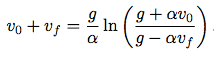
Given that ##v_0## and ##v_f## are positive variables related by the equation
Screen Shot 2016-06-24 at 4.52.38 am.png

where ##g## and ##\alpha## are positive constants.

Can you show that ##v_f<v_0## for all positive values of ##v_0## using a non-graphical method?

Physically, ##v_0## and ##v_f## are the initial and final speeds (at the same height) of a ball thrown upwards in a medium with a drag force ##F=-m\alpha v##.
 
Mathematics news on Phys.org
Yes. Hint: -ln(1-x) > ln(1+x) for positive x.
 
mfb said:
Yes. Hint: -ln(1-x) > ln(1+x) for positive x.

But this is only true for positive ##x<1##. How then can we show ##v_f<v_0## for all positive values of ##v_0##?

Using the hint, I can only get to ##y-\ln(1+y)>\ln(1+x)-x##, where ##x=\frac{\alpha v_0}{g}## and ##y=\frac{\alpha v_f}{g}##.
 
Happiness said:
But this is only true for positive ##x<1##.
Your logarithm is not defined otherwise, a vf where the logarithm is not defined cannot be a solution.

But does that have a solution at all?
Let ##c=\frac{g}{\alpha}##, and using the inequality for the denominator, I get

$$v_0 + v_f \leq c \ln(1+v_0/c) + c \ln(1+v_f/c)$$
That is wrong, as x > ln(1+x).
 
mfb said:
But does that have a solution at all?
Let ##c=\frac{g}{\alpha}##, and using the inequality for the denominator, I get

$$v_0 + v_f \leq c \ln(1+v_0/c) + c \ln(1+v_f/c)$$
That is wrong, as x > ln(1+x).

Using the hint

##c\ln(\frac{1+v_0/c}{1-v_f/c})>c\ln(1+v_0/c)+c\ln(1+v_f/c)##

So

##v_0+v_f>c\ln(1+v_0/c)+c\ln(1+v_f/c)##

Your logarithm is not defined otherwise, a vf where the logarithm is not defined cannot be a solution.

Indeed, ##v_f<\frac{g}{\alpha}##. It can be easily shown that ##\frac{g}{\alpha}## is the terminal velocity. So, indeed, only positive ##x<1## needs to be considered.
 
Oh right, wrong direction. Hmm, making it symmetric does not help. Okay, more mathematics.

Introduce V as ##V=\frac{v_0 \alpha}{g}## and ##a>0## as ##v_f=a v_0##. Then we get
$$V+aV = ln(1+V) - ln(1-aV)$$
Here is a plot

Consider f(x)=x-ln(1+x) where x>0.
##f'(x)=\frac{x}{x+1} > 0##
Rewrite the equation from above:
$$V-ln(1+V)- aV + ln(1-aV) = 2aV$$
$$f(V) - f(aV) = 2 aV$$As a>0, V>0, we get
$$f(V) > f(aV)$$
We established that f is increasing monotonically, therefore a<1 which corresponds to ##v_f < v_0##.
 
mfb said:
Rewrite the equation from above:
$$V-ln(1+V)- aV + ln(1-aV) = 2aV$$
$$f(V) - f(aV) = 2 aV$$

This doesn't seem right.

##f(V) - f(aV)=V-\ln(1+V)-\bigg(aV - \ln(1+aV)\bigg)=V-\ln(1+V)- aV + \ln(1+aV)##

The last term is different from the LHS in the previous step.

And the RHS should be ##-2aV##.
 
Last edited:
That should work now:
Consider f(x)=x-ln(1+x) where x>-1.
$$f'(x)=\frac{x}{x+1}$$
Note that |f'(-x)| > |f'(x)| for 0<x<1.
Via integration from 0 to x, we can conclude that f(-x)>f(x) for positive x.
$$V+aV = ln(1+V) - ln(1-aV)$$
$$V- ln(1+V) = -aV - ln(1+(-aV))$$
$$f(V) = f(-aV) > f(aV)$$
$$f(V) > f(aV)$$
The function f has a minimum at x=0 and is monotonically increasing for positive x.
=> a < 1
 
  • Like
Likes   Reactions: Happiness

Similar threads

  • · Replies 25 ·
Replies
25
Views
2K
Replies
38
Views
3K
  • · Replies 12 ·
Replies
12
Views
2K
  • · Replies 1 ·
Replies
1
Views
5K
  • · Replies 5 ·
Replies
5
Views
2K
  • · Replies 53 ·
2
Replies
53
Views
5K
Replies
5
Views
14K
Replies
8
Views
4K
  • · Replies 3 ·
Replies
3
Views
4K
  • · Replies 23 ·
Replies
23
Views
8K