Proving commutator relation between H and raising operator

Click For Summary
SUMMARY

The discussion centers on proving the commutator relation [H, a†] = hωa†, where H is the Hamiltonian operator and a† is the raising operator. The user initially encounters a negative sign due to mistakenly using the commutation relation [a†, a] instead of the correct [a, a†]. A hint suggests calculating [H, a†] |1> using the Hamiltonian equation H|n> = (n + 1/2)ħω |n> and the raising operator's action a† |1> = c |2>. The user resolves the issue by adhering to the proper order of operations in the commutation process.

PREREQUISITES
  • Understanding of quantum mechanics, specifically operator algebra.
  • Familiarity with commutation relations in quantum mechanics.
  • Knowledge of the Hamiltonian operator and its role in quantum systems.
  • Experience with raising and lowering operators in quantum harmonic oscillators.
NEXT STEPS
  • Review the derivation of commutation relations in quantum mechanics.
  • Study the properties of the Hamiltonian operator in quantum systems.
  • Learn about the application of commutator rules, specifically [AB, C] = A[B, C] + [A, C]B.
  • Practice problems involving the raising and lowering operators in quantum harmonic oscillators.
USEFUL FOR

Students and professionals in quantum mechanics, particularly those studying operator algebra and commutation relations in quantum systems.

guyvsdcsniper
Messages
264
Reaction score
37
Homework Statement
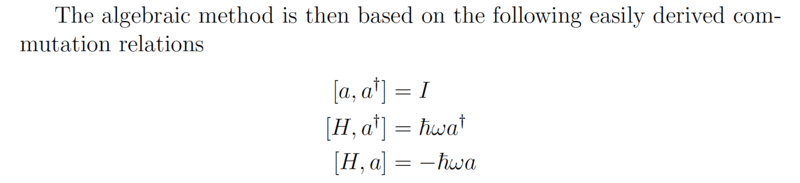
Prove the commutator relation [H,a*]=hwa*
Relevant Equations
[H,a*]=hwa*
I am going through my class notes and trying to prove the middle commutator relation,
Screen Shot 2022-08-25 at 10.06.11 PM.png


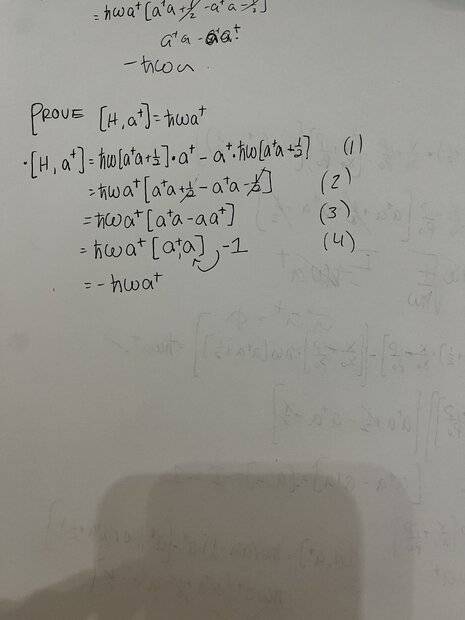
I am ending up with a negative sign in my work. It comes from [a,a] being invoked during the commutation. I obviously need [a,a] to appear instead.

Why am I getting [a,a] instead of [a,a]?

IMG_1106.JPG
 
Physics news on Phys.org
quittingthecult said:
Homework Statement:: Prove the commutator relation [H,a*]=hwa*
Relevant Equations:: [H,a*]=hwa*

I am going through my class notes and trying to prove the middle commutator relation, View attachment 313257

I am ending up with a negative sign in my work. It comes from [a,a] being invoked during the commutation. I obviously need [a,a] to appear instead.

Why am I getting [a,a] instead of [a,a]?

View attachment 313258
Hint: Calculate ##[H, a^{\dagger} ] |1>## using ##H|n> = (n + 1/2) \hbar \omega |n>## and ##a^{\dagger} |1> = c |2>##. What happens?

-Dan
 
  • Like
Likes   Reactions: guyvsdcsniper
Seems to me the step (2) is wrong, you are changing the order of operation there

In step (1) you have ## (a^\dagger a + \frac{1}{2})a^\dagger - a^\dagger(a^\dagger a + \frac{1}{2}) ##
But in step (2) you have ## a^\dagger (a^\dagger a + \frac{1}{2} - a^\dagger a - \frac{1}{2})##

Redo step (1) to (2), keep the order of operators unaltered.
 
Last edited:
  • Like
Likes   Reactions: guyvsdcsniper
It seems to me step (1) is wrong. The commutator disappeared…

Too early in the morning, you just expanded the commutator. I would not do this, I would apply commutator rules for ##[AB,C] = A[B,C]+[A,C]B##.
 
  • Like
Likes   Reactions: guyvsdcsniper, malawi_glenn and vanhees71
Thanks to all, I have seen the trivial mistake I made. I was able to get the correct answer now.
 
  • Like
Likes   Reactions: vanhees71

Similar threads

Replies
6
Views
2K
  • · Replies 2 ·
Replies
2
Views
2K
  • · Replies 1 ·
Replies
1
Views
2K
  • · Replies 1 ·
Replies
1
Views
2K
  • · Replies 2 ·
Replies
2
Views
3K
  • · Replies 2 ·
Replies
2
Views
3K
  • · Replies 2 ·
Replies
2
Views
2K
  • · Replies 1 ·
Replies
1
Views
2K
  • · Replies 4 ·
Replies
4
Views
2K
  • · Replies 3 ·
Replies
3
Views
2K