Proving eigenvalues of a 2 x 2 square matrix

Click For Summary
SUMMARY

The discussion centers on the conditions under which the eigenvalues of a 2 x 2 matrix can be determined, specifically addressing the equation involving the matrix \(A - 2I_2\) and its invertibility. It is established that if \(A - \lambda I\) does not have an inverse, then the determinant \(Det(A - \lambda I) = 0\) must hold true, indicating the presence of eigenvalues. The participants clarify that finding eigenvalues is independent of the matrix's invertibility, emphasizing the necessity of nonzero vectors in the eigenvalue definition.

PREREQUISITES
  • Understanding of eigenvalues and eigenvectors
  • Familiarity with matrix operations and determinants
  • Knowledge of linear algebra concepts
  • Basic understanding of matrix inverses
NEXT STEPS
  • Study the properties of determinants in linear algebra
  • Learn about the characteristic polynomial and its role in finding eigenvalues
  • Explore the implications of non-invertible matrices in eigenvalue problems
  • Investigate the relationship between eigenvalues and eigenvectors in depth
USEFUL FOR

Students and educators in linear algebra, mathematicians focusing on matrix theory, and anyone seeking to deepen their understanding of eigenvalue calculations and their significance in mathematical applications.

member 731016
Homework Statement
Please see below
Relevant Equations
Please see below
For this,
1684972106439.png

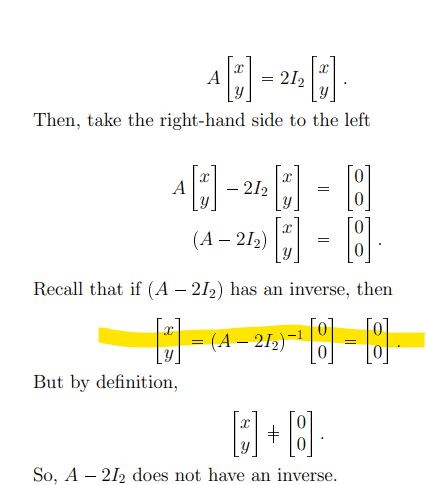
Does someone please know why the equation highlighted not be true if ##(A - 2I_2)## dose not have an inverse?

Many thanks!
 
Physics news on Phys.org
ChiralSuperfields said:
Homework Statement: Please see below
Relevant Equations: Please see below

For this,
View attachment 327021
Does someone please know why the equation highlighted not be true if ##(A - 2I_2)## dose not have an inverse?

Many thanks!
You “take” the matrix to the other side of the equation by multiplying from the left each side of the equation by the inverse. If the inverse does not exist, one cannot multiply by it.
 
  • Like
Likes   Reactions: FactChecker and member 731016
Eigenvalues ##\lambda## for a matrix ##A##are defined to satisfy ##Det(A-\lambda I)=0##. This comes from ##Ax=\lambda x ##, so that ##(A-\lambda I )x=0 ##.
 
  • Like
Likes   Reactions: member 731016
@ChiralSuperfields, what textbook are you getting this stuff from? Your thread here seems related to two of you recent threads. As I mentioned before, finding eigenvalues of a matrix has nothing to do with finding the inverse of a matrix.

The definition of an eigenvalue (usually represented by ##\lambda##) is that for some specific vector ##\vec x##, ##A\vec x = \lambda \vec x##, or equivalently, ##(A - \lambda I)\vec x = \vec 0##. If we restrict ##\vec x## to nonzero vectors, it must be true that ##|A - \lambda I| = 0##. That means that ##A - \lambda I## does not have an inverse.

One other thing. Near the bottom of the attachment you posted it says
But by definition,
##\begin{bmatrix}x \\ y \end{bmatrix} \ne \begin{bmatrix}0 \\ 0 \end{bmatrix}##

Unless it was specifically stated that this vector was nonzero somewhere above what you posted in the attachment, the line I quoted makes no sense.
 
  • Like
Likes   Reactions: member 731016 and Steve4Physics
Mark44 said:
@ChiralSuperfields, what textbook are you getting this stuff from? Your thread here seems related to two of you recent threads. As I mentioned before, finding eigenvalues of a matrix has nothing to do with finding the inverse of a matrix.

The definition of an eigenvalue (usually represented by ##\lambda##) is that for some specific vector ##\vec x##, ##A\vec x = \lambda \vec x##, or equivalently, ##(A - \lambda I)\vec x = \vec 0##. If we restrict ##\vec x## to nonzero vectors, it must be true that ##|A - \lambda I| = 0##. That means that ##A - \lambda I## does not have an inverse.

One other thing. Near the bottom of the attachment you posted it says

Unless it was specifically stated that this vector was nonzero somewhere above what you posted in the attachment, the line I quoted makes no sense.
Thank you for your replies @Frabjous , @WWGD , and @Mark44!

I understand now :) @Mark44, this is not from a textbook but course notes.

Many thanks!
 
ChiralSuperfields said:
this is not from a textbook but course notes.
It's hard to tell where they're going with these notes.
 
  • Like
Likes   Reactions: member 731016

Similar threads

  • · Replies 5 ·
Replies
5
Views
2K
  • · Replies 4 ·
Replies
4
Views
1K
Replies
5
Views
1K
Replies
5
Views
2K
  • · Replies 4 ·
Replies
4
Views
1K
Replies
4
Views
2K
  • · Replies 8 ·
Replies
8
Views
2K
  • · Replies 4 ·
Replies
4
Views
1K
  • · Replies 2 ·
Replies
2
Views
2K
  • · Replies 2 ·
Replies
2
Views
1K