Proving Segment Measure in Triangle ABC: BM+CM < AB+AC

  • Thread starter Thread starter Cantor
  • Start date Start date
  • Tags Tags
    Geometry Neutral
Click For Summary
To prove that segment BM + CM < AB + AC for a point M inside triangle ABC, the Triangle Inequality Theorem is a key tool, but it requires careful consideration of M's position. Drawing additional segments, such as AM, can create more inequalities to explore. It's important to note that BM does not necessarily have to be less than AB, which complicates the proof. Exploring degenerate cases, where M is at a vertex or on a side, may provide insights into the relationship between the segments. Ultimately, the challenge lies in ensuring that the inequalities hold true when M is confined within the triangle.
Cantor
Messages
8
Reaction score
0
I have a question involving the measure of segments

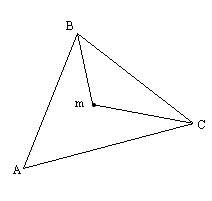
If m is a point inside a triangle ABC how could we prove that segment BM+CM < AB+AC. I am trying to use the Triangle Inequality Theorem (If A, B, C are three non-collinear points then AC < AB+BC) but I am stuck.

Should I prove by contradiction or show that BM < AB and CM <AC

Any help would be appreciated, Thanks:smile:

th_26657_triangle.jpg
 
Physics news on Phys.org
My first instinct is to draw some more lines. (e.g. maybe draw in the segment AM, or extend BM and CM to intersect the opposite sides of the triangle)

This would give me more inequalities to play with, and maybe I could derive something from there.


P.S. BM doesn't have to be less than AB. A counterexample isn't hard to find -- just draw AB and BM so that BM > AM, and then try and draw in the rest of the diagram.
 
Just make sure that whatever inequalities you end up working with, knowing they are true ensures that m is inside ABC.
 
Try thinking of points B and C as foci of an ellipse with A on the boundary.

Carl
 
I have tried all the possible inequalities but still nothing, the problem i am having is M could be anywhere so AB could be bigger or small them BM depending. Any other ideas by any chance.:smile:

Thanks

Cantor
 
Try thinking of points B and C as foci of an ellipse with A on the boundary.
Based on the title of the post, I think he's at a level where he's not allowed to simply assume that one ellipse lies inside the other, and he's not in a class where it's fair game to assume the Jordan curve theorem.

And the thought of studying conic sections in a (possibly) non-Euclidean setting makes me shudder!


Anyways, back to the original question -- I think looking at degenerate cases might help. They're often easier. What if M lies at one of the vertices? Or on one of the sides?

And, obviously, the theorem isn't true if M lies outside the triangle, so you have to use some fact that only works when M is inside.

(And, there's still the chance that inspired... or brute force... manipulation of the inequalities will provide the answer)
 
Last edited:
Question: A clock's minute hand has length 4 and its hour hand has length 3. What is the distance between the tips at the moment when it is increasing most rapidly?(Putnam Exam Question) Answer: Making assumption that both the hands moves at constant angular velocities, the answer is ## \sqrt{7} .## But don't you think this assumption is somewhat doubtful and wrong?

Similar threads

Replies
5
Views
2K
  • · Replies 13 ·
Replies
13
Views
2K
  • · Replies 1 ·
Replies
1
Views
2K
  • · Replies 1 ·
Replies
1
Views
1K
  • · Replies 4 ·
Replies
4
Views
1K
Replies
1
Views
2K
  • · Replies 4 ·
Replies
4
Views
4K
Replies
4
Views
2K
Replies
2
Views
2K
Replies
3
Views
2K