Proving trig identities -- Is the method related to the unit circle?

member 731016
Homework Statement
Pls see the statement below
Relevant Equations
Binomial theorem
Why when proving trig identities,
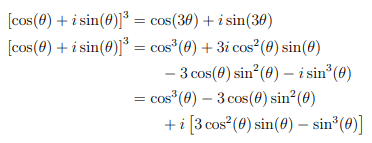
1678912054265.png

Do we assume that r = 1 from ## rcis\theta = r[\cos\theta + i\sin\theta]##? This makes me think that this is somehow it is related the unit circle.

Note: I am trying to prove the ##cos3\theta## identity and am curious why we assume that the modulus is 1.

Many thanks!
 
Physics news on Phys.org
Eh?
 
  • Like
Likes   Reactions: member 731016
PeroK said:
Eh?
Thank you for your reply @PeroK!

Sorry what do you mean? I can explain.

Many thanks!
 
PeroK said:
Eh?
I have edited the post @PeroK . Dose that help?
 
Callumnc1 said:
Thank you for your reply @PeroK!

Sorry what do you mean? I can explain.

Many thanks!
What do you mean? What ##r##?
 
  • Like
Likes   Reactions: member 731016
Include ##r## if you want. It will make no difference to the final identity.
 
  • Like
Likes   Reactions: member 731016
Callumnc1 said:
Homework Statement:: Pls see the statement below
Relevant Equations:: Binomial theorem

Why when proving trig identities,
View attachment 323655
Do we assume that r = 1 from ## rcis\theta = r[\cos\theta + i\sin\theta]##? This makes me think that this is somehow it is related the unit circle.

Note: I am trying to prove the ##cos3\theta## identity and am curious why we assume that the modulus is 1.

Many thanks!
Here we go again.

No. We don't need to assume that the modulus of ##\displaystyle \cos(\theta)+i\sin(\theta)## is ##1## . You should be able to show it.

What is the modulus of ##\displaystyle x+iy ## ?
 
  • Like
Likes   Reactions: member 731016
PeroK said:
What do you mean? What ##r##?
Thank you for your reply @PeroK!

##r## is the modulus

Many thanks!
 
PeroK said:
Include ##r## if you want. It will make no difference to the final identity.
Thank you for your reply @PeroK!

Sorry I forgot to mention that ##r## is just some scalar (modulus)

Many thanks!
 
  • #10
##\cos(\theta) + i\sin(\theta)## is the polar form of a point P(x, y) on the unit circle. The ray from the origin to point P makes an angle of ##\theta## with the horizontal axis. This fact is something you would have learned in a precalc class...

Since P is a point on the unit circle, its modulus r = ... ?
 
  • Like
Likes   Reactions: chwala and member 731016
  • #11
SammyS said:
Here we go again.

No. We don't need to assume that the modulus of ##\displaystyle \cos(\theta)+i\sin(\theta)## is ##1## . You should be able to show it.

What is the modulus of ##\displaystyle x+iy ## ?
Thank you for your reply @SammyS!

Sorry what do you mean show it? Do you mean by by trying to do the proof when r = 2 say?

Many thanks!
 
  • #12
Mark44 said:
##\cos(\theta) + i\sin(\theta)## is the polar form of a point P(x, y) on the unit circle. The ray from the origin to point P makes an angle of ##\theta## with the horizontal axis. This fact is something you would have learned in a precalc class...

Since P is a point on the unit circle, its modulus r = ... ?
Thank you for your reply @Mark44!

I think I did learn. But I though the point on a unit circle was ##(\cos(\theta), \sin(\theta))## not with the imaginary component? Are you talking about a unit circle in the complex plane? I can see that would have a point ##(\cos(\theta), i\sin(\theta))##.

Many thanks!
 
  • #13
Mark44 said:
##\cos(\theta) + i\sin(\theta)## is the polar form of a point P(x, y) on the unit circle. The ray from the origin to point P makes an angle of ##\theta## with the horizontal axis. This fact is something you would have learned in a precalc class...

Since P is a point on the unit circle, its modulus r = ... ?
Thank you for your reply @Mark44!

r = 1

Many thanks!
 
  • #14
Callumnc1 said:
Do we assume that r = 1 from ## rcis\theta = r[\cos\theta + i\sin\theta]##?
No.

But the problem you posted doesn't include r. It is a proof of the identity ##(\cos(\theta) + i
\sin(\theta))^3 = \cos(3\theta) + i\sin(3\theta)##.
 
  • Like
Likes   Reactions: member 731016
  • #15
SammyS said:
Here we go again.

No. We don't need to assume that the modulus of ##\displaystyle \cos(\theta)+i\sin(\theta)## is ##1## . You should be able to show it.

What is the modulus of ##\displaystyle x+iy ## ?
Thank you for your reply @SammyS!

##r = \sqrt {x^2 + y^2}##

Many thanks!
 
  • #16
Mark44 said:
No.

But the problem you posted doesn't include r. It is a proof of the identity ##(\cos(\theta) + i
\sin(\theta))^3 = \cos(3\theta) + i\sin(3\theta)##.
Thank you for your reply @Mark44!

I am wondering whether the identity can be proved in general for any r. That is, if we let
##(r[\cos(\theta) + i\sin(\theta)])^3##.

EDIT: I believe it would work, but why?

Many thanks!
 
  • #18
Mark44 said:
Not for just any old r, but it can be proved for integer values of r. This is what De Moivre's Theorem is concerned with. See https://math.libretexts.org/Bookshelves/Precalculus/Book:_Trigonometry_(Sundstrom_and_Schlicker)/05:_Complex_Numbers_and_Polar_Coordinates/5.03:_DeMoivres_Theorem_and_Powers_of_Complex_Numbers.
Thank you for your reply @Mark44!

I will check that out. Sorry, I was meant to post that question I had (accidently in the intro physics forum) about complex identity in this forum.

Many thanks!
 
  • #19
You basically need to understand where those identities come from ##z^n + \dfrac{1}{z^n} = 2 \cos (n\theta)## in your (now) closed thread https://www.physicsforums.com/threads/another-way-to-find-trig-identities.1050812/

Here is a guide you can follow to prove the identity above.
1) any complex number ##z## where ##|z| = 1## can by definition be written as ##\cos \theta + \mathrm{i} \sin \theta##.
2) ##z^n = \cos (n\theta) + \mathrm{i} \sin (n\theta)## where ##n## is a positive integer. This one is pretty simple to prove, you have probably done so in class. Otherwise, it is pretty simple to show using a proof by induction, e.g. show that if ##z^p = \cos (p\theta) + \mathrm{i} \sin (p\theta)## where ##p## is a positive integer, then show the following also holds: ##z^{p+1} = \cos ((p+1)\theta) + \mathrm{i} \sin ((p+1)\theta)##
3) Next things to understand, is that ##\dfrac{1}{z^n} = \cos (-n\theta) + \mathrm{i} \sin (-n\theta)## for ##n## any integer, positive or negative (and 0 of course). This is also pretty simple to show. Use that cos is even function and that sin is odd function. Then show that this indeed is equal to ##\dfrac{1}{z^n}##.
4) Now you are almost there. Should be straightforward to show that ##z^n + \dfrac{1}{z^n} = 2 \cos (n\theta)## at this point.
 
Last edited:
  • Like
  • Informative
Likes   Reactions: chwala, scottdave and member 731016
  • #20
Callumnc1 said:
Thank you for your reply @SammyS!

##r = \sqrt {x^2 + y^2}##

Many thanks!
What do you mean by "Thanks"?

I intended that you apply that to ##\displaystyle \cos(\theta)+i\sin(\theta)## and show that its Modulus is indeed ##1## .

Math is a not a spectator sport. You must practice and do, not just watch and cheer.
 
  • Like
  • Haha
Likes   Reactions: chwala, PeroK and member 731016
  • #21
malawi_glenn said:
You basically need to understand where those identities come from ##z^n + \dfrac{1}{z^n} = 2 \cos (n\theta)## in your (now) closed thread https://www.physicsforums.com/threads/another-way-to-find-trig-identities.1050812/

Here is a guide you can follow to prove the identity above.
1) any complex number ##z## can by definition be written as ##\cos \theta + \mathrm{i} \sin \theta##.
No, this is only true if ##|z| = 1##. In general,
##z = |z|e^{i \arg(z)} = |z|(\cos(\arg(z))+i\sin(\arg(z))) = |z|(\cos(\theta)+i\sin(\theta))##, where ##\theta = \arg(z)##.
 
  • Like
Likes   Reactions: malawi_glenn and member 731016
  • #22
malawi_glenn said:
You basically need to understand where those identities come from ##z^n + \dfrac{1}{z^n} = 2 \cos (n\theta)## in your (now) closed thread https://www.physicsforums.com/threads/another-way-to-find-trig-identities.1050812/

Here is a guide you can follow to prove the identity above.
1) any complex number ##z## can by definition be written as ##\cos \theta + \mathrm{i} \sin \theta##.
2) ##z^n = \cos (n\theta) + \mathrm{i} \sin (n\theta)## where ##n## is a positive integer. This one is pretty simple to prove, you have probably done so in class. Otherwise, it is pretty simple to show using a proof by induction, e.g. show that if ##z^p = \cos (p\theta) + \mathrm{i} \sin (p\theta)## where ##p## is a positive integer, then show the following also holds: ##z^{p+1} = \cos ((p+1)\theta) + \mathrm{i} \sin ((p+1)\theta)##
3) Next things to understand, is that ##\dfrac{1}{z^n} = \cos (-n\theta) + \mathrm{i} \sin (-n\theta)## for ##n## any integer, positive or negative (and 0 of course). This is also pretty simple to show. Use that cos is even function and that sin is odd function. Then show that this indeed is equal to ##\dfrac{1}{z^n}##.
4) Now you are almost there. Should be straightforward to show that ##z^n + \dfrac{1}{z^n} = 2 \cos (n\theta)## at this point.
Thank you for your reply @malawi_glenn!

That is very helpful!

I will try to prove it.

Many thanks!
 
  • #23
SammyS said:
What do you mean by "Thanks"?

I intended that you apply that to ##\displaystyle \cos(\theta)+i\sin(\theta)## and show that its Modulus is indeed ##1## .

Math is a not a spectator sport. You must practice and do, not just watch and cheer.
Thank you for your reply @SammyS!

Oh, so ## r = \sqrt {\cos^2\theta + (i^2\sin\theta)} = \sqrt { \cos^2\theta + \sin^2\theta} = 1##
Many thanks!
 
  • #24
Callumnc1 said:
Homework Statement:: Pls see the statement below
Relevant Equations:: Binomial theorem

Why when proving trig identities,
View attachment 323655
Do we assume that r = 1 from ## rcis\theta = r[\cos\theta + i\sin\theta]##? This makes me think that this is somehow it is related the unit circle.
Yes, it is. ##[\cos(\theta) + i \sin(\theta)]^3 = [e^{i \theta}]^3##. Now use the properties of exponents and put it back into the cos(), i sin() form.
 
  • Informative
  • Like
Likes   Reactions: scottdave and member 731016
  • #25
FactChecker said:
No, this is only true if ##|z| = 1##. In general,
##z = |z|e^{i \arg(z)} = |z|(\cos(\arg(z))+i\sin(\arg(z))) = |z|(\cos(\theta)+i\sin(\theta))##, where ##\theta = \arg(z)##.
Thank you for your reply @FactChecker !

True it is ##z = |z|e^{i\theta}##

Many thanks!
 
  • #26
FactChecker said:
Yes, it is. ##[\cos(\theta) + i \sin(\theta)]^3 = [e^{i \theta}]^3##. Now use the properties of exponents and put it back into the cos(), i sin() form.
Thank you for your reply @FactChecker!

Sorry what do you mean?

Many thanks!
 
  • #27
FactChecker said:
Yes, it is. ##[\cos(\theta) + i \sin(\theta)]^3 = [e^{i \theta}]^3##. Now use the properties of exponents and put it back into the cos(), i sin() form.
Thank you for your reply @FactChecker!

Sorry never mind. I think I understand now.

##[e^{i\theta}]^3 = e^{3\theta i}## which from the definition of Euler's formula gives
##\cos3\theta + i\sin3\theta## interesting that we don't have to use de moiré's theorem.Many thanks!
 
  • Like
Likes   Reactions: FactChecker
  • #28
Callumnc1 said:
Thank you for your reply @SammyS!

Oh, so ## r = \sqrt {\cos^2\theta + (i^2\sin\theta)} = \sqrt { \cos^2\theta + \sin^2\theta} = 1##
Many thanks!
Not quite right.

Details:

##\displaystyle \sqrt {\cos^2\theta + (i^2\sin\theta)}##

is wrong in a couple of ways,
 
  • Like
Likes   Reactions: member 731016
  • #29
SammyS said:
Not quite right.

Details:

##\displaystyle \sqrt {\cos^2\theta + (i^2\sin\theta)}##

is wrong in a couple of ways,
Thank you for your reply @SammyS!

Sorry how?

Many thanks!
 
  • #30
Callumnc1 said:
Thank you for your reply @SammyS!

Sorry how?

Many thanks!
You tell me.
 
  • Like
Likes   Reactions: member 731016

Similar threads

  • · Replies 14 ·
Replies
14
Views
3K
Replies
7
Views
2K
  • · Replies 29 ·
Replies
29
Views
6K
Replies
4
Views
2K
  • · Replies 7 ·
Replies
7
Views
11K
  • · Replies 10 ·
Replies
10
Views
2K
  • · Replies 1 ·
Replies
1
Views
2K
  • · Replies 69 ·
3
Replies
69
Views
12K
  • · Replies 5 ·
Replies
5
Views
2K
  • · Replies 8 ·
Replies
8
Views
9K