Proving trigonometry identities

Click For Summary
SUMMARY

The discussion focuses on proving trigonometric identities, specifically the identity involving the equation sin²x + cos²x = 1. Participants explore various methods, including the use of the difference of squares and the sine and cosine addition formulas. A key point is the correct application of the identity sin²x - cos²x, which factors into (sin x + cos x)(sin x - cos x). The conversation highlights the importance of understanding fundamental trigonometric identities for accurate problem-solving.

PREREQUISITES
  • Understanding of basic trigonometric identities, including sin²x + cos²x = 1.
  • Familiarity with the sine and cosine addition formulas.
  • Knowledge of factoring techniques in algebra.
  • Ability to manipulate trigonometric expressions.
NEXT STEPS
  • Study the difference of squares in trigonometric identities.
  • Learn how to apply the sine and cosine addition formulas in proofs.
  • Explore advanced trigonometric identities and their applications.
  • Practice proving various trigonometric identities using different methods.
USEFUL FOR

Students studying trigonometry, educators teaching trigonometric identities, and anyone looking to enhance their problem-solving skills in mathematics.

chwala
Gold Member
Messages
2,827
Reaction score
415
Homework Statement
see attached
Relevant Equations
trigonometry concept
I was just looking at the problem below: there may be several ways to prove the identity:

question:

1626491496310.png


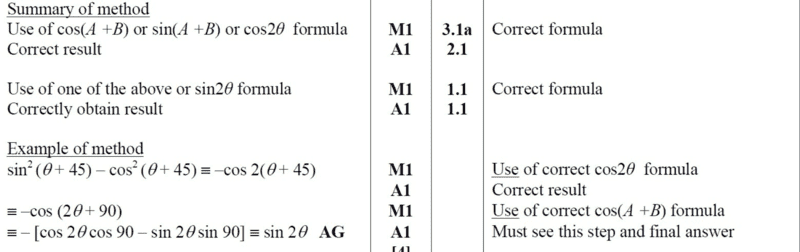
Mark scheme solution:

1626491538005.png


My take:
we may also use ##sin^{2}x+cos^{2}x≡(sin x+ cos x)(sin x-cosx)##...
we end up with(##\frac 2 {\sqrt{2}}##cos ∅)(##\frac 2 {\sqrt{2}}##sin ∅)=##2 sin ∅ cos ∅ ##= ##sin 2∅##
 
Last edited:
Physics news on Phys.org
The formula
cos(\alpha+\beta)=\cos\alpha cos\beta - \sin \alpha \sin \beta
is helpful.
 
anuttarasammyak said:
The formula
cos(\alpha+\beta)=\cos\alpha cos\beta - \sin \alpha \sin \beta
is helpful.
True, that's what I used...together with the one for sine...
 
chwala said:
My take:
we may also use ##sin^{2}x+cos^{2}x≡(sin x+ cos x)(sin x-cosx)##...
No, that's incorrect.
##\sin^2(x) + \cos^2(x) = 1##, for all x.
If you meant ##\sin^2(x) - \cos^2{x}##, that that does factor as you show above.
chwala said:
we end up with(##\frac 2 {\sqrt{2}}##cos ∅)(##\frac 2 {\sqrt{2}}##sin ∅)=##2 sin ∅ cos ∅ ##= ##sin 2∅##
 
Mark44 said:
No, that's incorrect.
##\sin^2(x) + \cos^2(x) = 1##, for all x.
If you meant ##\sin^2(x) - \cos^2{x}##, that that does factor as you show above.
yeah, true...i made a slight mistake there...it should be the difference of two squares, thanks mark...i.e
##[sin(∅+45)+cos(∅+45)]⋅[sin(∅+45)-cos(∅+45)]##
##[(sin ∅cos 45+cos ∅sin 45)+(cos ∅cos 45-sin ∅sin 45)]⋅
[(sin ∅cos 45+cos ∅sin 45)-(cos ∅cos 45-sin ∅sin 45)]##
thanks Mark cheers.
 

Similar threads

  • · Replies 5 ·
Replies
5
Views
2K
  • · Replies 6 ·
Replies
6
Views
1K
Replies
3
Views
2K
Replies
4
Views
2K
  • · Replies 3 ·
Replies
3
Views
2K
  • · Replies 15 ·
Replies
15
Views
2K
  • · Replies 4 ·
Replies
4
Views
1K
Replies
12
Views
2K
Replies
3
Views
2K