Pulley problem with incline plane

Click For Summary

Homework Help Overview

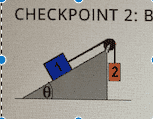
The discussion revolves around a physics problem involving two blocks connected by a rope over a pulley, with one block on a frictionless inclined plane and the other hanging. The goal is to determine the angle θ at which the system is in equilibrium.

Discussion Character

  • Exploratory, Assumption checking, Problem interpretation

Approaches and Questions Raised

  • Participants discuss the forces acting on the blocks and the setup of the coordinate axes. There are attempts to derive equations based on the forces involved, with some questioning the definitions and directions of these forces.

Discussion Status

Participants are actively engaging with each other's reasoning, providing feedback on the setup and calculations. Some have suggested re-evaluating the definitions of forces and the axes used, while others are attempting to clarify the steps in the derivation of the equations.

Contextual Notes

There is an ongoing discussion about the correctness of the initial assumptions regarding the forces and their components, as well as the implications of defining the inclined ramp as the axis for the problem.

putongren
Messages
124
Reaction score
1
Consider two blocks connected by an ideal rope that passes through an ideal pulley fixed on the corner of the wedge as shown in the figure. The blocks have masses m1 and m2. The block of mass m1 is on the incline surface (which is frictionless) while the block of mass m2 hangs up in the air. Find the angle θ at which the two blocks are in equilibrium (i.e., not moving)..
upload_2016-1-30_17-56-52.png

1. Homework Statement
N = Normal =m1g
T = m2g

Homework Equations


f = ma

The Attempt at a Solution


x - direction[/B]
N sin θ = T cos θ
m1g sin θ = m2g cos θ
cos θ = (m1/m2)sin θ

y - direction

N cos θ + T sin θ = m1g
m1g cos θ + m2g sin θ = m1g

substitute cos θ = (m1/m2)sin θ

(m21 / m2) sin θ + m2 sin θ = m1

sin θ = m21 m2 / m1g + m2

θ = sin-1(m21 m2)/ m1g + m2


But the angle is actually something else according to the answer key.
 
Last edited:
Physics news on Phys.org
N = Normal =m1g
... check this: N us usually the force acting normal to a surface - ##m_1g## is gravity on ##m_1## which is not normal to any of the surfaces in the diagram.

In your working, you should specify how you are using your axes... where are you placing the x and y axis?
I think you have got the directions of the forces mixed up - just draw the forces in as arrows, and use trigonometry to work out the right equations.
i.e.
"N sin θ = T cos θ"
... suggests that you are using x and y as horizontal and vertical ... you'll find the maths easier if the x-axis for m1 points upwards along the ramp.
 
putongren said:
(m21 / m2) sin θ + m2 sin θ = m1

sin θ = m21 / m2 / m1g + m2
How did you get from the above line to the bottom line? What is the order of operations in the bottom line? What order of divisions do you want to have happen?

\frac{m_{1}{}^{2}}{m_2} \sin \theta + m_2 \sin \theta = m_1

Try to simplify and then factor out the sine term.
 
Les talons said:
How did you get from the above line to the bottom line? What is the order of operations in the bottom line? What order of divisions do you want to have happen?

\frac{m_{1}{}^{2}}{m_2} \sin \theta + m_2 \sin \theta = m_1

Try to simplify and then factor out the sine term.
Hey thanks for the feedback ... I defined the inclined ramp as the axis.m_1g \sin \theta = m_2 g

\sin \theta = m_2 / m_1

\theta = \arcsin{m_2 / m_1}

Which is the answer.
 
Last edited:
putongren said:
Hey thanks for the feedback ... I defined the inclined ramp as the axis.
If the x-axis is along the ramp for m1, then the normal force N has no component along the x-axis and the tension T has no component along the y axis.
So whichever way you look at it: "N sin θ = T cos θ" cannot be correct.

For m1, the tension T points upwards and to the left (the +x direction) ... the normal force N points upwards along the y-axis ... and the weight (gravity) W points directly downwards (this is the only force with components in x and y directions). Since the block is motionless, ##\vec N + \vec W + \vec T = 0##
That should make a difference to your equations.
 

Similar threads

  • · Replies 5 ·
Replies
5
Views
2K
  • · Replies 1 ·
Replies
1
Views
3K
Replies
14
Views
3K
Replies
2
Views
2K
  • · Replies 7 ·
Replies
7
Views
4K
  • · Replies 4 ·
Replies
4
Views
2K
  • · Replies 4 ·
Replies
4
Views
3K
  • · Replies 6 ·
Replies
6
Views
3K
  • · Replies 1 ·
Replies
1
Views
3K
  • · Replies 4 ·
Replies
4
Views
3K