Pulley's mass is invariant to the physics problem?

Click For Summary

Homework Help Overview

The discussion revolves around a physics problem involving a pulley system with masses and the moment of inertia of the pulley. The original poster seeks to determine the velocity of one mass at the ground while considering the implications of the pulley's mass on the solution.

Discussion Character

  • Mixed

Approaches and Questions Raised

  • Participants explore various methods for analyzing the system, including Newton's second law and energy conservation. Questions arise about the relevance of the pulley's mass and moment of inertia, as well as the implications for tension in the string.

Discussion Status

Multiple approaches are being discussed, with some participants suggesting the application of Newton's second law to each object and the pulley. Others are considering energy conservation as a potential method. There is an acknowledgment that the presence of mass in the pulley changes the dynamics compared to typical examples.

Contextual Notes

Participants note that the string does not slip on the pulley, which affects the tensions in different sections of the string. There is also a mention of the need for free body diagrams to clarify the forces at play.

Helena Wells
Messages
125
Reaction score
9
New user has been reminded to post schoolwork problems in the Homework Help forums
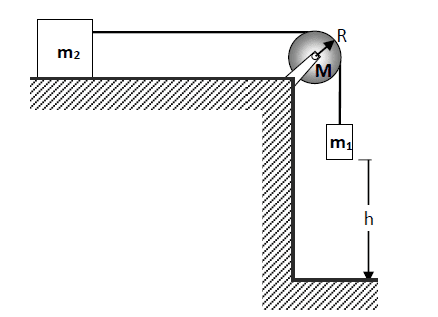
I have this system of masses and the goal is to find the velocity of $m_1$ at the ground. But it gives me the moment of inertia of the pulley as well which is $xMR^2$.
1611683210479.png
I know how to solve a pulley problem but since it gives me the moment of inertia of the pulley maybe it has something to do with the solution? and I don't know if I should use the normal method.Help appreciated!
 
Physics news on Phys.org
What's "the normal method"? Often in these sorts of problems, the pulley is given as massless but that is not the case here.

Start (in the usual manner :smile: ) by drawing free body diagrams for both masses and the pulley.
 
  • Like
Likes   Reactions: russ_watters
Hmm the 'normal method' is we treat m1 and m2 as 1 object m = m1+m2.

Then we apply Newton's second law of motion ΣF = ma where the forces sign depends on if it resists or not the motion of m in our case weight m2 - friction . And since we know the acceleration we can find time of fall and velocity at the ground.Then we apply Newton's 2nd law again for each object m1 and m2 with our found acceleration to find the tension of the rope in both objects.

But all the examples I have done this don't give mass to the pulley so I was wondering if anything could change here
 
perfectbornimoutlook said:
Hmm the 'normal method' is we treat m1 and m2 as 1 object m = m1+m2.
That won't help here, since the pulley has mass also. (Even for the massless pulley case, I don't like that method.)

What I recommend is to apply Newton's 2nd law to each object. That will give you three equations and three unknowns, which you can solve. As usual, you'll solve for the acceleration and then do your kinematic analysis.
 
  • Like
Likes   Reactions: SammyS
perfectbornimoutlook said:
Hmm the 'normal method' is we treat m1 and m2 as 1 object m = m1+m2.

Then we apply Newton's second law of motion ΣF = ma where the forces sign depends on if it resists or not the motion of m in our case weight m2 - friction . And since we know the acceleration we can find time of fall and velocity at the ground.Then we apply Newton's 2nd law again for each object m1 and m2 with our found acceleration to find the tension of the rope in both objects.

But all the examples I have done this don't give mass to the pulley so I was wondering if anything could change here
I suspect this is one of those problems that requires you to think for yourself! What do you know about rotational motion? What do you know about energy?
 
Hello its herperfectbornimoutlook here. This is my main account I had forgot it existed! Anyway I was thinking about applying Netwon's 2nd law of motion (torque) for the pulley but I don't think it will help me much.And how could conservation of energy help me here?
 
As @PeroK hints, there are several ways of solving this one. (Well, at least two.) I suggested one way since it uses Newton's 2nd law (which I assume you know). But there's an even easier way if you've gotten far enough in your studies.
 
Helena Wells said:
Anyway I was thinking about applying Netwon's 2nd law of motion (torque) for the pulley but I don't think it will help me much.
Try it and see!

Helena Wells said:
And how could conservation of energy help me here?
Well, is energy conserved?
 
Helena Wells said:
Anyway I was thinking about applying Netwon's 2nd law of motion (torque) for the pulley but I don't think it will help me much.
That's exactly what you were given the moment of inertia for.
 
  • #10
You are meant to assume the string does not slip on the pulley. Think what that means for the tensions in different sections of the string. (Or use energy, which avoids having to worry about forces.)
 
  • Like
Likes   Reactions: Lnewqban
  • #11
Helena Wells said:
... I know how to solve a pulley problem but since it gives me the moment of inertia of the pulley maybe it has something to do with the solution?
As the string does not slip on the pulley, its rotational inertia slows down any linear movement of the string-m1-m2 system.
Using all your strength, you will never be able to open a very heavy door as quickly as you could open a light door.

Copied from
https://en.m.wikipedia.org/wiki/Moment_of_inertia

"When a body is free to rotate around an axis, torque must be applied to change its angular momentum. The amount of torque needed to cause any given angular acceleration (the rate of change in angular velocity) is proportional to the moment of inertia of the body."
 
  • #12
  1. Make a labelled drawing. Because the pulley has mass you cannot assume the Tension in the horizontal string ##T_1## is equal to the vertical string segment ##T_2##
  2. You have three unknown quantities ##T_1,T_2, a## where a is the acceleration of, say, ##m_1##
  3. You have three equations from Newton two linear (masses) and one rotational (pulley). Make a free body diagram for each and write down the equations
  4. Solve
 
  • Like
Likes   Reactions: Steve4Physics and Delta2
  • #13
another problem for the law of energy conservation
 
Last edited:
  • #14
That, too. Or do it both ways for fun/pedagogy!
 

Similar threads

  • · Replies 30 ·
2
Replies
30
Views
4K
  • · Replies 13 ·
Replies
13
Views
3K
  • · Replies 10 ·
Replies
10
Views
5K
  • · Replies 22 ·
Replies
22
Views
2K
  • · Replies 15 ·
Replies
15
Views
7K
Replies
8
Views
15K
  • · Replies 10 ·
Replies
10
Views
3K
  • · Replies 18 ·
Replies
18
Views
5K
  • · Replies 17 ·
Replies
17
Views
3K
  • · Replies 22 ·
Replies
22
Views
7K