Pump water from multiple tanks under vacuum by common pump?

Click For Summary

Discussion Overview

The discussion revolves around the feasibility of using a common pump to extract water from three tanks, each under different vacuum levels, into a single atmospheric pressure tank. Participants explore the implications of this setup, including pressure profiles, flow rates, and potential backflow issues.

Discussion Character

  • Exploratory
  • Technical explanation
  • Debate/contested

Main Points Raised

  • One participant questions whether a common pump can effectively draw water from three tanks under varying vacuum levels without causing issues.
  • Another participant inquires about the flow rates, line lengths, and sizes, noting that the tanks are elevated above the atmospheric tank.
  • It is mentioned that the flow rates are low, approximately 500 Litres/hr from each tank, and that a line size of 1/2 inch is considered adequate.
  • Concerns are raised about the need for check valves on the exit lines, particularly since some tanks may be self-draining while others will require pumping.
  • A participant speculates on the effects of stronger vacuum levels on the pumping scheme, expressing hesitation about relying on gravity for draining.
  • Another participant questions the consequences of backflow into the process lines, suggesting that while it may not be disastrous, it could lead to intermittent cross-contamination.
  • A separate query is posed regarding the energy required to compress air at different altitudes, exploring whether altitude affects the energy needed for compression.
  • Lastly, a participant asks about the dynamics of pressure equalization among the source tanks.

Areas of Agreement / Disagreement

Participants express various concerns and hypotheses, but no consensus is reached on the overall feasibility of the proposed pumping arrangement or the implications of backflow and pressure equalization.

Contextual Notes

Limitations include assumptions about the behavior of fluids under varying vacuum conditions, the impact of elevation on flow dynamics, and the specific configurations of the piping and tanks.

rollingstein
Messages
644
Reaction score
16
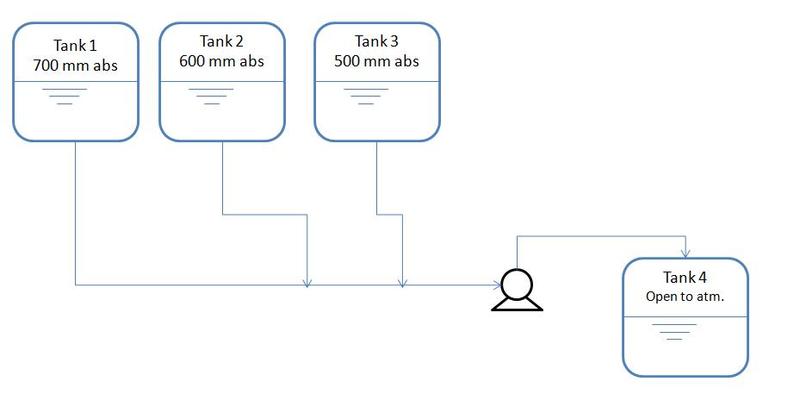
Is it possible to pump out water from three tanks all under a different vacuum level using a common pump and common suction header? Or would this arrangement cause problems? The destination is a single tank at atmospheric pressure.

See Sketch below.

I'm trying to intuitively figure how the pressure profile in the piping would look like.
D9WD7cD.jpg
 
Engineering news on Phys.org
Flow rates? Line lengths and sizes?
 
Bystander said:
Flow rates? Line lengths and sizes?

Tanks are all next to each other. Line length is approx. 100 ft total from anyone vacuum tank till the atm tank. Where to keep pump etc. is flexible. All three vacuum tanks are elevated approximately 10 feet above the atmospheric tank.

Flow rates are low; approx. 500 Litres/hr from each tank. Line size is flexible too but I was thinking 1/2 inch would be generous.

Basically, three condensate accumulations have to be emptied out & I was wondering if I could do with one pump instead of three separate ones.
 
rollingstein said:
10 feet above the atmospheric tank.
Check valves on the exit lines? One and two are going to be self-draining, and three is the only one that will require pumping.
 
Bystander said:
Check valves on the exit lines? One and two are going to be self-draining, and three is the only one that will require pumping.

Makes sense thanks.

Out of curiosity what if the vacuum levels were stronger. i.e. none of the tanks were self draining. Would this pumping scheme work then?

Say assume 300, 200, 100 mmHg?

I'm always hesitant to count on a gravity head for draining. That's why a pump would give me a margin of safety. But what I worry hear is a higher vacuum tank pulling from another via the interconnections.
 
How bad do things get if you get backflow into your process/condensate lines feeding these tanks?
 
Bystander said:
How bad do things get if you get backflow into your process/condensate lines feeding these tanks?

Not very bad. It won't be a disaster if there's any intermittent cross contamination.

So long as, on average, in the long run I can stabilize the system without any inter-flows.
 
Poster was warned about hijacking threads
Hi,

Let's say I have an air compressor. If I compress exactly one kilogram of air at STP, I mean the total mass of the sealed tank is one kilogram plus the mass of the tank when empty, it will take a fixed amount of energy to do that. Now suppose my compressor is located at 1km up in the atmosphere. I also operate it to compress exactly one kilogram of air into the empty tank. My question is this; does it take exactly the same amount of energy to compress the same mass of air into the tank regardless of altitude or does the energy required to compress exactly one kilogram of air increase at an altitude of say 1km?

Or more simply put, does it take more energy to compress the same amount of air at altitude and if so, does that extra energy exactly correlate to the gravitational potential energy ?Thanks.
 
Last edited:
What stops the three source tanks trying to equalise their pressures?
 

Similar threads

Replies
1
Views
1K
Replies
18
Views
3K
  • · Replies 15 ·
Replies
15
Views
4K
  • · Replies 3 ·
Replies
3
Views
4K
Replies
50
Views
8K
  • · Replies 15 ·
Replies
15
Views
4K
  • · Replies 14 ·
Replies
14
Views
2K
  • · Replies 37 ·
2
Replies
37
Views
4K
Replies
4
Views
2K
  • · Replies 13 ·
Replies
13
Views
4K