PWM controlled fan responds unexpectedly

  • Thread starter Thread starter Artlav
  • Start date Start date
  • Tags Tags
    Fan Pwm
Click For Summary

Discussion Overview

The discussion revolves around the unexpected behavior of a PWM-controlled fan, specifically a 12V CPU cooler, when attempting to regulate its speed using a PWM signal generated by a 555 timer and a MOSFET. Participants explore the relationship between the PWM duty cycle and the fan's RPM, noting inconsistencies in performance across different duty cycle ranges.

Discussion Character

  • Exploratory
  • Technical explanation
  • Debate/contested

Main Points Raised

  • One participant observes that the fan's RPM does not consistently correlate with the PWM duty cycle, with peculiar behavior noted at various duty cycle percentages.
  • Another participant suggests checking the gate-source voltage of the MOSFET with an oscilloscope to better understand the switching waveform, indicating that visual checks with an LED may not reveal all issues.
  • A different participant points out that the fan is likely a brushless DC motor with onboard controller chips, which may complicate PWM control and contribute to the observed irregularities.
  • Another participant argues that the fan's electronics might be simple and only responsible for commutation, implying that the PWM scheme should generally work.
  • One suggestion involves using a power MOSFET to charge an electrolytic capacitor, proposing that this could help manage current pulses that may be higher than expected.
  • A participant shares their experience with a simpler fan that operates correctly under PWM control, contrasting it with the more complex fan that requires near full power to start but can be throttled once running.

Areas of Agreement / Disagreement

Participants express differing views on the nature of the fan's electronics and their impact on PWM control. Some believe the fan's complexity is the source of the issue, while others maintain that the PWM approach should work as intended. The discussion remains unresolved regarding the best method to achieve effective control of the fan's speed.

Contextual Notes

There is uncertainty regarding the specific characteristics of the fan's internal controller and how it interacts with PWM signals. Participants have not reached a consensus on the best approach to address the observed behavior.

Artlav
Messages
161
Reaction score
1
Hello.

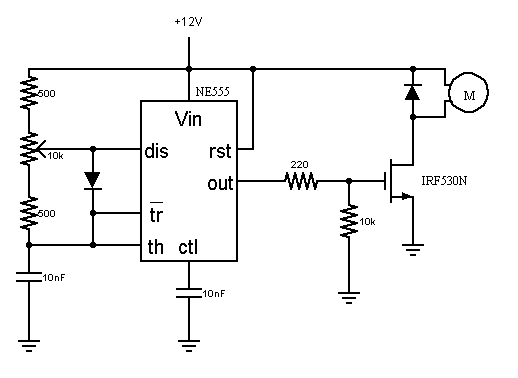
I'm trying to control the speed of a fan (12V cpu cooler) with PWM (555 + MOSFET).
Should be quite straightforward, but i noticed that the speed of the fan does not seem to always change in the same way the duty cycle does.

With an optical RPM meter I'm seeing that the lowest RPM is at about 5% of POT's range, and goes slightly higher below that.
In the 5%-60% range the RPM climbs steadily with the duty cycle.
At 60% there is the maximum RPM.
Between 60% and about 80% it decreases.
Then between 80% and 90% it increases again, but at 90% it's less than at 60%.
And 90% to 100% it decreases again.

Even better, that 60% peak is higher that the RPM of the fan just hooked up to the 12V directly, while 100% is less than that.

An LED hooked up to the same controller seem to change brightness linearly.

What is causing such a strange behaviour?
Or rather, how to fix it?

Schematics:
pwm_fan.png
 
Engineering news on Phys.org
Sounds odd indeed, with those resistors and pot your duty cycle should be within ~5-50%.

Do you have access to an oscilloscope? I would have a look at the gate-source voltage of your MOSFET to see what it's actually doing. It's probably hard to judge visually with the LED if there's any problem with your switching waveform.

Edit:
I didn't notice the charging diode, duty cycle should be within ~5-95%.
 
Last edited:
Your fan is no ordinary motor, it is a brush-less DC motor with some controller chips on board. So, I am not sure its safe/good to PWM control it. The Odd behavior has got to do something with the BLDC motor controller on your fan.
 
The electronics in that fan motor is in all likelihood completely "dumb" and only handles commutation:
AVR442: PC Fan Control using ATtiny13

You might have a super weird fan motor but the PWM scheme in your circuit has always worked for me.
 
You could try a power MOSFET charging an electrolytic capacitor from the + rail. Your motor could be connected across that electrolytic.

You can get the same effect by connecting an electrolytic across your motor terminals in the arrangement you have. Current pulses may be higher than anticipated.
 
I_am_learning said:
brush-less DC motor with some controller chips on board.
Looks like that's what the problem is - the fan is too "smart".
I tried a "dumber" fan with only 2 wires, and everything works nicely.
The new fan won't start spinning unless given nearly full power, but once spinning it can be throttled up and down cleanly.

So, once again - if it does not make sense, look elsewhere :)
Thanks all.
 

Similar threads

  • · Replies 6 ·
Replies
6
Views
7K
  • · Replies 10 ·
Replies
10
Views
6K
Replies
10
Views
3K
  • · Replies 2 ·
Replies
2
Views
7K
  • · Replies 6 ·
Replies
6
Views
20K
  • · Replies 2 ·
Replies
2
Views
2K
  • · Replies 21 ·
Replies
21
Views
10K
  • · Replies 7 ·
Replies
7
Views
7K
Replies
29
Views
28K
  • · Replies 14 ·
Replies
14
Views
4K