Quantum Mechanics Hydrogen Atom Expectation Value Problem

Click For Summary
SUMMARY

The discussion centers on the expectation value problem in quantum mechanics related to the hydrogen atom, specifically focusing on the spherical harmonics Ylm and their significance in angular momentum. Participants clarify that Y21 and Y11 are joint eigenfunctions of L2 and Lz, with l=2 corresponding to the d orbital and indicating total angular momentum squared. The expected value of angular momentum is derived from the superposition of eigenstates, with the formula for L2 expectation value being ⟨L²⟩ = |a|² l1(l1 + 1)ℏ² + |b|² l2(l2 + 1)ℏ².

PREREQUISITES
  • Understanding of quantum mechanics concepts, specifically eigenstates and superposition.
  • Familiarity with spherical harmonics and their role in angular momentum.
  • Knowledge of quantum numbers l and m and their significance in quantum states.
  • Basic grasp of operators in quantum mechanics, particularly L2 and Lz.
NEXT STEPS
  • Study Griffiths' "Introduction to Quantum Mechanics," particularly Chapter 4.3 on angular momentum.
  • Explore the mathematical derivation of expectation values in quantum mechanics.
  • Learn about the role of spherical harmonics in quantum systems and their applications.
  • Investigate advanced quantum mechanics texts that cover angular momentum in detail.
USEFUL FOR

Students and professionals in physics, particularly those specializing in quantum mechanics, as well as educators seeking to deepen their understanding of angular momentum and expectation values in quantum systems.

cemtu
Messages
99
Reaction score
7
Homework Statement
Expected Value of L^2 is needed
Relevant Equations
In a similar problem, similar way of solution is presented at attempted solution
I can not solve this problem:
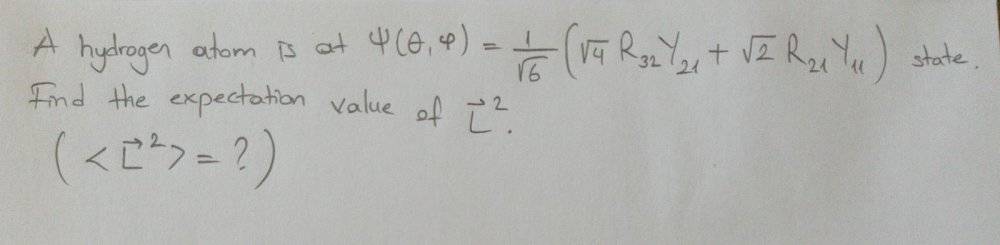
expected.jpeg

However, I have a similar problem with proper solution:
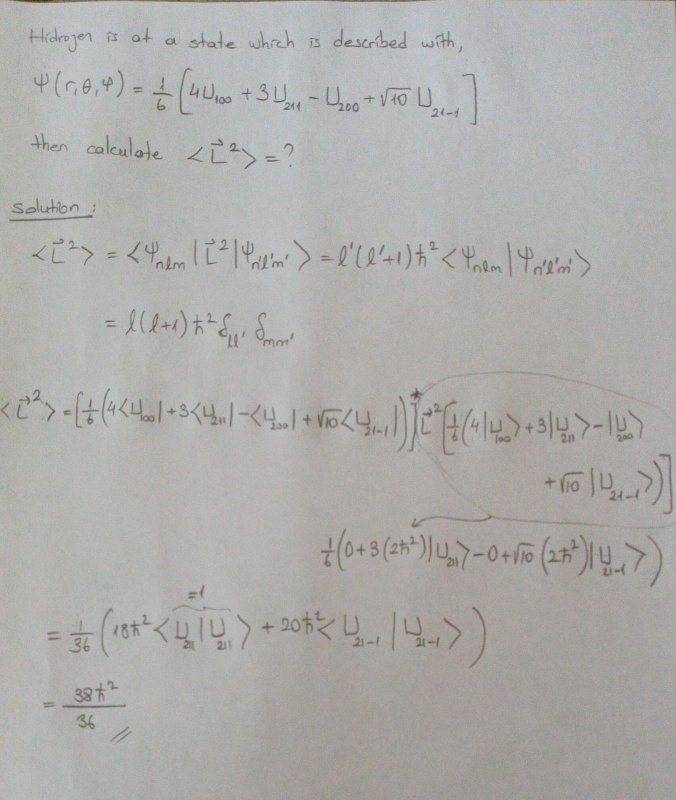
QUAN.jpeg

Can you please guide me to solve my question? I am not being able to relate Y R (from first question) and U (from second question), and solve the question at the top above...
 
Last edited:
Physics news on Phys.org
What do ##Y_{21}## and ##Y_{11}## tell you?
 
  • Like
Likes   Reactions: cemtu
PeroK said:
What do Y21Y21 and Y11Y11 tell you?
In spherical harmonics it means:
ooo.jpeg
 
Okay, but what does that function represent (in terms of angular momentum)?
 
  • Like
Likes   Reactions: cemtu
PeroK said:
Okay, but what does that function represent (in terms of angular momentum)?
They are joint eigenfunctions of L^2 and Lz, and they constitue an orthonormal basis in the Hilbert space.
 
cemtu said:
They are joint eigenfunctions of L^2 and Lz, and they constitue an orthonormal basis in the Hilbert space.
Okay, and what do the "11" and "21" mean?
 
  • Like
Likes   Reactions: cemtu
PeroK said:
Okay, and what do the "11" and "21" mean?
21 means that " 2 is given for "l" and 1 is given for "m", both m and l are quantum numbers. And for 11, 1 is given for both m and l.
 
cemtu said:
21 means that " 2 is given for "l" and 1 is given for "m", both m and l are quantum numbers.
Okay, but what does ##l = 2## mean? Isn't that something to do with angular momentum?
 
l=2 gives 5 different possible numbers for m, and corresponds to d orbital.
 
  • #10
cemtu said:
l=2 gives 5 different possible numbers for m, and corresponds to d orbital.
Let me tell you the answer: ##l = 2## tells you the total angular momentum squared for that state. That's how the spherical harmonics arose in the first place - as eigenstates of angular momentum.

If you find a system in that state, then you know its angular momentum.
 
  • #11
PeroK said:
Let me tell you the answer: ##l = 2## tells you the total angular momentum squared for that state. That's how the spherical harmonics arose in the first place - as eigenstates of angular momentum.

If you find a system in that state, then you know its angular momentum.
Okay.
 
  • #12
you can direct me more questions. I will try to answer all until the question is solved bit by bit.
 
  • #13
cemtu said:
you can direct me more questions. I will try to answer all until the question is solved bit by bit.
How much angular momentum is associated with ##Y_{11}## and ##Y_{21}##?
 
  • #14
PeroK said:
How much angular momentum is associated with ##Y_{11}## and ##Y_{21}##?
for ##Y_{11}## L and for ##Y_{21}## L^2 . Sorry sir but I couldn't think of, or find any answer in books(griffits) other than this.
 
  • #15
The ##l## quantum number is the eigenvalue of ##L^2## corresponding to ##l(l+1)\hbar^2##.
 
  • Like
Likes   Reactions: UnkindledParticle
  • #16
PeroK said:
The ##l## quantum number is the eigenvalue of ##L^2## corresponding to ##l(l+1)\hbar^2##.
okay. I am still here.
 
  • #17
So what is $$L^2\left[\frac{1}{\sqrt{6}}\left(\sqrt{4}R_{32}Y_{21}+\sqrt{2}R_{21}Y_{11}\right)\right]~?$$What do you get when you operate on the given wavefunction with ##L^2##?
 
  • #18
can anyone please recommend me any source book to study this topic. Griffits Quantum book ain't doing good...
 
  • #19
cemtu said:
can anyone please recommend me any source book to study this topic. Griffits Quantum book ain't doing good...
This is all covered in Griffiths (Chapter 4.3). That's where I learned QM. There are many other texts out there, but ultimately you have to understand the material.
 
  • Like
Likes   Reactions: cemtu
  • #20
PeroK said:
This is all covered in Griffiths (Chapter 4.3). That's where I learned QM. There are many other texts out there, but ultimately you have to understand the material.
On it.
 
  • #21
cemtu said:
On it.
Let me summarise two important aspects of QM: eigenstates and superposition. I'll do this for AM (angular momentum), but the same ideas apply across QM generally.

An eigenstate (of AM) means that you get a single value of AM if you make a measurement on that state. The spherical harmonics ##Y_{lm}## are eigenstates of AM. If you have a system in this eigenstate and you measure AM you always get ##l## and ##m##, which correspond to the values:
$$L^2 = l(l+1)\hbar^2, \ \text{and} \ L_z = m\hbar$$
Systems, however, can be in a superposition of eigenstates. In this case, you may get different values of AM, associated with the different eigenstates in the superposition. To some extent we can ignore the spatial wavefunction and focus on AM. For example, if you have the superposition:
$$aY_{l_1m_1} + bY_{l_2m_2}$$
Then the coefficients ##a## and ##b## tell you how likely the system is to be found in each eigenstate if AM is measured. The probabilities are, of course, ##|a|^2## and ##|b|^2##. And, the AM you get in each case is ##l_1, m_1## and ##l_2, m_2##.

The expected value of AM is then the statistical mean of: ##l_1, m_1## with probability ##|a|^2## and ##l_2, m_2## with probability ##|b|^2##. For the expected value of ##L^2## this is:
$$\langle L^2 \rangle = |a|^2 l_1(l_1 + 1)\hbar^2 + |b|^2 l_2(l_2 + 1)\hbar^2$$

Note that you can derive this from the formal definition of expected value:
$$\langle L^2 \rangle = \langle \Psi | L^2 | \Psi\rangle$$
That's an important exercise to work through.

I hope this helps.
 
  • #22
PeroK said:
An eigenstate (of AM) means that you get a single value of AM if you make a measurement on that state. The spherical harmonics ##Y_{lm}## are eigenstates of AM. If you have a system in this eigenstate and you measure AM you always get ##l## and ##m##, which correspond to the values:
$$L^2 = l(l+1)\hbar^2, \ \text{and} \ L_z = m\hbar$$
Let me be pedantic. The equation as written makes no sense, what @PeroK means is
$$L^2 Y_{lm} = l(l+1)\hbar^2 Y_{lm}, \ \text{and} \ L_z Y_{lm} = m\hbar Y_{lm}$$
 
  • #23
DrClaude said:
Let me be pedantic. The equation as written makes no sense, what @PeroK means is
$$L^2 Y_{lm} = l(l+1)\hbar^2 Y_{lm}, \ \text{and} \ L_z Y_{lm} = m\hbar Y_{lm}$$

I meant ##L^2## and ##L_z## as quantities, as opposed to operators.
 
  • #24
PeroK said:
I meant ##L^2## and ##L_z## as quantities, as opposed to operators.
Got it. But I never saw such a notation before.
 
  • #25
DrClaude said:
Got it. But I never saw such a notation before.
I guess if I were being pedantic I would put hats on the operators, to distiguish them from the observable quantities:
$$\langle L^2 \rangle = \langle \psi | \hat L^2 | \psi \rangle$$
 
  • Like
Likes   Reactions: cemtu

Similar threads

Replies
14
Views
3K
  • · Replies 0 ·
Replies
0
Views
2K
  • · Replies 1 ·
Replies
1
Views
2K
Replies
1
Views
3K
Replies
3
Views
2K
  • · Replies 4 ·
Replies
4
Views
5K
Replies
3
Views
2K
Replies
6
Views
4K
  • · Replies 3 ·
Replies
3
Views
2K
  • · Replies 5 ·
Replies
5
Views
2K