cemtu said:
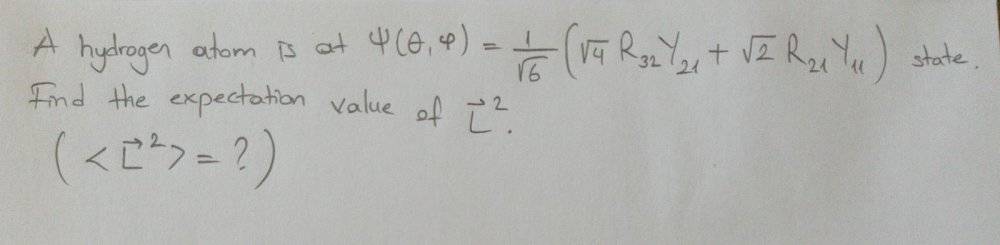
Let me summarise two important aspects of QM: eigenstates and superposition. I'll do this for AM (angular momentum), but the same ideas apply across QM generally.
An eigenstate (of AM) means that you get a single value of AM if you make a measurement on that state. The spherical harmonics ##Y_{lm}## are eigenstates of AM. If you have a system in this eigenstate and you measure AM you always get ##l## and ##m##, which correspond to the values:
$$L^2 = l(l+1)\hbar^2, \ \text{and} \ L_z = m\hbar$$
Systems, however, can be in a superposition of eigenstates. In this case, you may get different values of AM, associated with the different eigenstates in the superposition. To some extent we can ignore the spatial wavefunction and focus on AM. For example, if you have the superposition:
$$aY_{l_1m_1} + bY_{l_2m_2}$$
Then the coefficients ##a## and ##b## tell you how likely the system is to be found in each eigenstate if AM is measured. The probabilities are, of course, ##|a|^2## and ##|b|^2##. And, the AM you get in each case is ##l_1, m_1## and ##l_2, m_2##.
The expected value of AM is then the statistical mean of: ##l_1, m_1## with probability ##|a|^2## and ##l_2, m_2## with probability ##|b|^2##. For the expected value of ##L^2## this is:
$$\langle L^2 \rangle = |a|^2 l_1(l_1 + 1)\hbar^2 + |b|^2 l_2(l_2 + 1)\hbar^2$$
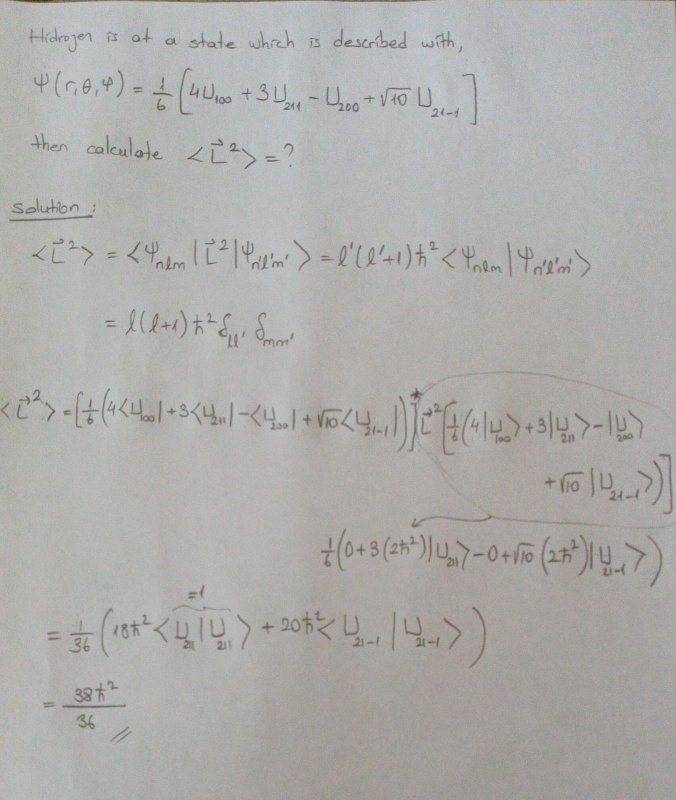
Note that you can derive this from the formal definition of expected value:
$$\langle L^2 \rangle = \langle \Psi | L^2 | \Psi\rangle$$
That's an important exercise to work through.
I hope this helps.