Question about the nonlinear Hooke's law

Click For Summary

Homework Help Overview

The discussion revolves around the application of nonlinear Hooke's law, specifically the force equation \( F = k u + \epsilon u^3 \), and the derivation of force from a potential energy function using Taylor series expansion. Participants are examining the presence and implications of various terms in the force equation, particularly the absence of the \( x^2 \) term.

Discussion Character

  • Exploratory, Conceptual clarification, Assumption checking

Approaches and Questions Raised

  • Participants are questioning why the \( x^2 \) term is omitted in the force derived from the potential function. Some are exploring the implications of assuming certain coefficients are zero and discussing the behavior of materials in relation to the potential function.

Discussion Status

The discussion is ongoing, with various interpretations being explored regarding the omission of the \( x^2 \) term. Some participants suggest that this omission is based on observations of material behavior, while others are considering the mathematical implications of higher-order terms in the potential function.

Contextual Notes

Participants note that the problem involves using MATLAB's ode45 to analyze the nonlinear behavior of springs, and there is a mention of the potential need to fit models to experimental data. The discussion also touches on the physical meaning of higher-order derivatives in the context of spring properties.

patric44
Messages
308
Reaction score
40
Homework Statement
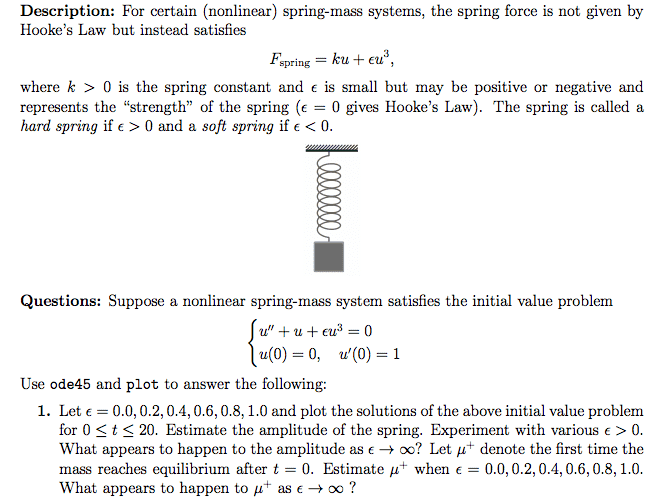
why the non linear hoock's law is given by : F_spring = ku + u^3 in this question ? i guess a u^2 is missing ?!
Relevant Equations
F = -kx-eu^2+...
hi guys
i saw this problem online about using the MATLAB ode45 to solve the nonlinear Hoock's law and its specifically stated that
the nonlinear hoock's law is given by
$$F = k\;u + \epsilon\;u^{3}$$ , but when expanding the potential function in a Taylor series where you obtain the force from it
it seems that the force is given by :
$$F = -\frac{dV}{dx}_{x_0} *(x)-\frac{1}{2} \frac{d^{2}V}{dx^{2}}_{x_0}*(x)^2+...$$
$$F = -k\;x-\epsilon\;x^{2}$$
the problem :
2F25f410a6-92e6-4206-9068-06001c6ca729%2FphpR67HIk.png

my question is where is the x^2 term ?? why did he jump directly to the x^3 term ?
 
Physics news on Phys.org
If the potential energy function is$$V(x) = V(0) + x \frac{dV}{dx} (0) + \frac{1}{2!} x^2 \frac{d^2 V}{dx^2}(0) + \frac{1}{3!} x^3 \frac{d^3 V}{dx^3}(0) + \frac{1}{4!} x^4 \frac{d^4 V}{dx^4}(0) + \dots $$the force is$$F_x = -\frac{dV(x)}{dx} = -\frac{dV}{dx}(0) - x\frac{d^2 V}{dx^2}(0) - \frac{1}{2} x^2 \frac{d^3 V}{dx^3}(0) - \frac{1}{6}x^3 \frac{d^4 V}{dx^4}(0) +\dots$$then why is it unreasonable that the coefficient of ##x^2## in ##F_x## is zero? All you need is that ##\frac{d^3 V}{dx^3}(0)## is zero. That doesn't mean that ##\frac{d^2 V}{dx^2}(0)## and ##\frac{d^4 V}{dx^4}(0)## can't be non-zero. And in fact, in the problem you attached, you're given that ##\frac{d^2 V}{dx^2}(0) = k## and ##\frac{1}{6}\frac{d^4 V}{dx^4}(0) = \varepsilon##.
 
etotheipi said:
If the potential energy function is$$V(x) = V(0) + x \frac{dV}{dx} (0) + \frac{1}{2!} x^2 \frac{d^2 V}{dx^2}(0) + \frac{1}{3!} x^3 \frac{d^3 V}{dx^3}(0) + \dots $$the force is$$F_x = -\frac{dV(x)}{dx} = -\frac{dV}{dx}(0) - x\frac{d^2 V}{dx^2}(0) - \frac{1}{2} x^2 \frac{d^3 V}{dx^3}(0) + \dots$$then why is it unreasonable that the coefficient of ##x^2## in ##F_x## is zero? All you need is that ##\frac{d^3 V}{dx^3}(0)## is zero. That doesn't mean that ##\frac{d^2 V}{dx^2}(0)## and ##\frac{d^4 V}{dx^4}(0)## can't be non-zero.
but using the same argument i could say that hoock's law is given by :
$$F = -k\;x-\eta\;x^{7}$$
assuming that the other coefficient is zero ?
why did he assumed that the coefficient of x^2 equal zero , the problem specifically states that the hoock's law is generaly given by
$$F = ku+\epsilon\;u^3$$
they didnt include an x^2 term then sat its coefficient equal zero ?
is there some thing special about $\frac{d^{3}V}{dx^{3}}$ that make it always zero ?
 
patric44 said:
why did he assumed that the coefficient of x^2 equal zero
I suggest it is an observation about how materials actually behave, not an assumption.
 
  • Like
Likes   Reactions: Vanadium 50, patric44 and etotheipi
Different springs might obey different potential functions. The more accurate the model, the more higher order terms will contribute to Hooke's law. For the purposes of this problem, the author probably thought that the behaviour of his spring was most simply modeled by a potential function for which the derived force has terms in ##x## and ##x^3## (the ##x^3## term being a correction term).
 
  • Informative
Likes   Reactions: patric44
ok its clear for me now thanks a lot :smile: , but i have a another question , is there is a way to obtain the potential
curve of a specific spring ?
another question : does these higher order derivatives has some physical or even a mathematical meaning , i know that the first derivative specify if the point is maxima or minima and so on , does ## \frac{d^{3}V}{dx^{3}}## has any meaning what so ever related to the property of the spring ?
 
  • Like
Likes   Reactions: etotheipi
patric44 said:
another question : does these higher order derivatives has some physical or even a mathematical meaning , i know that the first derivative specify if the point is maxima or minima and so on , does ## \frac{d^{3}V}{dx^{3}}## has any meaning what so ever related to the property of the spring ?

In all cases, it's a mathematical model, which hopefully fits the properties of the real spring close enough for purpose. To determine better and better models, you'll need to look at some research surrounding strain energy functions and I suspect you'll need to start looking quite closely at what happens on the molecular level. However, most probably, these models are experimentally determined.

I don't know enough about elasticity theory to know how the higher order terms vary between different materials and types of springs, but perhaps someone else will. :smile:
 
  • Like
Likes   Reactions: patric44
thank you so much for helping
 
  • Like
Likes   Reactions: etotheipi
I think the motivation for omitting the ##x^2## term in the force is that it will mean a ##x^3## in the potential. It is reasonable to assume that an elastic potential is symmetric about ##x=0##, i.e. ##U(x)=U(-x)##. If one adds higher order terms to the potential to make it more realistic, these terms must be even powers of ##x##. That's because the restoring elastic force, ##F=-\frac{\partial U}{\partial x}## will have only odd powers in ##x## and its magnitude will be symmetric about ##x=0##. Of course if the magnitude of the force is not the same when the spring is compressed as opposed to stretched, then odd terms in the potential will be required. Normally, one would collect data and fit the force function to a polynomial.

My own view is that this problem is not about elasticity theory but about using ode45 and plot (whatever they are) to get some results that you can then interpret in terms of a concrete example.
 
  • Like
Likes   Reactions: vela, haruspex, patric44 and 1 other person
  • #10
etotheipi said:
In all cases, it's a mathematical model, which hopefully fits the properties of the real spring close enough for purpose. To determine better and better models, you'll need to look at some research surrounding strain energy functions and I suspect you'll need to start looking quite closely at what happens on the molecular level. However, most probably, these models are experimentally determined.

I don't know enough about elasticity theory to know how the higher order terms vary between different materials and types of springs, but perhaps someone else will. :smile:
kuruman said:
I think the motivation for omitting the ##x^2## term in the force is that it will mean a ##x^3## in the potential. It is reasonable to assume that an elastic potential is symmetric about ##x=0##, i.e. ##U(x)=U(-x)##. If one adds higher order terms to the potential to make it more realistic, these terms must be even powers of ##x##. That's because the restoring elastic force, ##F=-\frac{\partial U}{\partial x}## will have only odd powers in ##x## and its magnitude will be symmetric about ##x=0##. Of course if the magnitude of the force is not the same when the spring is compressed as opposed to stretched, then odd terms in the potential will be required. Normally, one would collect data and fit the force function to a polynomial.

My own view is that this problem is not about elasticity theory but about using ode45 and plot (whatever they are) to get some results that you can then interpret in terms of a concrete example.
that's a really good explanation thanks a lot , i have a little bit of a stupid question 🤔 when i plotted this using Matlab ode45 with an epsilon = 0.2 it seems like any ordinary oscillating system ! , shouldn't i see some non linear behavior or something ? i was expecting some alien looking graph or something due to that extra ##x^{3}## term :smile: .
my Matlab graph :
spring.jpg
 
  • #11
The symmetric potential will display oscillatory motion regardless of whether it has terms higher than ##x^2## in it or not. There is nothing alien about it. The motion will not be simple harmonic, but how good is your eye distinguishing a pure sinusoid from what you plotted? That's perhaps part of the lesson to be learned here.

As another example of adding non-linear terms to linear forces consider the simple pendulum equation $$\ddot \theta+\omega^2~\sin\theta=0.$$ In the "small angle approximation" you get the pure sinusoidal solution, but what happens at angles larger than "small"? You can keep, say, the next two terms in the sine expansion and get $$\ddot \theta+\omega^2~\left(\theta-\frac{\theta^3}{3!}+\frac{\theta^5}{5!}\right)=0.$$Note that here too you can use ode45 and plot to illustrate what this looks like. Also note that you should not expect it to look astonishingly different from a pure sinusoidal. Why? Because if you swing a pendulum at large amplitude, its motion looks to the eye pretty much like that of a pendulum swinging at a smaller amplitude.
 
  • Informative
  • Like
Likes   Reactions: patric44 and etotheipi
  • #12
kuruman said:
The symmetric potential will display oscillatory motion regardless of whether it has terms higher than ##x^2## in it or not. There is nothing alien about it. The motion will not be simple harmonic, but how good is your eye distinguishing a pure sinusoid from what you plotted? That's perhaps part of the lesson to be learned here.

As another example of adding non-linear terms to linear forces consider the simple pendulum equation $$\ddot \theta+\omega^2~\sin\theta=0.$$ In the "small angle approximation" you get the pure sinusoidal solution, but what happens at angles larger than "small"? You can keep, say, the next two terms in the sine expansion and get $$\ddot \theta+\omega^2~\left(\theta-\frac{\theta^3}{3!}+\frac{\theta^5}{5!}\right)=0.$$Note that here too you can use ode45 and plot to illustrate what this looks like. Also note that you should not expect it to look astonishingly different from a pure sinusoidal. Why? Because if you swing a pendulum at large amplitude, its motion looks to the eye pretty much like that of a pendulum swinging at a smaller amplitude.
your answers and comments are astonishingly clear and very informative thank you so much
 
  • Like
Likes   Reactions: kuruman
  • #13
patric44 said:
Homework Statement:: why the non linear hoock's law is given by : F_spring = ku + u^3 in this question ? i guess a u^2 is missing ?!
Relevant Equations:: F = -kx-eu^2+...

my question is where is the x^2 term ?? why did he jump directly to the x^3 term ?
If the force is quadratic, then where is the minimum of the potential?
 
  • Like
Likes   Reactions: etotheipi
  • #14
TeethWhitener said:
If the force is quadratic, then where is the minimum of the potential?
It's not whether the force is quadratic but whether it has a quadratic term.
I do not see that it would create a problem for the minimum of the potential. If the force is ##F=ax+bx^2## then there's a local extremum of potential at x=0. dF/dx(0)=a, so if a>0 it is a minimum.
Maybe I misunderstand your point.
 
  • Like
Likes   Reactions: patric44 and etotheipi
  • #15
haruspex said:
It's not whether the force is quadratic but whether it has a quadratic term.
I do not see that it would create a problem for the minimum of the potential. If the force is ##F=ax+bx^2## then there's a local extremum of potential at x=0. dF/dx(0)=a, so if a>0 it is a minimum.
Maybe I misunderstand your point.

I think you're right, but I interpreted it to mean that it seems very unlikely that such a force would represent a spring. If the force and potential energy is $$F_x = -ax - bx^2 \implies U(x) = \frac{a}{2}x^2 + \frac{b}{3}x^3$$then if the mass overcomes the potential barrier in the ##-\hat{x}## direction, it undergoes runaway contraction with a large force in the ##-\hat{x}## direction forever... which is quite unphysical!
 
  • Like
Likes   Reactions: TeethWhitener
  • #16
haruspex said:
It's not whether the force is quadratic but whether it has a quadratic term.
I do not see that it would create a problem for the minimum of the potential. If the force is ##F=ax+bx^2## then there's a local extremum of potential at x=0. dF/dx(0)=a, so if a>0 it is a minimum.
Maybe I misunderstand your point.
If ##F(x)=ax+bx^2##, what is the minimum of ##V(x)##? (Hint: it’s not ##x=0##)
 
  • #17
etotheipi said:
I think you're right, but I interpreted it to mean that it seems very unlikely that such a force would represent a spring. If the force and potential energy is $$F_x = -ax - bx^2 \implies U(x) = \frac{a}{2}x^2 + \frac{b}{3}x^3$$then if the mass overcomes the potential barrier in the ##-\hat{x}## direction, it undergoes runaway contraction with a large force in the ##-\hat{x}## direction forever... which is quite unphysical!
But the presence of a quadratic term term does not rule out a cubic one. For what value of x<0 is ##-x-x^2-x^3## negative?
 
  • Like
Likes   Reactions: patric44 and etotheipi
  • #18
haruspex said:
But the presence of a quadratic term term does not rule out a cubic one. For what value of x<0 is ##-x-x^2-x^3## negative?
@etotheipi got the gist of what I was saying. And the OP (whom I was addressing in my initial post) asked specifically about a force where the highest power was quadratic.
 
  • #19
TeethWhitener said:
If ##F(x)=ax+bx^2##, what is the minimum of ##V(x)##? (Hint: it’s not ##x=0##)
I think you are saying it has a second minimum, but you are assuming there is no cubic term. See post #17.
 
  • #20
haruspex said:
But the presence of a quadratic term term does not rule out a cubic one. For what value of x<0 is ##-x-x^2-x^3## negative?

Yeah, I think as a rule of thumb potentials with an even highest order term (and consequently forces with an odd highest order term) will be candidates to model an elastic force. In the context of the OP, it would be unphysical to have a highest order term in the force of ##x^2##, however there is nothing specifically wrong with having non-zero terms of both ##x^2## and ##x^3## in the force expression. So I assume the author just omitted an ##x^2## term for reasons of simplicity.

In short, which lower order terms you choose to keep in your model will come down to the specific physical properties of the spring under consideration, and how many terms you include in the model reflects how accurate you want the model to be.
 
  • Like
Likes   Reactions: patric44
  • #21
TeethWhitener said:
the OP (whom I was addressing in my initial post) asked specifically about a force where the highest power was quadratic.
Did he? Post #1:
patric44 said:
my question is where is the x^2 term ?? why did he jump directly to the x^3 term ?
Similarly in other posts.
 
  • Like
Likes   Reactions: patric44
  • #22
etotheipi said:
Yeah, I think as a rule of thumb potentials with an even highest order term (and consequently forces with an odd highest order term) will be candidates to model an elastic force. In the context of the OP, it would be unphysical to have a highest order term in the force of ##x^2##, however there is nothing specifically wrong with having non-zero terms of both ##x^2## and ##x^3## in the force expression. So I assume the author just omitted an ##x^2## term for reasons of simplicity.

In short, which lower order terms you choose to keep in your model will come down to the specific physical properties of the spring under consideration, and how many terms you include in the model reflects how accurate you want the model to be.
As long as there are no nontrivial solutions of F=0, and dF/dx has the right sign at x=0, there is no obvious reason the function cannot be valid.
But @kuruman's symmetry argument in post #9 is persuasive.
 
  • Like
Likes   Reactions: patric44 and etotheipi
  • #23
haruspex said:
Did he?
Maybe I just misinterpreted.
haruspex said:
I think you are saying it has a second minimum, but you are assuming there is no cubic term. See post #17.
If the highest order term in the force is quadratic, then the highest order term in the potential is cubic, and the potential therefore has no global minimum. It may have a local minimum which might be useful for small perturbations, but there will always be a range of initial values that sends the poor particle careening off into the wild blue yonder.

(It’s not much of a problem for classical mechanics, but in quantum mechanics, it turns into a very big problem.)
 
  • Like
Likes   Reactions: etotheipi
  • #24
TeethWhitener said:
If the highest order term in the force is quadratic, then the highest order term in the potential is cubic
Agreed, but nobody else is suggesting that the highest term in the force could be quadratic.
 
  • #25
@TeethWhitener i guess you misunderstood my question
my question can be boiled down to this graph of the potential :
pot.jpg

it was why not the left , and after all the arguments about the symmetry and some deeper physical reasons i am convinced that it should be the one on the right for this this specifically (symmetrically elastic spring) :smile: .
 
  • Like
Likes   Reactions: TeethWhitener
  • #26
TeethWhitener said:
It’s not much of a problem for classical mechanics, but in quantum mechanics, it turns into a very big problem.

Out of interest, and if it's not too much of a deviation from the topic of the thread, I wondered if you could explain why potentials with no global minimum are more of a problem in QM than in CM? My very untrained intuition tells me that it can be problematic in both disciplines. Is it because in QM we're more often dealing with bound states?
 
  • #27
etotheipi said:
Out of interest, and if it's not too much of a deviation from the topic of the thread, I wondered if you could explain why potentials with no global minimum are more of a problem in QM than in CM? My very untrained intuition tells me that it can be problematic in both disciplines. Is it because in QM we're more often dealing with bound states?
It’s probably off topic, but at a B-level, there’s no ground state. If the system does start off in a local potential well, it will have a nonzero probability of tunneling through the barrier, at which point its energy shoots off to infinity.
 
  • Informative
Likes   Reactions: etotheipi
  • #28
Ah, yes that makes sense, thanks! Also when you say its energy shoots off to infinity, are you talking about the kinetic energy (in that if ##V \rightarrow -\infty##, then ##T = E-V \rightarrow + \infty##, with ##E = \text{constant}##)? In any case, the tunnelling seems like the key difference!
 
  • #29
etotheipi said:
Ah, yes that makes sense, thanks! Also when you say its energy shoots off to infinity, are you talking about the kinetic energy (in that if ##V \rightarrow -\infty##, then ##T = E-V \rightarrow + \infty##, with ##E = \text{constant}##)? In any case, the tunnelling seems like the key difference!
Yes sorry, I haven’t been putting enough care into my responses in this thread. The potential energy is unbounded from below and the (expectation value of the) kinetic energy is unbounded from above: you can show this using the virial theorem. But yes, as you pointed out: tunneling is what makes the quantum case different.
 
  • Like
Likes   Reactions: etotheipi

Similar threads

Replies
2
Views
1K
Replies
3
Views
857
Replies
2
Views
1K
  • · Replies 22 ·
Replies
22
Views
2K
  • · Replies 35 ·
2
Replies
35
Views
5K
Replies
3
Views
1K
  • · Replies 2 ·
Replies
2
Views
1K
  • · Replies 10 ·
Replies
10
Views
1K
Replies
3
Views
2K
  • · Replies 1 ·
Replies
1
Views
1K