Question about the output voltage of 79L05

  • Thread starter Thread starter Monisa
  • Start date Start date
  • Tags Tags
    Output Voltage
Click For Summary
SUMMARY

The forum discussion centers on the performance of the 79L05 voltage regulator when used with varying output filter capacitance. Initially, a 220µF capacitor caused the regulator to overheat and output only -2V instead of the expected -5V. After switching to a 47µF capacitor, the regulator functioned correctly, providing -5V without excessive heating. The discussion highlights the importance of equivalent series resistance (ESR) in capacitors for stability in LDO and negative regulators.

PREREQUISITES
  • Understanding of voltage regulators, specifically the 79L05 model.
  • Knowledge of capacitor characteristics, including ESR and capacitance values.
  • Familiarity with LDO (Low Dropout) regulator topology and operation.
  • Basic circuit design principles, including component placement and orientation.
NEXT STEPS
  • Review the datasheet for the 79L05 to understand its specifications and limitations.
  • Learn about the impact of ESR on voltage regulator stability and performance.
  • Investigate the differences between positive and negative voltage regulators, particularly in terms of output impedance.
  • Experiment with different capacitor values and configurations in voltage regulator circuits to observe effects on performance.
USEFUL FOR

Electronics engineers, hobbyists designing power supply circuits, and anyone troubleshooting voltage regulator performance issues will benefit from this discussion.

Monisa
Messages
1
Reaction score
0
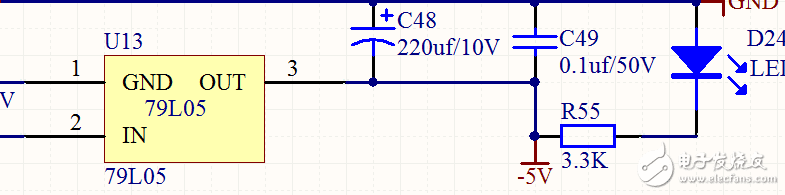
Hi, today I used 79L05 as the negative electrical level. The output filter capacitance is very large at first, just like the figure below:
132148e7kcgby4candigcb.png

It is -12V. Under this condition, the chip is very hot,and the output voltage is just about -2V.

I changed the 220uf to 47uf, then the chip worked well and the output voltage was at -5V without heating. I wonder why?
Sorry for my poor English, but can anyone answer me? Thanks very much!
 
Engineering news on Phys.org
Monisa said:
Hi, today I used 79L05 as the negative electrical level. The output filter capacitance is very large at first, just like the figure below:

132148e7kcgby4candigcb.png

It is -12V. Under this condition, the chip is very hot,and the output voltage is just about -2V.

I changed the 220uf to 47uf, then the chip worked well and the output voltage was at -5V without heating. I wonder why?
Sorry for my poor English, but can anyone answer me? Thanks very much!
Welcome to the PF.

Is there any chance that you got the first capacitor backwards in the circuit? That would have drawn a pretty big current. Or maybe the capacitor had been previously damaged?
 
  • Like
Likes   Reactions: Averagesupernova and davenn
berkeman said:
Is there any chance that you got the first capacitor backwards in the circuit?

yes, that would have been my suspicion as wellDave
 
  • Like
Likes   Reactions: Averagesupernova
IC voltage regulators have some esoteric fine points.

Note that the negative regulator uses a common emitter output stage which has higher output impedance than positive regulators with common collector.
Look at this schematic, it has the series pass element Q21's collector tied to the output pin.
http://www.st.com/content/ccc/resou...df/jcr:content/translations/en.CD00000450.pdf
lm2905.jpg


That's same as in LDO regulators. That topology requires a minimum ESR to be stable, unlike the positive regulators which are basically common collector output stage
see http://www.ti.com/lit/an/snva167a/snva167a.pdf
and http://www.ti.com/lit/an/slyt194/slyt194.pdf
and http://www.ti.com/lit/an/snva020b/snva020b.pdf

I don't know whether your particular regulator is internally stabilized for low ESR loads. Is there a precaution in its datasheet ?
Those could be compensating capacitors around Q16 and Q20 in that ST schematic just above, i don't know..

Do you suppose that your 220uf capacitor was just "Too good" for the lightly loaded regulator ? Try tacking it back in with maybe an ohm in series and see if things get any better.

Anyhow, that's just something to be aware of when using LDO and negative regulators.

old jim
 
jim hardy said:
capacitor was just "Too good" for the lightly loaded regulator

Some positive ones have this problem as well. As well as some switching ones. I have seen them where they recommend low ESR types with a known series resistor rather than rely on an unknown value from a sloppier cap.

BoB
 
  • Like
Likes   Reactions: jim hardy
It is interesting that when you look at the internal schematic for a positive or negative they are very similar. The three terminals are not the same but the layout is very similar. I hadn't paid attention but quite often the negative regulators are low dropout by default. I found this recently while looking for a way to drive LED backlit LCD display modules.
 
Averagesupernova said:
It is interesting that when you look at the internal schematic for a positive or negative they are very similar. The three terminals are not the same but the layout is very similar. I hadn't paid attention but quite often the negative regulators are low dropout by default.

That's it !

Pass transistor emitter to output pin in this 7800 positive regulator,, as opposed to collector in negative 7900 above. Emitter follower has lower Zout.
https://www.sparkfun.com/datasheets/Components/LM7805.pdf
lm7800.jpg
 

Similar threads

  • · Replies 6 ·
Replies
6
Views
2K
  • · Replies 4 ·
Replies
4
Views
2K
  • · Replies 38 ·
2
Replies
38
Views
5K
  • · Replies 13 ·
Replies
13
Views
2K
  • · Replies 16 ·
Replies
16
Views
3K
  • · Replies 5 ·
Replies
5
Views
2K
  • · Replies 50 ·
2
Replies
50
Views
8K
  • · Replies 2 ·
Replies
2
Views
2K
Replies
37
Views
5K
Replies
6
Views
5K