Question in Franck and Hertz Experiment

Click For Summary
SUMMARY

The discussion centers on the Franck and Hertz experiment, which demonstrates the existence of discrete energy levels in atoms using Mercury vapors. The ionization potential of Mercury is defined as the energy required to remove the most loosely bound electron, measured at 10.4 volts. The graph of current versus accelerating potential will show increased conductivity and larger current as the ionization voltage is reached, due to the generation of free electrons. The measurement of ionization potential can be approximated using a Franck-Hertz apparatus or more precisely determined through spectroscopic methods that analyze emitted light wavelengths.

PREREQUISITES
  • Understanding of the Franck and Hertz experiment
  • Knowledge of ionization potential and excitation potential
  • Familiarity with basic atomic structure and electron configurations
  • Basic principles of spectroscopy and light emission
NEXT STEPS
  • Research the Franck-Hertz apparatus and its operational principles
  • Study the concept of ionization energy and its measurement techniques
  • Explore the relationship between excitation potentials and atomic spectra
  • Learn about spectroscopic methods for measuring energy levels in atoms
USEFUL FOR

Students and educators in physics, researchers in atomic and molecular physics, and anyone interested in experimental methods for studying atomic energy levels.

Wrichik Basu
Science Advisor
Insights Author
Gold Member
Messages
2,180
Reaction score
2,690
My book gives the following graph for current vs accelerating potential for Franck and Hertz experiment (used to prove existence of discrete energy levels in atoms) using Mercury vapours in the tube:
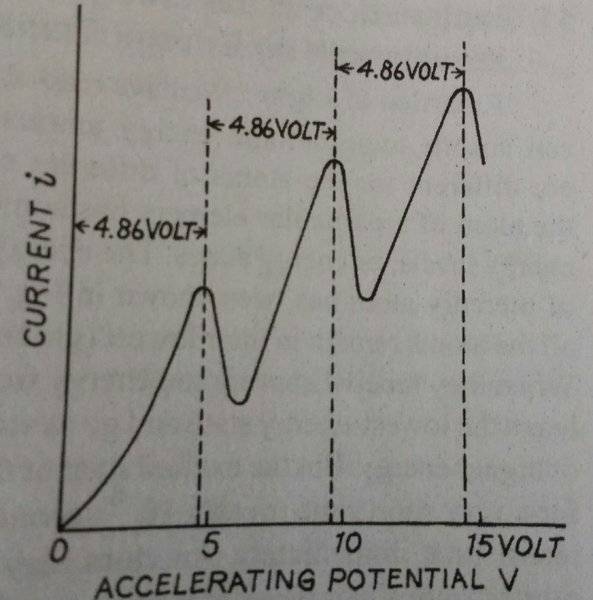
20170621_225100.jpg


The book then writes:

"Actually, atoms have more than one excitation potential and also an ionisation potential. For example, the second excitation potential if Mercury is 6.67 volt and the ionisation potential is 10.4 volt. Hence, the second and third peaks in the graph become complicated."

Now, is this Ionisation Potential the same as "amount of energy required to remove the most loosely bound electron from the outermost shell of an isolated, neutral, gaseous atom to form a unicharged ion"? If so, then how is that measured? If not, then what is the proper definition?

Secondly, how will the graph change?
 
Physics news on Phys.org
Wrichik Basu said:
My book gives the following graph for current vs accelerating potential for Franck and Hertz experiment (used to prove existence of discrete energy levels in atoms) using Mercury vapours in the tube:

View attachment 205867

The book then writes:

"Actually, atoms have more than one excitation potential and also an ionisation potential. For example, the second excitation potential if Mercury is 6.67 volt and the ionisation potential is 10.4 volt. Hence, the second and third peaks in the graph become complicated."

Now, is this Ionisation Potential the same as "amount of energy required to remove the most loosely bound electron from the outermost shell of an isolated, neutral, gaseous atom to form a unicharged ion"? If so, then how is that measured? If not, then what is the proper definition?

Secondly, how will the graph change?
Your second question is more easily answered=the gas will become very conductive and the current will get very large as the ionization voltage is reached, corresponding to free electrons being able to acquire enough energy from the voltage to create a chain reaction that generates more free electrons. (Basically, you can sustain an arc in the lamp at that voltage.). ## \\ ## Additional question you ask is how is it measured? The Franck Hertz type apparatus will give you an approximate answer for that voltage, but a spectroscopic apparatus that observes the wavelength ## \lambda ## of the emitted light as a free electron gets captured by an ion and goes back into the ground state might give a more precise answer for the energy required to ionize the atom. Note energy ## E=\frac{hc}{\lambda} ##.
 
Last edited:

Similar threads

Replies
4
Views
3K
Replies
1
Views
3K
  • · Replies 1 ·
Replies
1
Views
2K
  • · Replies 9 ·
Replies
9
Views
8K
  • · Replies 5 ·
Replies
5
Views
4K
  • · Replies 3 ·
Replies
3
Views
3K
  • · Replies 2 ·
Replies
2
Views
3K
  • · Replies 3 ·
Replies
3
Views
2K
  • · Replies 7 ·
Replies
7
Views
2K
Replies
18
Views
13K