Question in thermodynamics -- Two paths on a P-V diagram....

Click For Summary
SUMMARY

The discussion centers on a thermodynamics question regarding two processes of an ideal gas represented on a P-V diagram. Participants debate the validity of statements concerning heat transfer, temperature change, and internal energy change in isothermal and adiabatic processes. The consensus is that statement 'a' regarding equal heat transfer in both processes is incorrect, as isothermal processes do not imply zero temperature change or internal energy change. The correct understanding of these thermodynamic principles is essential for accurate problem-solving.

PREREQUISITES
  • Understanding of thermodynamic processes, specifically isothermal and adiabatic processes.
  • Familiarity with the concepts of heat transfer, temperature change, and internal energy in thermodynamics.
  • Knowledge of P-V diagrams and their interpretation in thermodynamic contexts.
  • Basic principles of ideal gas behavior and the laws of thermodynamics.
NEXT STEPS
  • Study the First Law of Thermodynamics and its application to isothermal and adiabatic processes.
  • Learn how to analyze P-V diagrams for different thermodynamic processes.
  • Explore the mathematical relationships governing heat transfer in isothermal and adiabatic conditions.
  • Investigate real-world applications of isothermal and adiabatic processes in engineering and physics.
USEFUL FOR

Students of thermodynamics, educators teaching thermodynamic principles, and professionals in engineering fields who require a solid understanding of gas behavior and thermodynamic processes.

Zouatine
Messages
19
Reaction score
0
Member warned that some effort must be shown
Homework Statement
thermodynamic
Relevant Equations
I think the answer is b , is that true ?
Hi every one , I have this question today :

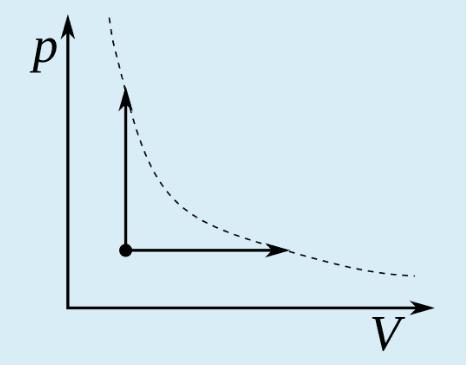
The two arrows in the figure show two thermodynamic processes of a certain amount of ideal gas. The dashed line is a hyperbola. Which of the following statements is not true?
241473

a. The heat transfer is the same in the two processes.
b. The temperature change is the same in the two processes.
c. The change in internal energy is the same in the two processes.
 
Physics news on Phys.org
You need to post homework questions with your attempt at a solution so that you can be helped past the obstacles you have run across. This is not a forum where you can simply ask others to do your homework for you. Firstly it helps you not at all in discovering how to actually solve problems. Secondly it is against this forums policies.
 
  • Skeptical
Likes   Reactions: affeshatem
What is the basis for your choice of the answer as b?
 
i think a is correct
 
aliserwan said:
i think a is correct
Correct!
 
a isn't correct
 
Bilbo B said:
a isn't correct
Why?
Note: when you figure out the correct answer and reason, please do not post it in this thread just yet. Give time for @Zouatine to respond.
 
Bilbo B said:
a isn't correct
Wrong!
 
  • #10
I found that Isothermal state :
delta T = 0
Delta U=0
then the correct answer is a
In Adiabatic state: transfer heat zero
True or False ??
 
  • #11
aliserwan said:
I found that Isothermal state :
delta T = 0
Delta U=0
then the correct answer is a
In Adiabatic state: transfer heat zero
True or False ??
No, there is a transfer of heat in both processes. What makes you think ΔT is zero? ΔP is zero in one, ΔV is zero in the other.
The question asks whether the same quantity is transferred,
 
  • #12
One of the conditions of the case Isothermal : delta t =0
 
  • #13
haruspex said:
No, there is a transfer of heat in both processes. What makes you think ΔT is zero? ΔP is zero in one, ΔV is zero in the other.
The question asks whether the same quantity is transferred,
 

Attachments

  • Untitled.jpg
    Untitled.jpg
    40.5 KB · Views: 245
  • #14
aliserwan said:
I found that Isothermal state :
delta T = 0
Delta U=0
then the correct answer is a
Delta T and delta U are the same in both processes. But, they are not zero.
In Adiabatic state: transfer heat zero
True or False ??
This is the definition of an adiabatic process, so True. But what has this got to do with the present problem?
 
  • #15
Chestermiller said:
Delta T and delta U are the same in both processes. But, they are not zero.

This is the definition of an adiabatic process, so True. But what has this got to do with the present problem?
the present problem is Isothermal state
so delta T = 0
Delta U=0
then the correct answer is a
 
  • #16
aliserwan said:
the present problem is Isothermal state
so delta T = 0
Delta U=0
then the correct answer is a
Are you saying the delta T is zero for each of the two process paths? Or are you saying that delta T is zero between the two final states of the two processes?
 
  • #17
Chestermiller said:
Are you saying the delta T is zero for each of the two process paths? Or are you saying that delta T is zero between the two final states of the two processes?
i don't know exactly , However, do you agree with me that the correct answer is a
 
  • #18
aliserwan said:
i don't know exactly , However, do you agree with me that the correct answer is a
Even though a is the right answer, I mark you wrong on this problem because you were unable to provide an acceptable explanation.
 
  • Like
Likes   Reactions: aliserwan
  • #19
In that attachment, isothermal follows one of the curves. In the present problem, each process follows a straight line, one vertical, one horizontal. Neither is isothermal.

You seem to be thinking of a process that runs from one of those two final states to the other. That is not the question asked. You are asked to compare the two non isothermal processes.
 
  • Like
Likes   Reactions: Chestermiller

Similar threads

  • · Replies 2 ·
Replies
2
Views
2K
Replies
16
Views
4K
  • · Replies 33 ·
2
Replies
33
Views
2K
Replies
11
Views
2K
  • · Replies 3 ·
Replies
3
Views
2K
  • · Replies 4 ·
Replies
4
Views
1K
  • · Replies 1 ·
Replies
1
Views
2K
  • · Replies 4 ·
Replies
4
Views
2K
Replies
49
Views
3K
Replies
20
Views
5K