Question on equation for instantaneous E field along the transmission medium.

Click For Summary

Discussion Overview

The discussion revolves around the equation for the instantaneous electric field along a transmission medium, particularly in the context of Poynting vectors and phasor representation. Participants are exploring the implications of complex amplitudes and phase angles in electromagnetic wave propagation, questioning the assumptions made in various textbooks.

Discussion Character

  • Debate/contested
  • Technical explanation
  • Mathematical reasoning

Main Points Raised

  • One participant expresses confusion about the equation for the electric field, noting discrepancies between their derivation and textbook claims, particularly regarding the treatment of the complex amplitude.
  • Another participant suggests that in the phasor domain, the incident phase angle can be assumed to be zero, and that the maximum amplitude is assumed to occur at z=0, which may not align with the original derivation.
  • A later reply emphasizes that while phasors strip time dependence, the phase angle of the incident electric field is a spatial consideration that cannot be ignored, challenging the assumptions made by the textbooks.
  • One participant questions the ability to distinguish between small phase shifts in an electromagnetic wave using an oscilloscope, drawing parallels to voltage phasors in transmission lines.
  • Another participant notes that many textbooks assert the amplitude at z=0 is real and lacks a phase angle, seeking a theoretical justification for this claim, while referencing Ulaby's book as an exception that allows for complex values.

Areas of Agreement / Disagreement

Participants express differing views on the treatment of phase angles and the nature of amplitudes at z=0. There is no consensus on whether the phase angle can be ignored or if the amplitude must always be considered real.

Contextual Notes

Participants highlight potential limitations in the assumptions made by textbooks, particularly regarding the treatment of phase angles and the conditions under which amplitudes are considered real or complex. These assumptions may affect the validity of the conclusions drawn from the equations discussed.

yungman
Messages
5,741
Reaction score
291
I am studying Poynting vectors. I run into question that I don't see any good explanation in all the books I have. All the books claimed
E_{(z,t)} =E_{(z=0)} Re[e_{j(wt-\beta z)} + \Gamma e_{j(wt+\beta z)}]

But sinse E0 is complex so this is what I have and is not equal to what the book gives. In fact the Electromagnetic by Ulaby actually say ignor the phase angle of E0! Below is what I have:
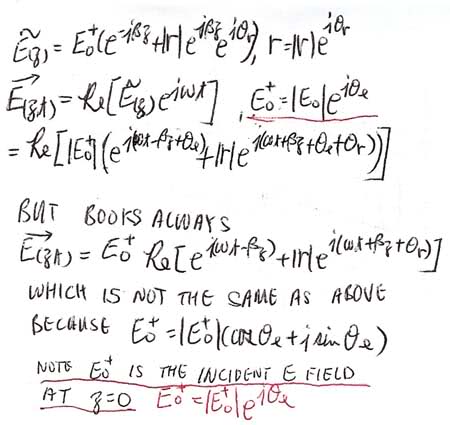
a44s9e.jpg


Obviously the answer does not agree. This is particularly obvious when working on Poynting vectors. Please tell me what do I miss in this whole thing.

Thanks
 
Last edited:
Engineering news on Phys.org
Once you go into phasor domain, all information is just relative time. Therefore you can assume your Incident Phase Angle is zero. As well as that I believe that your book is assuming that maximum amplitude occurs at z=0(From your Latex Code). These two assumptions seem to be apparent in line 1, but not in line 3 of your derivations.
 
Last edited:
ravioli said:
Once you go into phasor domain, all information is just relative time. Therefore you can assume your Incident Phase Angle is zero. As well as that I believe that your book is assuming that maximum amplitude occurs at z=0(From your Latex Code). These two assumptions seem to be apparent in line 1, but not in line 3 of your derivations.

But the book of Ulaby even expressly said that the incident E field at z=0 is complex and it has an angle. It just said they are going to ignor it! Ulaby simply say don't look at the phase angle of the incident E field and Cheng just ignor it.

A phasor strip the time domain \omegat out, but the phase angle of incident E field is absolute a spatial domain and cannot be ignor. The solution from the two cannot be made equal to justify that.

I spent 2 days deriving the formulas and just can not make the two agree. I don't see how they can ignor the phase angle unless the incident E field at z=0 is always at maximum which is cosine(0)=1 like you suggested! But what is the justification that the forward traveling E field is ALWAYS maximum at z=0? I have modify my original equation drawing above, please take a look again.
 
Last edited:
If you were given an oscilloscope, could you distinguish between the incident wave having a phase shift of 0 degrees, 10 degrees, 20 degrees, 30 degrees...?
 
ravioli said:
If you were given an oscilloscope, could you distinguish between the incident wave having a phase shift of 0 degrees, 10 degrees, 20 degrees, 30 degrees...?

No! This is EM wave, not the voltage and current phasor in transmission. They are the same though, the same question apply on voltage phasor at z=0 at the load. A directional coupler can separate the incident and reflected. But getting to the z=0 is easy to talk, impossible to get to!
 
I have been looking up quite a few books today on both Plane Wave phasor and transmission line traveling wave phasor. All the books specified that the amplitude at z=0 is REAL. There is not phase angle. If the amplitude is real, then I agree with the book!

Can anyone give me a conclusive theory why the amplitude at z=0 is always real? The only book that claimed the value can be complex, that is Ulaby book.
 

Similar threads

  • · Replies 3 ·
Replies
3
Views
2K
  • · Replies 11 ·
Replies
11
Views
4K
  • · Replies 4 ·
Replies
4
Views
3K
  • · Replies 10 ·
Replies
10
Views
3K
  • · Replies 18 ·
Replies
18
Views
3K
  • · Replies 0 ·
Replies
0
Views
2K
  • · Replies 27 ·
Replies
27
Views
3K
  • · Replies 17 ·
Replies
17
Views
2K
  • · Replies 17 ·
Replies
17
Views
6K
  • · Replies 3 ·
Replies
3
Views
3K