Question regarging pendulum axis and its motion

  • Context: Undergrad 
  • Thread starter Thread starter callekula
  • Start date Start date
  • Tags Tags
    Axis Motion Pendulum
Click For Summary
SUMMARY

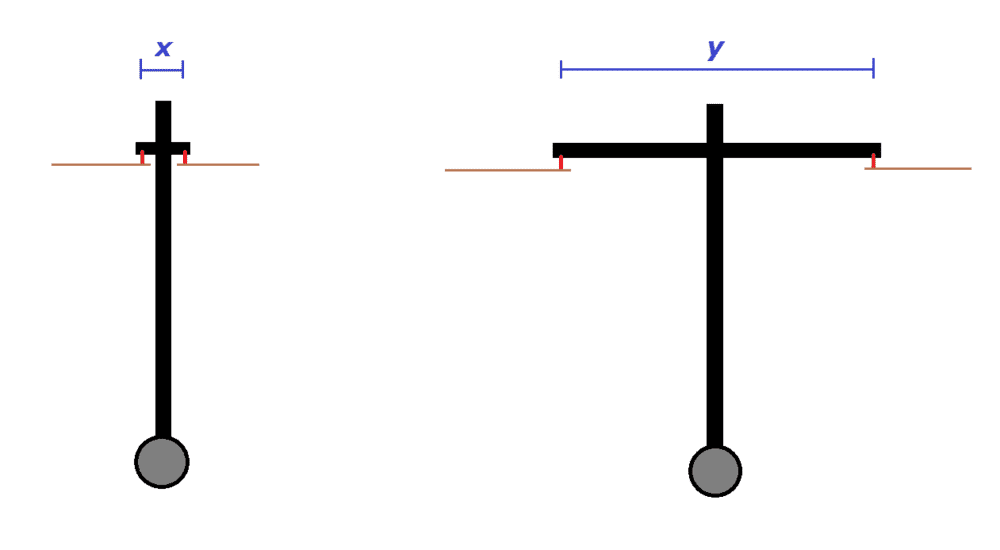
The discussion centers on the motion of a pendulum with a horizontal bar supported by two nails, specifically examining how the distance of the axis affects its motion. The participants conclude that the equations of motion for the pendulum do not include the x and y distances when neglecting the weight of the horizontal bar. However, if the bar's weight is considered, it could influence the pendulum's motion, potentially leading to a longer period due to increased moment of inertia and energy dissipation from bending. Experimentation is encouraged to observe these effects in practice.

PREREQUISITES
  • Understanding of pendulum motion and basic physics principles
  • Familiarity with equations of motion in classical mechanics
  • Knowledge of moment of inertia and energy dissipation
  • Experience with experimental physics and data collection
NEXT STEPS
  • Research the equations of motion for pendulums with varying axis distances
  • Explore the effects of moment of inertia on pendulum dynamics
  • Learn about energy dissipation mechanisms in mechanical systems
  • Conduct experiments to measure the period of pendulums with different bar weights
USEFUL FOR

Physics students, mechanical engineers, and hobbyists interested in pendulum mechanics and experimental physics will benefit from this discussion.

callekula
Messages
3
Reaction score
0
Hi,

I have a question regarding a pendulum and it's motion/momentum given the axis it moves around.

In the below picture, there are two version of a pendulum with a weight at the bottom. It moves in and out of the screen, around an axis resting on two nails (red). My question is, how does the distance (x and y) of the axis affect the motion, if we neglect the weight of the horisontal bar? Will the x-version move for a longer period of time, if the pendulum is released from the same position as the other version? Or is there no difference?
pendulum.png
 
Physics news on Phys.org
Hello callekula, :welcome: !

In a physics forum you can expect a physics answer; in PF, however, we really value the input from the poster: what do you think ? And instead of a direct answer (a spoiler, so to say) you get guiding questions an little nudges to help you find the answers you are looking for. :wink:

To help you on your way: if you had to write down the equations of motion for these pendula, would your lengths appear in those ?
 
Hi BvU,

I appreaciate your willingness for me to figure it out myself. However, the pendulum I am building does not look like the ones in the school books with formulaes attached to them, there they are often depicted hanging in a string in one fixed point. This pendulum swings using this horisontal bar that rests on two screws, so I could never figure this out myself I think.
 
Seems to me you are able to do the experiment !
My reply was 'first order': pendulum moves in the z plane and your x and y don't appear in the equations of motion.
For an accurate clock mechanism you'd need a much more detailed description to estimate higher order effects (bending, friction, ...)
 
  • Like
Likes   Reactions: callekula
Sure, I'm not expecting to get an exact answer with such a simple problem description. My gut feeling, if the weight of the bar is neglected, is that it won't make any difference. But in my actual case it does have a weight, although very small (a wooden bar, 2 cm in diameter). So I'd be curious if it had a notable effect of the motion over a period of time, if this particular bar would be a factor say 6 times longer. I'd definitely do experiments, but was just reaching out if someone already knew :-)
 
callekula said:
Will the x-version move for a longer period of time, if the pendulum is released from the same position as the other version?
View attachment 248152

If the longer bar bends more, it will dissipate energy quicker. The period might also be different due to that and the greater moment of inertia.
 
  • Like
Likes   Reactions: callekula

Similar threads

  • · Replies 1 ·
Replies
1
Views
2K
  • · Replies 2 ·
Replies
2
Views
2K
  • · Replies 3 ·
Replies
3
Views
7K
  • · Replies 10 ·
Replies
10
Views
2K
  • · Replies 21 ·
Replies
21
Views
4K
  • · Replies 9 ·
Replies
9
Views
2K
  • · Replies 2 ·
Replies
2
Views
4K
  • · Replies 10 ·
Replies
10
Views
3K
  • · Replies 5 ·
Replies
5
Views
3K
  • · Replies 8 ·
Replies
8
Views
2K
