Questions about using an Inertia Wheel to apply a compressive linear force

Click For Summary

Discussion Overview

The discussion revolves around the design and dimensions of an inertia wheel intended to apply a compressive linear force in a test setup for an actuator used in aircraft flight control surfaces. Participants explore the purpose of the inertia wheel, its interaction with other components, and the challenges posed by a lack of information from the manufacturer.

Discussion Character

  • Exploratory
  • Technical explanation
  • Debate/contested
  • Homework-related

Main Points Raised

  • Some participants inquire about the dimensions, weight, and material of the inertia wheel, emphasizing the need for specific information from the manufacturer.
  • One participant suggests that the inertia wheel may store energy to provide a strong pushing force when coupled with the linear actuator, proposing a method to estimate wheel dimensions based on energy calculations.
  • Another participant speculates that the load unit might mimic aerodynamic forces, with the inertia wheel modeling the mass of the stabilizer.
  • Concerns are raised about the lack of information necessary to design the inertia wheel, including force and torque diagrams, acceleration, and constraints on dimensions.
  • Participants discuss the importance of considering end-of-travel conditions for the actuator to prevent mechanical failures.
  • Some express frustration over the inability to obtain information from the manufacturer, which complicates the design process.
  • There are suggestions that understanding the complete science and application parameters is crucial for replicating the manufacturer's setup.
  • One participant emphasizes the need for additional details regarding hydraulic travel, side loads, and bending moments in the design considerations.
  • Another raises the importance of knowing how the inertia wheel shaft connects to other components in the system.

Areas of Agreement / Disagreement

Participants generally agree that more information is needed to design the inertia wheel effectively. However, there are competing views on the implications of the lack of information and the feasibility of replicating the manufacturer's setup without it. The discussion remains unresolved regarding the specific design parameters and the role of the inertia wheel.

Contextual Notes

Limitations include missing assumptions about the test setup, dependence on proprietary information from the manufacturer, and unresolved questions about the mechanical interactions between components.

Thesla
Messages
5
Reaction score
0
TL;DR
How to define dimensions of an inertia wheel
Summary: How to define dimensions of an inertia wheel

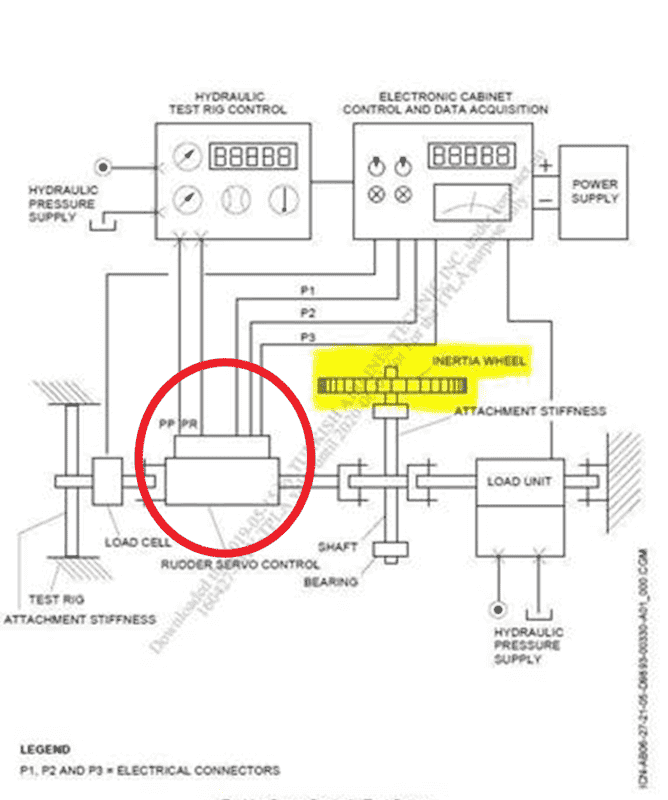
Firstly, I have been working in aviation industry, making me to involve in the Physics a lot. For the last few weeks, There have been a problem to solve since the manfacturer had not wanted to help us by not sharing information. We have asked them for information about dimension, weight and material that the inertia wheel is made of but nothing has been received back. All we know is that we are supposed to apply a load of 36000 lbf to the part circuled with red in direction of extend then retract in turn. Well.. What is the purpose of inertia wheel here, and how can we decide the dimension, weight and the material to produce it?

Thanks in advance.

Sincerely.
1573824074000.png
 
Last edited by a moderator:
Engineering news on Phys.org
Welcome to the PF. :smile:

Could you provide the make and model number of that test machine? Which standard is it meant to test to? What is the nature of the unit under test? It looks like some sort of impact stand for testing mechanical assemblies, but I'm not familiar with that kind of test. Thanks.
 
Thanks for the welcoming me here.

Well, in fact there is no specific model for the set up, at least, manifacturer of the unit that is to be tested is not willing to share it with us due to commercial reasons.

Unit being tested is an actuator that provides rotational moves for flight control surface of the aircraft known as Rudder.

I just wondered if it is possible calculate dimensions of the wheel, and its purpose to be attached to the set up.

Thanks.
 
So is the energy stored in the wheel in order to provide a very strong pushing force when coupled to the linear actuator mechanism? Or am I reading the diagram incorrectly?

If so, then you could get an approximate idea by figuring out the energy dumped into the linear actuator (via the rated pushing force and the length of the stroke), and equating that to the energy stored in various size spinning wheels (via the MOI and angular velocity). That will get you close to understanding what the wheel dimensions, mass and spin rate could be. Does the wheel dump all of its energy in a rotation or two?
 
Prehaps the load unit mimics the aerodynamic forces and the inertia wheel dynamically models the mass of the stabilizer? Just a guess...
 
Source of the mentioned load is another actuator, and between these two actuators there is the inertia wheel converting the linear force to angular one. When the UUT is kept retract position with hydraulic pressure of 3000 psi, we are supposed to apply a load of 35000 lbf in direction of extend with a load actuator coupled with the inertia wheel. Other than this, we unfortunetely have no any more information. I have not had the chance to observe the test yet. That is why, I am not able to tell you more.
 
hutchphd said:
Prehaps the load unit mimics the aerodynamic forces and the inertia wheel dynamically models the mass of the stabilizer? Just a guess...
It must be as you guess but how it helps us to design the wheel?
 
You are not (or cannot?) provide us with enough information to design the inertia wheel. In order to help you design an inertia wheel, we need a diagram showing the force (torque?) of the load unit, the force (torque?) of the rudder servo control, where and how those forces/torques are applied to the inertia wheel, the acceleration of the inertia wheel in radians per second squared, the torque of the inertia wheel, and any constraints on the dimensions of the inertia wheel. If it is for testing a rudder servo control, then the maximum speed of the inertia wheel is probably not important, but you should find that anyway.

Be aware that when an actuator is connected to an inertia, you need to design for end of travel. If the actuator is moving at speed when it reaches end of travel, things can break. I know of case where the engineer did not take that into account. His machine reached end of travel, sheared a dozen 3/4" bolts, and dropped slightly over a ton of machine with a large BOOM. Unfortunately, it happened in the customer's plant.
 
  • Wow
Likes   Reactions: berkeman
There seems to be a bit of a cross issue here; in that, you either have the manufacturer's machine in question, in which case you have no need to "design the wheel", or, you are attempting to copy the manufacturer's machine without fully understanding the complete science and application parameters for the elements of the existing machine.
 
  • Like
Likes   Reactions: berkeman
  • #10
JBA said:
There seems to be a bit of a cross issue here; in that, you either have the manufacturer's machine in question, in which case you have no need to "design the wheel", or, you are attempting to copy the manufacturer's machine without fully understanding the complete science and application parameters for the elements of the existing machine.
We have to copy the test set up about which the manifacturer provides no information at all with us. They express it is a industrial property cannot share any information regarding it without a contractual agreement. Even though we requested training on the UUT to observe the whole test and the set up, they rejected without any reasons.
 
  • #11
It sounds like you are being asked to supply the hydraulics and measurement devices for them to use in their plant.

If that is true, you would need to know the TRAVEL of the hydraulic LOAD UNIT and of the RUDDER SERVO CONTROL.

If you are to supply an assembled unit, you need the distance they require to mount their item(s).

You will also need the SIDE LOAD and any BENDING MOMENT applied to any of the mechanical or hydraulic parts you supply, both static and dynamic.

There are probably more things that I have missed. The mechanical experts here can likely say what was missed.

Cheers,
Tom
 
Last edited:
  • #12
You also need to determine how the inertia wheel shaft is coupled to the longitudinal shaft between the servo control and the load unit.
Who manufactures the aircraft? What model?
 

Similar threads

  • · Replies 20 ·
Replies
20
Views
4K
  • · Replies 11 ·
Replies
11
Views
2K
  • · Replies 4 ·
Replies
4
Views
3K
  • · Replies 35 ·
2
Replies
35
Views
5K
  • · Replies 6 ·
Replies
6
Views
3K
  • · Replies 11 ·
Replies
11
Views
3K
  • · Replies 6 ·
Replies
6
Views
4K
  • · Replies 11 ·
Replies
11
Views
3K
  • · Replies 2 ·
Replies
2
Views
4K