Questions based on derivation of electrical potential energy

Click For Summary

Discussion Overview

The discussion revolves around the derivation of electrical potential energy between two charges and the implications of the distance variables involved in the equations. Participants explore the assumptions made in the derivation, particularly regarding the relationship between the distances r1 and r2, and the interpretation of limits in integration.

Discussion Character

  • Technical explanation
  • Debate/contested

Main Points Raised

  • One participant questions how r2 can be greater than r1 when r1 is taken to be infinity, suggesting a conceptual confusion in the problem statement.
  • Another participant clarifies that the assumption of r2 being greater than r1 is not necessary for evaluating the integral, as integrals can be computed regardless of the order of limits.
  • A different participant points out that r2 has been replaced with a variable r, indicating a shift in perspective rather than a fixed value.
  • Some participants express that the example is poorly authored, leading to confusion about the relationships between r1 and r2.
  • There is a suggestion that the author may have intended to indicate a change to r2 rather than implying a greater distance.
  • Participants discuss the validity of the equations regardless of the order of integration limits, emphasizing that the integral's result remains consistent.
  • One participant refers to an external document for further clarification on the derivation of potential energy, indicating a search for additional resources.
  • There is a request for the entire example to be presented to better understand the context of the discussion.

Areas of Agreement / Disagreement

Participants express disagreement regarding the interpretation of the relationship between r1 and r2, with some asserting that r2 cannot be greater than r1 while others argue that the integral can be evaluated in either order. The discussion remains unresolved as participants explore different interpretations and assumptions.

Contextual Notes

There are indications of potential typos or misprints in the original problem statement that may contribute to the confusion regarding the distances involved. The discussion highlights the importance of clarity in mathematical expressions and assumptions.

gracy
Messages
2,486
Reaction score
83
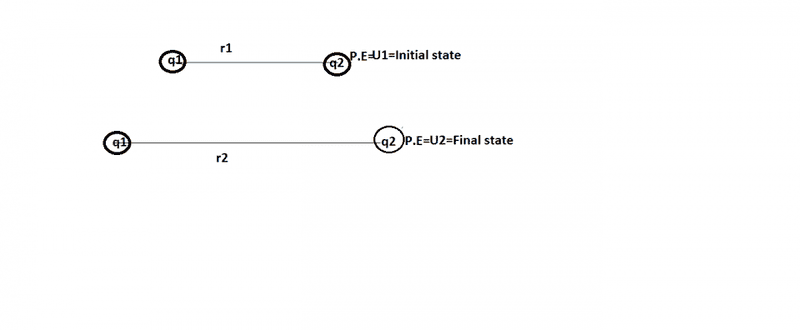
Consider a system of two charges ## q_1## and ##q_2## separated by distance ##r_1##.This configuration is associated with a potential energy ##U_1##.When the separation is increased to ##r_2##.Potential energy becomes ##U_2##
diag.png

##dW_E##=##\vec{F}##.##\vec{dr}##

##dW_E##=##Fdrcos0##=##\frac{1}{4πε0}\frac{q_1q_2}{r^2}##dr

⇒##W_E##=##\int_{r_1}^{r_2}####\frac{1}{4πε0}####\frac{q_1q_2}{r^2}##dr

##W_E##=##\frac{-q_1q_2}{4πε0}####[\frac{1}{r_2}##-##\frac{1}{r_1}]##

By definition of potential energy ,

##U_2##-##U_1##=##-W_E##

⇒##U_2##-##U_1##=##\frac{q_1q_2}{4πε0}####[\frac{1}{r_2}##-##\frac{1}{r_1}]##

Taking infinity as reference i.e ##r_1##=∞ and ##U_1##=0

⇒##U_2##-0=##\frac{q_1q_2}{4πε0}####[\frac{1}{r_2}##-##\frac{1}{∞}]##

⇒##U_2##=##\frac{1}{4πε0}####\frac{q_1q_2}{r^2}##

Taking ##U_2##=##U## and ##r_2##=##r_1##

##U##=##\frac{1}{4πε0}####\frac{q_1q_2}{r}##

I want to ask as we can see ##r_2 ##is >##r_1##

and then problem assumes ##r_1## to be ∞ my question is what is ##r2## then?how can ##r_2## be greater than ##r_1##?How can any number be greater than infinity?
 
Physics news on Phys.org
The only place where I see an assumption that r2 > r1 is in the limits of integration in ##W_E =\int_{r_1}^{r_2} \frac{1}{4πε0}\frac{q_1q_2}{r^2}dr##

But that is not an assumption that r2 > r1. You can evaluate an integral from a larger endpoint to a smaller. The result is the negative of the same integral evaluated from smaller to larger.
 
gracy said:
I want to ask as we can see ##r_2 ##is >##r_1##

This is what we see looking at the figure, yes.

and then problem assumes ##r_1## to be ∞

Yes, now they want you to imagine increasing ##r_1## so that it's not only bigger than ##r_2## but bigger than any value of ##r## you can imagine.

my question is what is ##r2## then?

They replaced ##r_2## with ##r##, meaning that instead of thinking of it as a fixed value for the separation distance, it's now thought of as a variable.

how can ##r_2## be greater than ##r_1##?

It can't. Very poorly authored example, if you ask me.
 
Mister T said:
Yes, now they want you to imagine increasing ##r_1## so that it's not only bigger than ##r_2## but bigger than any value of ##r## you can imagine.
But they don't want to increase ##r_1## such that distance between them becomes greater than ##r_2## instead they want to increase ##r_1## such that distance between them becomes ##r_2##
 
gracy said:
But they don't want to increase ##r_1## such that distance between them becomes greater than ##r_2## instead they want to increase ##r_1## such that distance between them becomes ##r_2##
Unless you have mistyped the final equation, it contains r, not r1. So it's a misprint: they mean replacing r2 with r.
 
haruspex said:
So it's a misprint: they mean replacing r2 with r.
Yes.
 
gracy said:
how can ##r_2## be greater than ##r_1##?
It isn't. When you write an integral from a to b, there is no requirement for b to be greater than a:
##\int_a^bf(x)dx = -\int_b^af(x)dx##
 
  • Like
Likes   Reactions: gracy
haruspex said:
When you write an integral from a to b, there is no requirement for b to be greater than a:
Yes,you have told me once.Upper and lower limit just indicate final and initial positions but this line confused me
gracy said:
When the separation is increased to ##r_2##
 
gracy said:
Yes,you have told me once.Upper and lower limit just indicate final and initial positions but this line confused me
Ok, but the equation is valid either way. With hindsight, the author might have preferred to write "changed to r2".
 
  • Like
Likes   Reactions: gracy
  • #10
I can also refer to this http://aakashtestguru.com/document/askExpert/08-10-2015-18:26:171608102015DP.pdf
for derivation of potential energy between the two charges ,right?
 
Last edited by a moderator:
  • #11
gracy said:
But they don't want to increase ##r_1## such that distance between them becomes greater than ##r_2##

Is this another typo then?

gracy said:
Taking infinity as reference i.e ##r_1##=∞ and ##U_1##=0

I suggest you present the entire example, as it was written by the author, along with a reference to the text you are quoting from.
 

Similar threads

  • · Replies 23 ·
Replies
23
Views
2K
  • · Replies 3 ·
Replies
3
Views
2K
Replies
4
Views
2K
Replies
92
Views
5K
  • · Replies 8 ·
Replies
8
Views
1K
  • · Replies 4 ·
Replies
4
Views
2K
  • · Replies 4 ·
Replies
4
Views
4K
  • · Replies 19 ·
Replies
19
Views
2K
  • · Replies 5 ·
Replies
5
Views
2K
  • · Replies 3 ·
Replies
3
Views
2K