Questions - solving pendulum period of rotation

Click For Summary

Homework Help Overview

The discussion revolves around the period of rotation of a physical pendulum and how it is affected by changes in temperature. Participants are exploring the relationship between temperature, frequency shift, and the parameters involved in the pendulum's motion.

Discussion Character

  • Exploratory, Assumption checking, Conceptual clarification

Approaches and Questions Raised

  • Participants are questioning the definitions of variables such as \(\Delta \theta\), "I", and "d". There is discussion about the implications of temperature changes on the pendulum's length and moment of inertia. Some are attempting to relate these variables to the period of rotation.

Discussion Status

The conversation is ongoing, with participants seeking clarification on the definitions and relationships between the variables. Some guidance has been offered regarding the use of ordinary differential equations (ODEs) and simple harmonic motion (SHM), but there is no consensus on how to proceed with the derivation or solution of the equations involved.

Contextual Notes

Participants express confusion due to incomplete information from the textbook and the professor's inability to clarify the concepts. There is a noted lack of explicit requirements regarding the derivation of the differential equation for the pendulum.

Physics7
Messages
18
Reaction score
0
Questions -- solving pendulum period of rotation

Physical pendulum has a period of rotation
gif.gif

that changes by Changing the temperature.
According to the above show that the frequency shift of the pendulum would be:
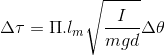
gif.latex?%5CDelta%20%5Ctau%20=%5CPi%20.gif


I have 2 questions,first solving the above question
and the second how Rotation period of the pendulum could be like this?
gif.gif
 
Last edited:
Physics news on Phys.org


please help me az fast as possible


Your first question is incomplete. How is [itex]\Delta \theta[/itex] defined?

As for your second question, it is also incomplete. What are "I" and "d"? I can guess that m and g are mass and the acceleration of gravity and possibly that "d" is the length of the pendulum but my guess would be that "I" is moment of inertia but that does not fit here.


my problem is these too,this is the book practice and hasn't explained anything even the professor didnt understand and he asked me to search for it...


HallsofIvy said:
Your first question is incomplete. How is [itex]\Delta \theta[/itex] defined?
Change in temperature, I would think. And lm must be the linear coefficient of expansion.
I can guess that m and g are mass and the acceleration of gravity and possibly that "d" is the length of the pendulum but my guess would be that "I" is moment of inertia but that does not fit here.
Yes, I as moment of inertia makes sense. If we assume that, and that d is the length of the pendulum from axis to centre of gravity, and we assume the pendulum expands uniformly, then I get the same answer as the book.


haruspex said:
Change in temperature, I would think. And lm must be the linear coefficient of expansion.

Yes, I as moment of inertia makes sense. If we assume that, and that d is the length of the pendulum from axis to centre of gravity, and we assume the pendulum expands uniformly, then I get the same answer as the book.

could you please tell more about it? and explain it?


Physics7 said:
could you please tell more about it? and explain it?
Do you know how to write down the differential equation for a simple pendulum and solve it? You will need a version of it that does not treat the pendulum as a point mass at the end of a massless rod.


I understand what you mean but I do' know how to solve it


Physics7 said:
I understand what you mean but I do' know how to solve it
So you can write down the ODE? If so, please post it.
Are you expected to be able to solve SHM ODEs, or perhaps just expected to recognise them and quote a solution?
 
  • #10


haruspex said:
So you can write down the ODE? If so, please post it.
Are you expected to be able to solve SHM ODEs, or perhaps just expected to recognise them and quote a solution?

sorry what do you mean by ode shm and odes ?
Im not native really sorry that bother you and put you in trouble :shy:
 
Last edited:
  • #11


Apologies. ODE = ordinary differential equation; SHM = simple harmonic motion.
 
  • #12


I know the diffrential equation but not for pendulum.
and shm if you mean
gif.gif
its okay,
I searched and I understand that complex pendulum period of rotation would be like this
gif.gif
but don't know how to do diffrential equation for it...
 
  • #13


Physics7 said:
I understand that complex pendulum period of rotation would be like this
gif.gif
OK, that should be enough for the question about change in temperature.
What you need to work out is how a small increase in length (resulting from a change in temperature) will affect I and d, and hence how it will affect the period. Do you understand how to use differentiation for that?
In the OP, you also said you wanted to know how the complex pendulum formula could be like that. To answer that, I need to walk you through the derivation and solution of the differential equation. OTOH, I get the impression you're not required to be able to do that yet. Please say how you'd like to proceed on that.
 

Similar threads

Replies
17
Views
1K
  • · Replies 14 ·
Replies
14
Views
2K
  • · Replies 9 ·
Replies
9
Views
3K
Replies
3
Views
2K
  • · Replies 7 ·
Replies
7
Views
4K
  • · Replies 27 ·
Replies
27
Views
2K
Replies
23
Views
2K
  • · Replies 2 ·
Replies
2
Views
1K
  • · Replies 20 ·
Replies
20
Views
2K