Chemistry Solve Log Rate Law Problem | Step-by-Step Guide for Optimal Results

  • Thread starter Thread starter r12214001
  • Start date Start date
  • Tags Tags
    Law Rate
Click For Summary
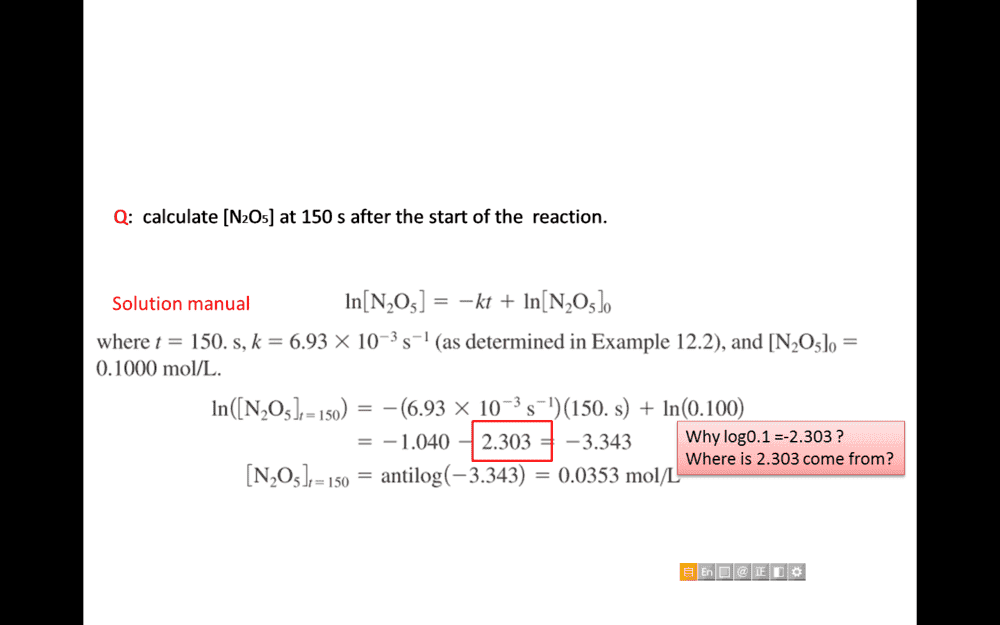
The discussion focuses on solving a logarithmic rate law problem, specifically addressing the calculation of log values. It clarifies that the logarithm and antilogarithm effectively cancel each other out in the equation presented. The participants confirm that the natural logarithm of 0.1 equals -2.303, derived from the properties of logarithms. This understanding is essential for accurately applying logarithmic functions in rate law calculations. The conversation emphasizes the importance of grasping these logarithmic principles for optimal results in problem-solving.
r12214001
Messages
24
Reaction score
2
Homework Statement
calculation
Relevant Equations
log problem
my question is in fig.
圖片1.png
 
Physics news on Phys.org
log0.1=-2.303
because that is what it is when you calculate it
did you calculate it?

you do not need to calculate it thought as the log and antilog cancel
$$\mathrm{antilog}(-1.040+\log(0.010))=\mathrm{antilog}(-1.040)\cdot\mathrm{antilog}(\log(0.100))
=\mathrm{antilog}(-1.040)\cdot(0.100)$$
 
ln means natural logarithm, base e.
 
TKS i get it
 
$$\ln{0.1}=\ln{\left(\frac{1}{10}\right)}=\ln{1}-\ln{10}=0-2.303=-2.303$$
 
  • Like
Likes jim mcnamara

Similar threads

  • · Replies 12 ·
Replies
12
Views
3K
  • · Replies 4 ·
Replies
4
Views
3K
  • · Replies 7 ·
Replies
7
Views
2K
  • · Replies 7 ·
Replies
7
Views
23K
  • · Replies 1 ·
Replies
1
Views
2K
  • · Replies 6 ·
Replies
6
Views
2K
  • · Replies 4 ·
Replies
4
Views
7K
  • · Replies 1 ·
Replies
1
Views
1K
  • · Replies 2 ·
Replies
2
Views
2K
  • · Replies 3 ·
Replies
3
Views
5K