Discussion Overview
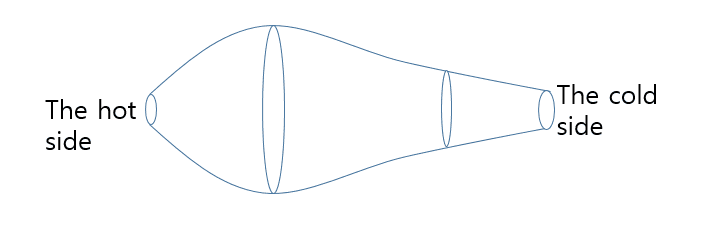
The discussion revolves around the rate of conduction heat transfer when the areas of the hot side and cold side differ. Participants explore the implications of varying cross-sectional areas on thermal conductivity and heat transfer calculations, with a focus on theoretical and mathematical considerations.
Discussion Character
- Exploratory
- Technical explanation
- Mathematical reasoning
Main Points Raised
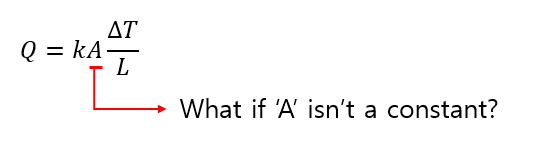
- One participant questions how to determine the rate of conduction heat transfer (Q) when the hot and cold side areas are not the same.
- Another participant emphasizes that thermal conductivity is a material property and does not depend on geometry, suggesting that conductance or resistance should be considered instead.
- It is proposed that the heat flux changes with the cross-sectional area, which affects the calculations of heat transfer.
- Some participants mention the need for assumptions of uniformity and directionality in heat flow to make meaningful calculations regarding resistance across a cross-section.
- One participant suggests a mathematical approach involving the integration of local cross-sectional area to calculate the rate of heat flow when the area changes gradually.
- Another participant notes that if the geometry does not vary gradually, solving the 2D or 3D heat conduction equation may be necessary.
Areas of Agreement / Disagreement
Participants express differing views on the implications of varying cross-sectional areas on heat transfer calculations. While some agree on the importance of considering conductance or resistance, others highlight the need for specific assumptions in modeling heat flow. The discussion remains unresolved regarding the best approach to take in these scenarios.
Contextual Notes
Participants acknowledge the limitations of their assumptions, particularly regarding uniformity and directionality of heat flow, which may affect the validity of their calculations. There is also mention of the complexity introduced by non-uniform geometries.