Rate of evaporation and steam tables

Click For Summary
SUMMARY

The discussion focuses on the thermodynamics of boiling water and steam generation, specifically addressing the energy requirements for phase changes. It is established that 419 kJ is necessary to bring 1 kg of water to 100°C, followed by an additional 2257 kJ to convert it to steam. The conversation clarifies that in an open boiler, the rate of steam generation remains constant if the heat supply is steady. The relationship between heat input and steam generation rate is confirmed, emphasizing that variations in heat supply will directly affect steam production rates.

PREREQUISITES
  • Understanding of thermodynamic principles, specifically phase changes.
  • Familiarity with steam tables and their applications in thermodynamics.
  • Knowledge of energy units, particularly kJ and their relevance in heating processes.
  • Basic concepts of open vs. closed systems in thermodynamic contexts.
NEXT STEPS
  • Research the properties of steam and water using steam tables.
  • Learn about the implications of pressure on boiling points in closed systems.
  • Explore the calculations involved in determining heat transfer rates in boilers.
  • Investigate the efficiency of different boiler designs in steam generation.
USEFUL FOR

Engineers, thermodynamics students, and professionals involved in boiler design and steam generation processes will benefit from this discussion.

jankod
Messages
2
Reaction score
0
Looking at the steam table below, if I understand things correctly, it will take 419kJ to bring a kg of water to the boil at 100°C and a further 2257kJ to turn all of that boiling water into steam.

I assume that would have to be in an open boiler, as the pressure inside of a closed vessel would increase, in turn increasing the boiling point of the water.

But in the simple case of an open boiler, does the rate of steam generation (as in kg/s or m3/s) remain constant during the time it takes to boil away that water?

From the table, I would deduce that 210kJ would bring 0.5kg of water to the boil and a further 1128kJ would evaporate all of it, but does that mean 1128kJ would evaporate half of 1kg of boiling water?
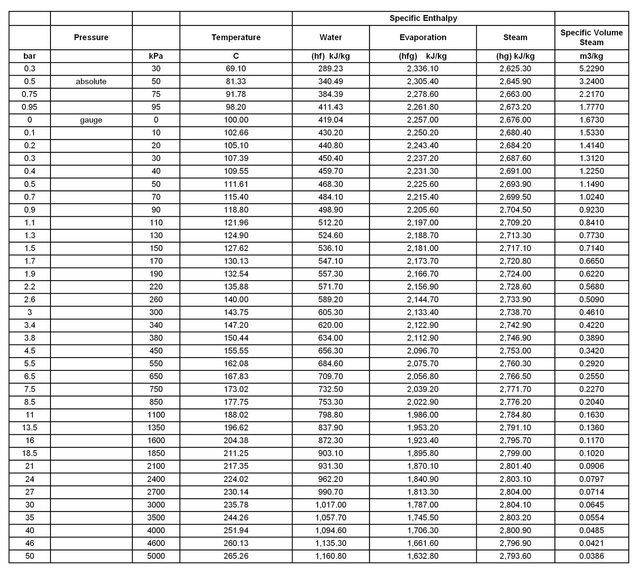
IgB1uRil.jpg
 
Last edited:
Science news on Phys.org
The amount of heat required to raise water to its boiling point depends on the starting temperature. The value you gave is for water starting out at 0 C. Once you reach the boiling point, the rate of steam generation is constant if the rate at which you are supplying heat to the boiler is held constant. Otherwise, it will vary in proportion to the rate of heat supplied.
 
Yes, that does make sense the more I think about it. Thanks.
 

Similar threads

  • · Replies 9 ·
Replies
9
Views
2K
  • · Replies 32 ·
2
Replies
32
Views
4K
  • · Replies 12 ·
Replies
12
Views
10K
  • · Replies 3 ·
Replies
3
Views
16K
  • · Replies 24 ·
Replies
24
Views
3K
  • · Replies 20 ·
Replies
20
Views
34K
  • · Replies 10 ·
Replies
10
Views
2K
  • · Replies 4 ·
Replies
4
Views
2K
  • · Replies 3 ·
Replies
3
Views
3K
Replies
9
Views
2K