johanns
- 2
- 0
Hey guys first time poster.
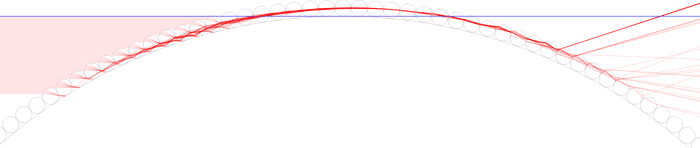
I have written a 2D ray tracer in Mathematica. It's very basic, all it does is use Snell's law to trace ray refraction and very basic absorption. The set up is a central absorbing circle surrounded by circular lenses. The central circle is a perfect absorber, so if a ray encounters it it is totally absorbed. The outer circles are perfect transmitters and if a ray encounters them it is refracted and transmitted.
This was just something I wanted to experiment with to see if I could bend light around and object. The results are pretty cool and the light seem to bend so perfectly I'm a bit suspicious. Can someone who know a lot about optics take a look a the results and tell me if you think they are within the realms of possibility.
The lenses have a refractive index of 1.65.
I have included a picture but I have also included a link to a vector file (.svg) which can be opened in any web browser and you can zoom into your hearts content (ctrl +)
NB the blue line is tangent to the large circle and parallel to all initial rays, so any rays that appear on the right half of the image would otherwise have been absorbed (ignoring diffraction)
Vector Link
Thanks
I have written a 2D ray tracer in Mathematica. It's very basic, all it does is use Snell's law to trace ray refraction and very basic absorption. The set up is a central absorbing circle surrounded by circular lenses. The central circle is a perfect absorber, so if a ray encounters it it is totally absorbed. The outer circles are perfect transmitters and if a ray encounters them it is refracted and transmitted.
This was just something I wanted to experiment with to see if I could bend light around and object. The results are pretty cool and the light seem to bend so perfectly I'm a bit suspicious. Can someone who know a lot about optics take a look a the results and tell me if you think they are within the realms of possibility.
The lenses have a refractive index of 1.65.
I have included a picture but I have also included a link to a vector file (.svg) which can be opened in any web browser and you can zoom into your hearts content (ctrl +)
NB the blue line is tangent to the large circle and parallel to all initial rays, so any rays that appear on the right half of the image would otherwise have been absorbed (ignoring diffraction)
Vector Link
Thanks