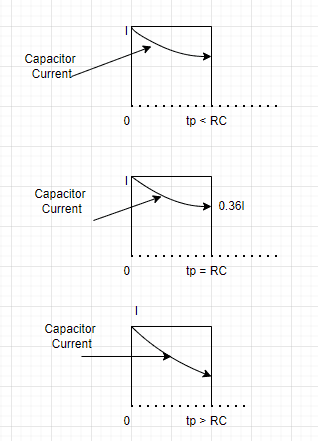
Another way to look at the circuit is via the exponential curves associated with the RC time constant.
Suppose you arbitrarily set the time constant to ##RC = 1~\rm{sec}## . Then you can adjust the value of ##t_p## accordingly. Arbitrarily set the current to 1 Ampere, too. All these values can be scaled accordingly, but this makes thing easier to work with.
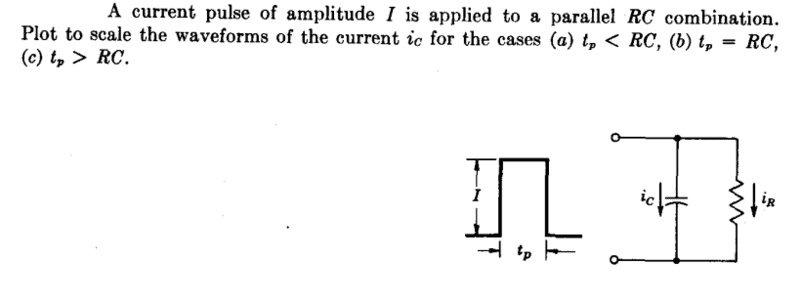
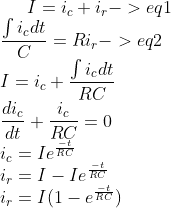
When the source current goes from 0 to 1 amp, the capacitor current follows it as it look initially like a short circuit. Then the capacitor current will drop exponentially, right? The source current is fixed at 1 ampere but as the capacitor begins to charge it's current will drop and the corresponding (leftover current) goes to the resistor. The time constant of the circuit is ##RC##.
The next "event" happens when the source current drops again to zero. How much time occurs between the two events? That depends upon the value of ##t_p##, right? The pulse length depends upon ##t_p##. So how much the capacitor current drops from 1 depends upon ##t_p## and the time constant we've set arbitrarily to 1 second. If ##t_p## is greater than 6 or so ##RC##, then the capacitor current will drop to (effectively) zero during this time. If ##t_p## is less than ##RC## it will drop only fractionally.
Question: What happens to the capacitor current when the source current changes from 1 to 0?