OceanWanderer
- 2
- 0
I am looking at building a pair of third class levers out of materials found at the local hardware store to lift up some 500lb and 1500lb hulls.
I have systematically gone through every option available to move these hull pieces out of the mold and I'm left with two:
1) Modify an "off the shelf" engine hoist to handle the 11' height requirement and load, or...
2) Build a wooden/metal/fiberglass/whatever jib crane (third class lever) on wheels to lift the hulls out of the mold and roll them aside.
Here are a couple of photos, which will explain things better than another 100 words. The first picture is somebody fortunate enough to have a roof with girders to attach ropes to. Must be nice. I have nothing overhead to attach to. The second picture is what I'd like to build out of primarily wood, found at the local hardware store, glue and metal or fiberglass reinforcements on the faces that would be in tension. I guess... that's where I need some input.
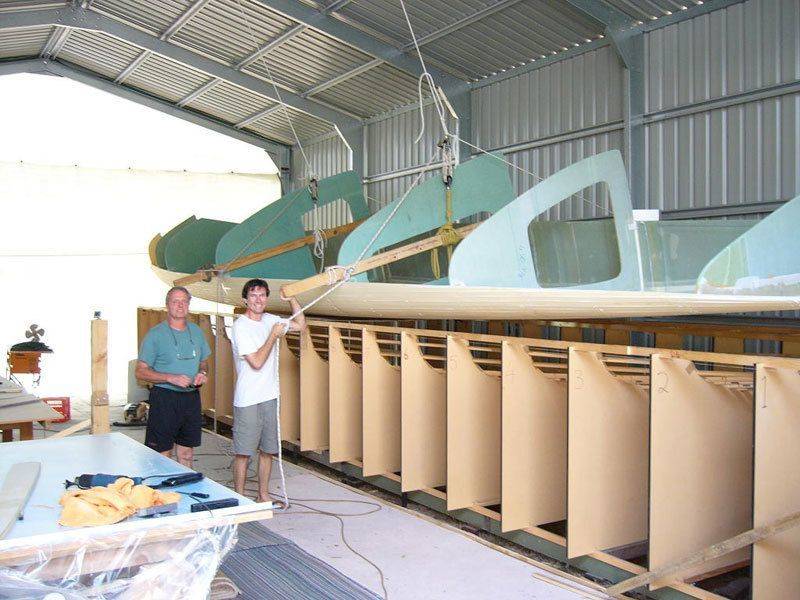
Lifting with rope.

The lift I'd like to make.
Questions:
1) What size of wood should I use for the structure... load beam, upright, legs?
2) What is the strongest way to join the wood from question #1 at the 90 degree joins seen in the diagram? Note that the 90 degree join is also the fulcrum, which gets a bit nasty.
3) Is there any other cost-effective way to build this?
The load to be lifted is a "c" shaped hull, like in the first picture, coming out of a mold by rope and pulley. Depending on the level of completion of the hull, it will weigh 500lbs (skin only) or 1500lbs (two skins joined with bulkheads installed). When two are joined and coming out of the mold, it will look like my diagram. The hull parts are 45' long by 8' wide by 3ft deep when on its side as seen in the picture. Sometimes, I have to pull a fully joined one off the mold (like in my diagram) that is 45' x 8' x 6'. This is made up of two half hulls that come off the mold after being joined.
Any ideas??
I have systematically gone through every option available to move these hull pieces out of the mold and I'm left with two:
1) Modify an "off the shelf" engine hoist to handle the 11' height requirement and load, or...
2) Build a wooden/metal/fiberglass/whatever jib crane (third class lever) on wheels to lift the hulls out of the mold and roll them aside.
Here are a couple of photos, which will explain things better than another 100 words. The first picture is somebody fortunate enough to have a roof with girders to attach ropes to. Must be nice. I have nothing overhead to attach to. The second picture is what I'd like to build out of primarily wood, found at the local hardware store, glue and metal or fiberglass reinforcements on the faces that would be in tension. I guess... that's where I need some input.
Lifting with rope.
The lift I'd like to make.
Questions:
1) What size of wood should I use for the structure... load beam, upright, legs?
2) What is the strongest way to join the wood from question #1 at the 90 degree joins seen in the diagram? Note that the 90 degree join is also the fulcrum, which gets a bit nasty.
3) Is there any other cost-effective way to build this?
The load to be lifted is a "c" shaped hull, like in the first picture, coming out of a mold by rope and pulley. Depending on the level of completion of the hull, it will weigh 500lbs (skin only) or 1500lbs (two skins joined with bulkheads installed). When two are joined and coming out of the mold, it will look like my diagram. The hull parts are 45' long by 8' wide by 3ft deep when on its side as seen in the picture. Sometimes, I have to pull a fully joined one off the mold (like in my diagram) that is 45' x 8' x 6'. This is made up of two half hulls that come off the mold after being joined.
Any ideas??


