Receiving High Freq Signals via Passive Downconverter

Click For Summary
SUMMARY

This discussion focuses on the use of a passive microwave signal downconverter to convert signals up to 3.5 GHz for reception with an RTL-SDR, which has an upper frequency limit of 1.5 GHz. It is established that using a Low Noise Amplifier (LNA) before the downconverter is beneficial to improve signal quality and impedance matching. The mixer requires sufficient Local Oscillator (LO) power to function effectively, and the specifications indicate a need for careful management of LO input power to avoid damage. Techniques for mitigating aliasing and optimizing signal reception are also discussed, including averaging multiple RF spectra.

PREREQUISITES
  • Understanding of passive microwave signal downconverters
  • Familiarity with RTL-SDR technology and its limitations
  • Knowledge of Low Noise Amplifiers (LNA) and their role in signal processing
  • Basic principles of mixing and frequency conversion in RF applications
NEXT STEPS
  • Research the specifications and applications of Marki Microwave's double balanced mixers
  • Learn about the implementation of Low Noise Amplifiers (LNA) in RF systems
  • Explore techniques for averaging RF spectra using the Linux "rtl_power" application
  • Investigate image rejection mixers and their advantages in eliminating unwanted sidebands
USEFUL FOR

RF engineers, hobbyists working with RTL-SDR, and anyone involved in microwave signal processing and reception optimization.

hilbert2
Science Advisor
Insights Author
Messages
1,600
Reaction score
607
TL;DR
Does a radio or microwave signal, received by an antenna, have to be amplified with external power before downconverting it to be below RTL-SDR maximum detection frequency?
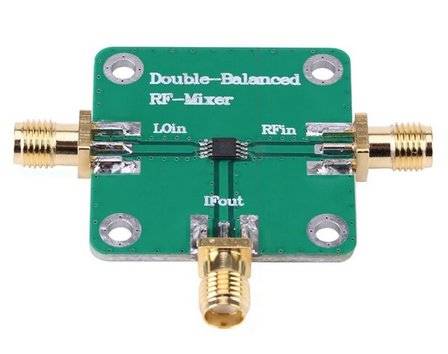
I'm getting this type of device in mail, it is a passive microwave signal downconverter that converts a signal of up to 3.5 GHz to something that can be received with an RTL-SDR of upper frequency limit less than 1.5 GHz. Is it expected that I have to put the antenna-received high freq signal through an amplifier before directing it through this device to the RTL-SDR to listen to it with a computer? The downconverter doesn't need any power source, which is why I'm not sure whether an unamplified signal from antenna is enough.

microwave-downconverter.jpg
 
Engineering news on Phys.org
You do not have to use an amplifier first.
Since mixers make more noise than Low Noise Amplifiers, it is common practice to use an LNA to lift the signal before the first mixer. That can also compensate for attenuation in the transmission lines.
An LNA also provides better impedance matching between the antenna and the mixer.
 
  • Like
Likes   Reactions: DaveE and hilbert2
Thanks for quick reply. So if I understand this correctly, if I put no signal at all (or "DC") to the LOin port, or if if I direct a low frequency sine signal to it, this device just act as a downconverter for what goes in the RFin port, and the downconverted version comes out of the IFout port? Or if the LOin signal is not just simple sine form, then this also acts as a modulator for the RFin signal?
 
hilbert2 said:
So if I understand this correctly, if I put no signal at all (or "DC") to the LOin port, or if if I direct a low frequency sine signal to it, this device just act as a downconverter for what goes in the RFin port, and the downconverted version comes out of the IFout port?
That is correct. A mixer expects a LO power sufficient to switch the internal mixer diodes. Once the diodes are switching, the lower power RF input signals will be down-converted, to appear on the IF output.

hilbert2 said:
Or if the LOin signal is not just simple sine form, then this also acts as a modulator for the RFin signal?
For use as a modulator, I would expect the sinewave carrier to be injected through the LO port, with the modulation signal into the RF or IF port. You need to look at the datasheet and verify that the bandwidth of the various ports are suitable for your application as a modulator.
 
  • Like
Likes   Reactions: hilbert2
For satellite reception I think you need a low noise amplifier ahead of the down converter so that the signal is raised above the receiver noise. Otherwise the mixer has losses will take the signal below the noise floor of the IF amplifier. In a typical case using the mixer alone may provide a noise figure of 8dB, but using a low noise amplifier might give a noise figure of 1dB. The satellite operates at very low signal-to-noise ratio, so every decibel is important.
 
  • Like
Likes   Reactions: hilbert2
The specifications of the circuit read "LO=312". If I want to convert a 2400-2500 MHz WiFi signal to one that can be seen with an RTL-SDR with upper reception limit of about 1480 MHz, I guess I would put a sine wave of more than 1000 MHz in the LO input? Just have to be careful to not use a too large LO input power that can break the device.
 
hilbert2 said:
The specifications of the circuit read "LO=312". If I want to convert a 2400-2500 MHz WiFi signal to one that can be seen with an RTL-SDR with upper reception limit of about 1480 MHz, I guess I would put a sine wave of more than 1000 MHz in the LO input? Just have to be careful to not use a too large LO input power that can break the device.
Yes, If you put a LO frequency of f_LO into the LO port and your input signal is f_in you will(for an ideal mixer) get TWO two ouput signals with frequencies f_in+f_LO and f_in-f_LO at the IF port. The upper band signal should ideally be filtered away but it is very possible that there is already a LP filter built into your receiver circuit.

it should say in the datasheet how much LO power you will need. Most mixers need quite a lot of MW power, anything between +7 to +13 dBm is quite common and that is a fair amount when talking about MW signals (most MW generators can't generate +13 dBm). However, the mixer will tolerate higher powers that. Under normal circumstances it is quite hard to break a mixer with too much LO Power.

Marki Microwave has some good application notes and tutorials about double balanced mixers.
 
  • Informative
  • Like
Likes   Reactions: hilbert2 and berkeman
Thanks for the replies to everyone. The only specifications I was able to find yet are like this, but there must be a datasheet somewhere...

Specification: RFin=1.5--4.5GHz
RFout=DC--1.5GHz
LO=312
Noise Factor: 0.6dB
LO/RF Isolation: 40dB
Frequency Conversion Loss: 8.5 dB
1dB Compression Point: 10dbm
RF/IF Max. Input Power: 13DBM
LO Maxi. Input Power: 27DBM
Connector: Standard SMA-female
Material:PCB
Length: approx. 3cm/1.18in
 
These specs depend on a perfect 50 Ohm source and not the Antenna impedance which may affect LO leakage, which is important and not specified.

Specifications:
RFin=1.5--4.5GHz
RFout=DC--1.5GHz
LO=312 ? 3 GHz is needed to convert 4.5 to 1.5
Noise Factor: 0.6dB
LO/RF Isolation: 40dB
Frequency Conversion Loss: 8.5dB
1dB Compression Point: 10dBm
RF/IF Max. Input Power: 13dBm
LO Max. Input Power: 27dBm
Connector: Standard SMA-female

This mixer will need an LNA and RF filter to prevent aliasing when LO = 3GHz, then IF filter to remove LO leakage and up.

I wouldn't trust any of these specs.

It requires 1.5 GHz to 3GHz to down-convert.

The conversion gain is LO (dBm) /RF (dBm) yet
LO isolation is only 40 dB from RF in.
 
Last edited:
  • Like
Likes   Reactions: hilbert2
  • #10
I got the device, and when I put an unmodulated 2100 MHz signal from an "ADF3491" signal generator to the "LOin" with as much power as possible, an antenna to the "RFin" and connected the "IF" to an RTL-SDR dongle, I was able to hear the signal from my Wi-Fi router (a periodic tapping sound most of the time, when listened to with AM modulation) at around 310 MHz as supposed. This is when it's using Wi-Fi channel 1 where the signal is found at freqs around 2410 MHz.

Covering the router with copper-nickel fabric made the signal inaudible, and changing the Wi-Fi channel to 11 caused it to be heard at higher frequencies between 2450 and 2480 MHz (or 345 - 380 MHz when downconverted).

It seems that superimposed on the downconverted radio spectrum there are original unconverted signal peaks when viewed with RTL-SDR and the Linux Gqrx application. And some of the converted peaks seem to move up instead of down in frequency when increasing the frequency of the LO signal (this is what is called "aliasing" in this context I guess).
 
  • #11
hilbert2 said:
And some of the converted peaks seem to move up instead of down in frequency when increasing the frequency of the LO signal (this is what is called "aliasing" in this context I guess).
There are both sum and difference frequencies from the mixer. Those that move in the opposite direction to the signal you want, are on the opposite side of the LO frequency from the signal you want.
 
  • #12
One way to eliminate upconverted peaks and non-converted peaks from the spectrum, I guess, is to record several RF spectra at ##n## different ##\nu_{LO}## values with spacing ##\delta##: ##\sigma (\nu; \nu_{LO}=\nu_0 )##, ##\sigma (\nu; \nu_{LO}=\nu_0 + \delta )##, ##\sigma (\nu; \nu_{LO}=\nu_0 + 2\delta )## ... ##\sigma (\nu; \nu_{LO}=\nu_0 + (n-1)\delta )##, and then just take the average value

##\displaystyle\frac{\sigma (\nu;\nu_{LO}=\nu_0 ) + \sigma (\nu - \delta ;\nu_{LO}=\nu_0 + \delta ) + \dots + \sigma (\nu -(n-1)\delta ;\nu_{LO}=\nu_0 + (n-1)\delta )}{n}##.

The larger the number ##n##, the better this keeps only the signal peaks that move to the left in the spectrum, by the same amount that you increase the ##\nu_{LO}## frequency. I have to try to do this with the Linux "rtl_power" application and the RTL-SDR receiver I have. Thanks for all the helpful information here.
 
  • #13

Similar threads

  • · Replies 29 ·
Replies
29
Views
5K
  • · Replies 27 ·
Replies
27
Views
3K
Replies
19
Views
6K
Replies
2
Views
3K
  • · Replies 13 ·
Replies
13
Views
6K
  • · Replies 7 ·
Replies
7
Views
4K
  • Poll Poll
  • · Replies 3 ·
Replies
3
Views
8K
  • · Replies 152 ·
6
Replies
152
Views
11K
  • · Replies 6 ·
Replies
6
Views
6K