Why does the apparent weight decrease when a body accelerates down a rope?

Click For Summary
SUMMARY

The apparent weight of a body decreases when it accelerates down a rope due to the relationship between gravitational force and normal force. According to Newton's first law of motion, a body in motion remains in motion unless acted upon by an external force. When a body accelerates downward, the normal force, which represents apparent weight, becomes less than the gravitational force, resulting in a reduced sensation of weight. This phenomenon occurs because the normal force is counteracting the gravitational force to maintain equilibrium, and during downward acceleration, this force diminishes.

PREREQUISITES
  • Understanding of Newton's laws of motion
  • Basic knowledge of forces and acceleration
  • Familiarity with the concepts of weight and apparent weight
  • Ability to analyze free body diagrams
NEXT STEPS
  • Study the implications of Newton's first law of motion in various contexts
  • Explore the differences between weight and apparent weight in physics
  • Learn how to construct and interpret free body diagrams
  • Investigate the effects of different forces on acceleration in dynamic systems
USEFUL FOR

Physics students, educators, and anyone interested in understanding the principles of motion and forces, particularly in relation to weight and acceleration.

Kaushik
Messages
282
Reaction score
17
When a body accelerates down(climbs down) a rope, why does its apparent weight reduce? Oh wait, does it even reduce in the first case?

If yes, is it because of the Newtons first law of motion, which states that a body in motion tends to be in motion and a body at rest tends to be at rest.

So when a body starts to accelerate downwards, it tends to be at rest, so there is a some random upward force that acts that tries to keep the body at the rest, which reduces its apparent weight.
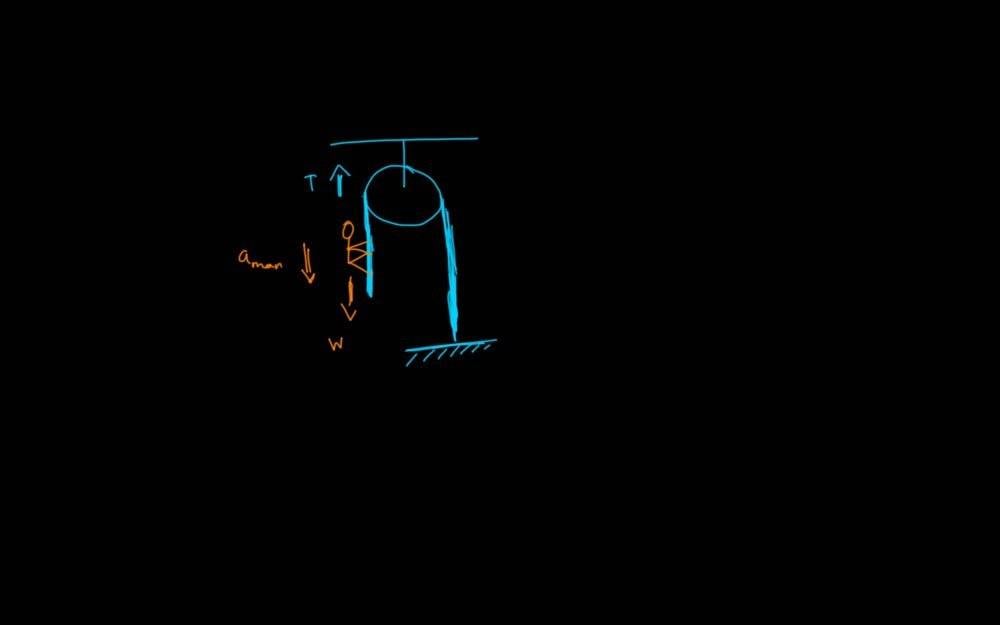
246743
 

Attachments

  • phy.forum.4.jpg
    phy.forum.4.jpg
    16.5 KB · Views: 231
Physics news on Phys.org
Kaushik said:
Summary: Why does the apparent weight of the body decrease while a body accelerates (climbs down) a rope?

When a body accelerates down(climbs down) a rope, why does its apparent weight reduce? Oh wait, does it even reduce in the first case?
Do you know what the definition of weight is ?

Kaushik said:
Summary: Why does the apparent weight of the body decrease while a body accelerates (climbs down) a rope?If yes, is it because of the Newtons first law of motion, which states that a body in motion tends to be in motion and a body at rest tends to be at rest.

does it ? ... have a look at this ...
https://en.wikipedia.org/wiki/Newton's_laws_of_motion
Kaushik said:
Summary: Why does the apparent weight of the body decrease while a body accelerates (climbs down) a rope?

So when a body starts to accelerate downwards, it tends to be at rest, so there is a some random upward force that acts that tries to keep the body at the rest, which reduces its apparent weight.

if it accelerating, how can it be at rest ?
 
Kaushik said:
Summary: Why does the apparent weight of the body decrease while a body accelerates (climbs down) a rope?

So when a body starts to accelerate downwards, it tends to be at rest, so there is a some random upward force that acts that tries to keep the body at the rest, which reduces its apparent weight.
There's two issues here. 1. What is the apparent weight? 2. Cause and effect.

1. What is the apparent weight.
Your real weight is the force of gravity on your body. There's no way to change that, apart from getting away from the Earth with a spaceship. Apparent weight is the force on your body that stops it from falling. If you are standing on the ground that will be the normal force from the ground on your feet, If you're hanging from a rope that will be the friction force from the rope on your hands. Of course if you don't accelerate, this force must be equal and in opposite direction from the force of gravity.
Apparent weight is the force that you actually feel.

2. Cause and effect.
Acceleration does not cause a reduction of the apparent weight. You cause acceleration by reducing your apparent weight. The easiest way is to let go of the rope. Your apparent weight will be 0, and because the force of gravity is still there, you will rapidly accelerate downwards. If you climb down the rope, you will just reduce the apparent weight for a short period.

If course if you want to go down, you must reduce your apparent weight, and if you see someone accelerating downwards, you can calculate that his apparent weight must be smaller, but neither of these dmean that acceleration is the cause of the reduction of the apparent weight.
 
  • Like
Likes   Reactions: hutchphd
davenn said:
if it accelerating, how can it be at rest ?
It tries.
 
davenn said:
Do you know what the definition of weight is ?
Weight is the force acting on a body due to gravity.
 
willem2 said:
Apparent weight is the force that you actually feel.
Is it the net vertical force acting on the body in the figure attached above?
 
willem2 said:
Acceleration does not cause a reduction of the apparent weight. You cause acceleration by reducing your apparent weight.
Oh yes, it is the force which cause the acceleration, not the other way around.
 
davenn said:
does it ? ... have a look at this ...
So first law states that, a body that is in motion or at rest will not be changed until ## F_{net} ≠ 0 ##. When there is some net force acting on it the body changes its state of motion(It starts to accelerate).
Am I right?
So, is the reduction of apparent weight somehow related to this?

Thanks.
 
Kaushik said:
Weight is the force acting on a body due to gravity.
Once you have subtracted out all the other forces on a body, "weight" is the remaining force that is required to explain the body's acceleration or lack thereof.

When defined in this way, "weight" depends crucially on what standard you measure your acceleration against. Change the standard for being at rest and you change your "weight".
 
  • Informative
Likes   Reactions: Kaushik
  • #10
Imagine the body standing on a scale.

First case:
Your body is not accelerating downward. You are in equilibrium. The normal force (n) exerted by the scale is equal and opposite to the weight (mg) of the body. Hence,

F = ma = n - mg = 0

Second case:
The body is accelerating downward in the negative direction:

F = ma = n - mg < 0

Hence

n < mg

The normal force (n) is your apparent weight and is now less than your actual weight.

The reason it has decreased is when talking about apparent weight we are talking about the weight of your body against the scale or conversely the scale against your body which is the normal force. If the scale is freely falling along with your body it exerts no normal force and so your weightless. But if it is not in free fall, that is the acceleration is less than g, then it must be preventing you from free falling since it is supporting you. But you are still accelerating downward a little bit. So your apparent weight is somewhere between 0 and your weight mg.
 
  • Informative
Likes   Reactions: Kaushik

Similar threads

  • · Replies 2 ·
Replies
2
Views
2K
  • · Replies 24 ·
Replies
24
Views
3K
  • · Replies 9 ·
Replies
9
Views
2K
  • · Replies 7 ·
Replies
7
Views
2K
  • · Replies 51 ·
2
Replies
51
Views
11K
  • · Replies 9 ·
Replies
9
Views
2K
  • · Replies 7 ·
Replies
7
Views
1K
  • · Replies 22 ·
Replies
22
Views
920
  • · Replies 50 ·
2
Replies
50
Views
4K
  • · Replies 38 ·
2
Replies
38
Views
5K