Regular Expressions Help: Find Language for DFA Drawing

  • Context:
  • Thread starter Thread starter evinda
  • Start date Start date
  • Tags Tags
    Expressions Regular
Join the discussion
Ask a follow-up here, or get your own question answered by working scientists, mathematicians and engineers — people, not an autocomplete.
Real named experts · corrections over time · the nuance an AI answer skips
13 replies · 4K views
evinda
Gold Member
MHB
Messages
3,741
Reaction score
0
Hello!
I have to draw the DFA of the language of the following expressions:
a){[tex]1^*\{00,010,\varnothing\}(01)^{*}[/tex]}
b)[tex](\{\{1,0\}^{*},(\varnothing,2)^*\})^{*}[/tex]

Could you help me to find the languages that are meant,so I can draw the DFAs?
 
Physics news on Phys.org
evinda said:
Hello!
I have to draw the DFA of the language of the following expressions:
a){[tex]1^*\{00,010,\varnothing\}(01)^{*}[/tex]}
b)[tex](\{\{1,0\}^{*},(\varnothing,2)^*\})^{*}[/tex]

Could you help me to find the languages that are meant,so I can draw the DFAs?
Hi evinda! :)

Effort?
What do you already know about DFA's and what they look like?
 
I like Serena said:
Hi evinda! :)

Effort?
What do you already know about DFA's and what they look like?

I know how to draw DFAs when I have a language,but I don't know how to find the language that is represented from the expressions above. :confused:

For example,if I had to draw the DFA,that accepts the language that contains the substring 001,I would do it like that: View attachment 1765
 

Attachments

  • dfa_001.jpg
    dfa_001.jpg
    16.5 KB · Views: 159
How can I find,in general,the language of a regular expression?? :confused:
 
evinda said:
How can I find,in general,the language of a regular expression??
This is just a remark (and a way to subscribe to the thread). There is no such thing as "finding the language" unless the language is finite. If the language is infinite, you cannot communicate or learn it as a set of words. Instead, you have to communicate some finite description of the language. Now, there is no canonical representation of a regular language. It can be described by a finite automaton, a regular expression, or a formula in first-order logic, and none of these is a priori better than the rest. For example, as you get familiar with regular expressions, they may become your preferred representation of regular languages.
 
Evgeny.Makarov said:
This is just a remark (and a way to subscribe to the thread). There is no such thing as "finding the language" unless the language is finite. If the language is infinite, you cannot communicate or learn it as a set of words. Instead, you have to communicate some finite description of the language. Now, there is no canonical representation of a regular language. It can be described by a finite automaton, a regular expression, or a formula in first-order logic, and none of these is a priori better than the rest. For example, as you get familiar with regular expressions, they may become your preferred representation of regular languages.

I understood...I tried to draw the finite automaton of the regular expression {[tex]1^*\{00,010,\varnothing\}(01)^{*}[/tex]} and that's what I did.Is this right? :)
View attachment 1767
 

Attachments

  • aut.jpg
    aut.jpg
    31.7 KB · Views: 147
Last edited:
Or am I wrong?If we have this: [tex]\{00,010,\varnothing\}[/tex],do the automaton has to read all of these: [tex]00,010,\varnothing\[/tex] or just one of them?
 
evinda said:
I tried to draw the finite automaton of the regular expression {[tex]1^*\{00,010,\varnothing\}(01)^{*}[/tex]} and that's what I did.Is this right?
Notations for regular expressions differ. Does comma denote alternation? Is there a difference between curly braces and parentheses? Why is the complete expression surrounded by curly braces?
 
Evgeny.Makarov said:
Notations for regular expressions differ. Does comma denote alternation? Is there a difference between curly braces and parentheses? Why is the complete expression surrounded by curly braces?

Oh sorry, the complete expression is not surrounded by curly braces. It is: [tex]1^*\{00,010,\varnothing\}(01)^{*}[/tex].

With the parentheses I think that it is meant that $0$ is followed by $1$ and this sequence appears $n$ times with $n \geq 0$.

And in the curly braces the comma may denote the alternation.
 
evinda said:
Oh sorry, the complete expression is not surrounded by curly braces. It is: [tex]1^*\{00,010,\varnothing\}(01)^{*}[/tex].

With the parentheses I think that it is meant that $0$ is followed by $1$ and this sequence appears $n$ times with $n \geq 0$.

And in the curly braces the comma may denote the alternation.

Looks like your off in the right direction! :D

Except... that with the commas between {} that mean alternation, your graph should be slightly different...
 
Looking good! ;)

One problem left. There is no such thing as an $\varepsilon$ transition.
It would be "no-input", which would not be deterministic.

Can you think of another (deterministic) transition that accepts either a '0' or a '1' that will show the same behavior?
And/or perhaps no transition at all, but marking the state as a final state?
 
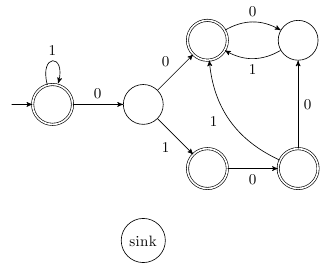
Here is my version.

automaton4.png


Missing arrows lead to sink.

Edit: Made the initial state to be also accepting in order to accept 1*. Still no warranty. :)
 
Last edited:
Thank you very much! :rolleyes: