Relation between magnetism and material creep

Click For Summary
SUMMARY

The discussion centers on the relationship between material creep in concrete and magnetism, specifically through the lens of Nuclear Magnetic Resonance (NMR). A civil engineer proposes a connection based on observed similarities in mathematical forms, such as the Bloch equation and creep equation, although he acknowledges the lack of definitive evidence linking the two phenomena. The conversation also touches on the Villari effect and the use of Discrete Elements Method (DEM) for simulating particle behavior, leading to visual patterns reminiscent of Rabi oscillations and free induction decay (FID) in NMR spectroscopy.

PREREQUISITES
  • Understanding of material creep in concrete
  • Familiarity with Nuclear Magnetic Resonance (NMR) principles
  • Knowledge of Discrete Elements Method (DEM) for particle simulation
  • Basic grasp of mathematical analogs in physics
NEXT STEPS
  • Research the Bloch equation and its applications in material science
  • Explore the Villari effect and its implications in magnetism
  • Study the principles of free induction decay (FID) in NMR spectroscopy
  • Investigate advanced techniques in Discrete Elements Method (DEM) for simulating complex particle interactions
USEFUL FOR

Civil engineers, materials scientists, physicists, and researchers interested in the intersections of material behavior and magnetic phenomena.

witu
Messages
2
Reaction score
0
TL;DR
Presumption about relation between Bloch equation and solid/fluid volumetric strain rate equation.
Hello,

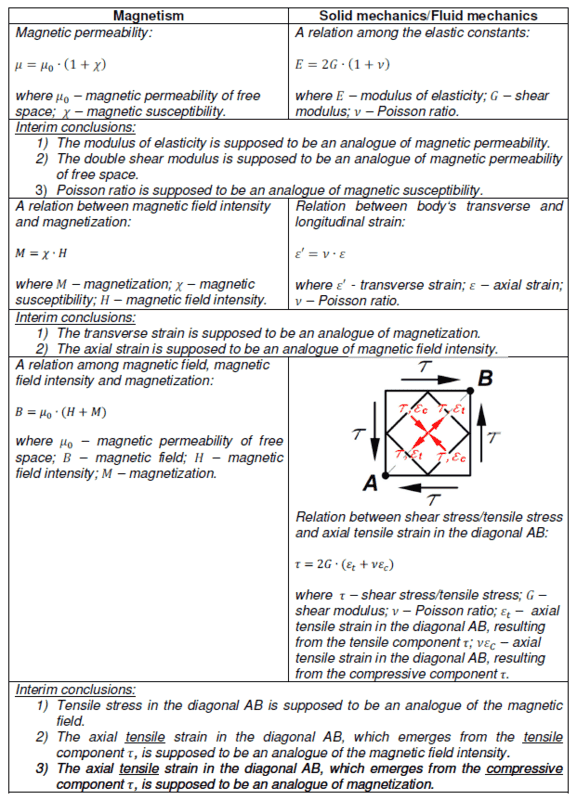
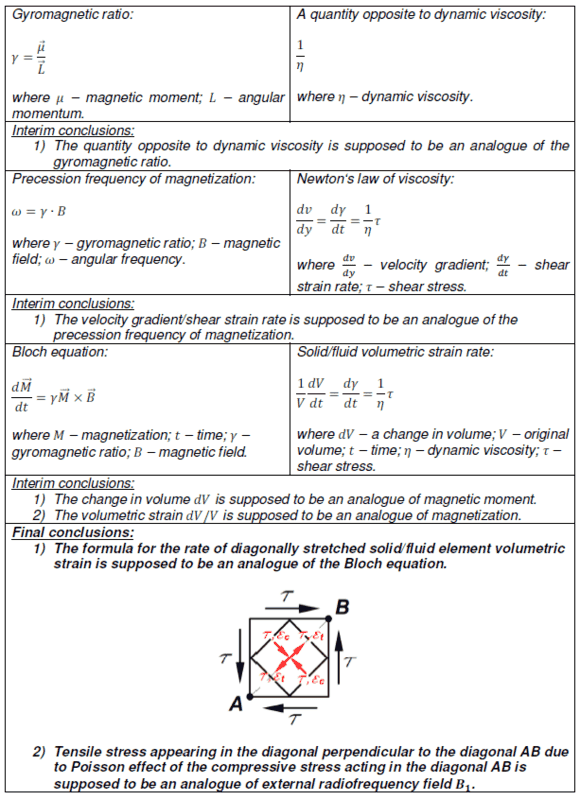
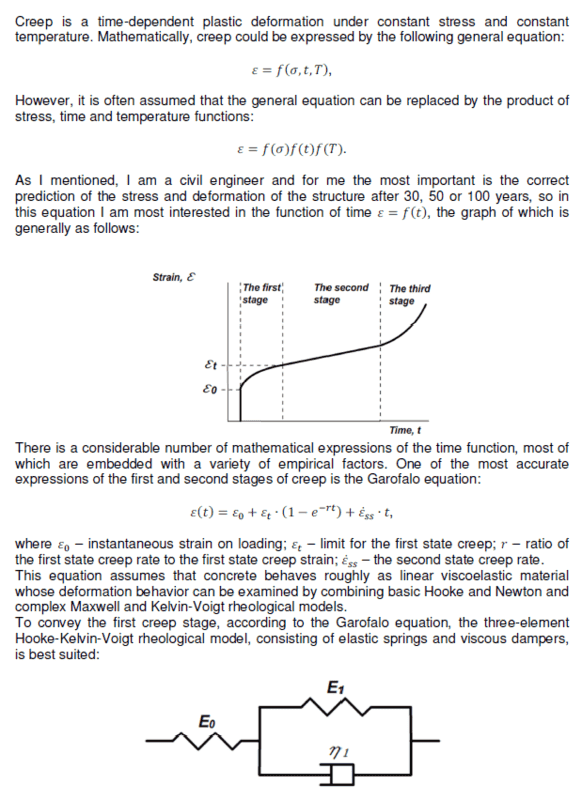
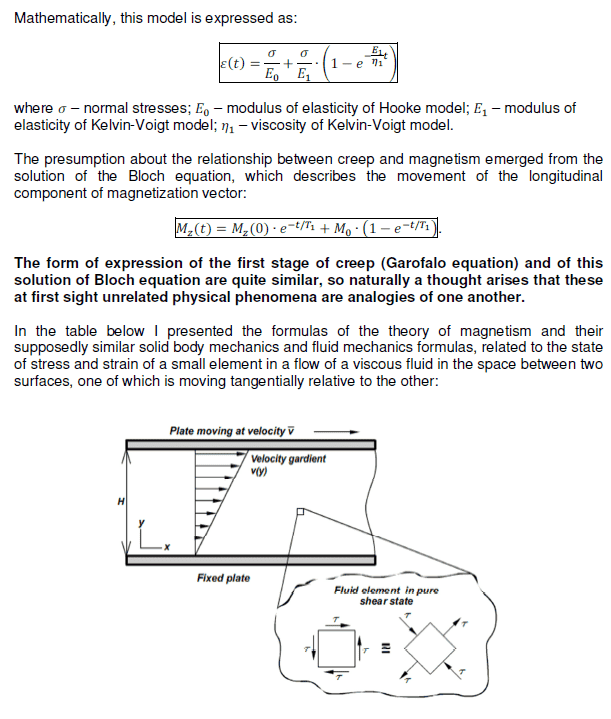
I am a civil engineer and have been working on concrete creep phenomenon for several years now. After reviewing a large amount of literature on related topics throughout this time, some interesting observations have emerged, and they have formed the idea that the material creep mechanism has some connection with NMR (Nuclear Magnetic Resonance). This is just my presumption and I do not have a hundred percent certainty on this, because I do not have enough competence in magnetism theories, but I still want to justify this my presumption somehow.
244639

244640

244641

244642
 
  • Skeptical
Likes   Reactions: trurle
Engineering news on Phys.org
Bloch equation is empirical (no firm theoretical proof for it). Same applies to creep equation. Similarity of form may indicate in both cases maker of equation have a similar math education background, and do not guarantee more precise forms of equations will still have a matching form.
 
Welcome to PF.
There is absolutely no evidence that material creep and magnetism are related.

The similarity of a mathematical forms is called an “analog”. For example;
Kinetic energy = half * mass * velocity squared;
Capacitive energy = half * capacitance * voltage squared;
Inductive energy = half * inductance * current squared.
https://en.wikipedia.org/wiki/Structural_analog_(electronic)
Correlation does not imply causation.
https://en.wikipedia.org/wiki/Correlation_does_not_imply_causation
 
  • Like
Likes   Reactions: anorlunda
I agree, I also find it odd to associate these two different things, but let's say there is a phenomenon like the Villari effect which links stresses and magnetization. This effect prompted me to use the term "relation".
Okay, apparently I used the wrong term. The term "analog" is also suitable for me. Below I will describe why I do all this.
I am using DEM (Discrete Elements Method) to simulate the compaction of particles in a given volume. My desire is to characterize each particle somehow uniquely in this particle collection.
I did so: until the movement of the particles in the volume stopped, I represented the change of the speed vector position for each particle.

244754


As a result, certain characteristic textures were formed on the surface of the particles: the particles at the top of the volume in question were simply rotating and collinear circles formed on their surface, and the trajectory of the most compressed particles at the bottom of the volume in question received a set of "8" trajectories forming a diamond texture. The movement of these diamond-like particles resembled Rabi oscillations.

244755


After trying to graphically represent the change in the angle of the particle velocity vector, I received spiral graphs similar to free induction decay (FID) in Fourier transform nuclear magnetic resonance spectroscopy.

244757


After all, there is a big surprise when you perform a simple experiment of free fall of particles, but you see all the physics in it and after that, the strangest questions arise :)
 
As children we often find interesting patterns, but as adults we cannot allow ourselves to become mesmerised or fascinated by what is only a simple analog. At some point we must escape the thrall by exercising the discipline necessary to get on with real science.
 
  • Like
Likes   Reactions: Greg Bernhardt

Similar threads

  • · Replies 2 ·
Replies
2
Views
4K
  • · Replies 3 ·
Replies
3
Views
2K
  • · Replies 1 ·
Replies
1
Views
741
  • · Replies 4 ·
Replies
4
Views
17K
  • · Replies 2 ·
Replies
2
Views
1K
  • · Replies 8 ·
Replies
8
Views
3K
  • · Replies 2 ·
Replies
2
Views
2K
  • · Replies 37 ·
2
Replies
37
Views
7K
  • · Replies 20 ·
Replies
20
Views
4K
  • · Replies 2 ·
Replies
2
Views
4K