Happiness
- 686
- 30
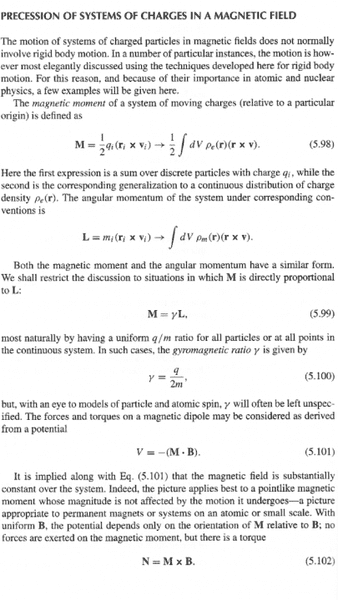
The magnetic moment ##\vec{M}## of a charged particle is defined as ##\vec{M}=\frac{1}{2}q\,(\,\vec{r}\times\vec{v})##.
Starting with torque ##\vec{N}=\vec{M}\times\vec{B}##, I arrive at a contradiction.
Consider a charge particle moving at a constant speed ##v## anticlockwise in a circle of radius ##r##. A magnetic field ##\vec{B}## is applied parallel to the plane of this circle. Consider the instant when ##\vec{B}## is in the same direction as ##\vec{r}##, the position vector of the particle, taking the center of the circle as the origin. Thus, ##\vec{r}\times\vec{B}=0##.
Then, ##\vec{N}=\frac{1}{2}q(\vec{r}\times\vec{v})\times\vec{B}##
##=\frac{1}{2}q[\vec{r}\times(\vec{v}\times\vec{B})-\vec{v}\times(\vec{r}\times\vec{B})]##
##=\frac{1}{2}\vec{r}\times\vec{F}-0##
##=\frac{1}{2}\vec{N}##, a contradiction.
What's wrong?
Starting with torque ##\vec{N}=\vec{M}\times\vec{B}##, I arrive at a contradiction.
Consider a charge particle moving at a constant speed ##v## anticlockwise in a circle of radius ##r##. A magnetic field ##\vec{B}## is applied parallel to the plane of this circle. Consider the instant when ##\vec{B}## is in the same direction as ##\vec{r}##, the position vector of the particle, taking the center of the circle as the origin. Thus, ##\vec{r}\times\vec{B}=0##.
Then, ##\vec{N}=\frac{1}{2}q(\vec{r}\times\vec{v})\times\vec{B}##
##=\frac{1}{2}q[\vec{r}\times(\vec{v}\times\vec{B})-\vec{v}\times(\vec{r}\times\vec{B})]##
##=\frac{1}{2}\vec{r}\times\vec{F}-0##
##=\frac{1}{2}\vec{N}##, a contradiction.
What's wrong?