Relation for combination of two thick lenses

Click For Summary
SUMMARY

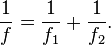
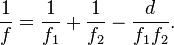
The discussion focuses on the optical principles governing the combination of two thick lenses. It establishes that while simple lenses can exhibit aberrations, these can be mitigated through the use of compound lenses, which consist of multiple simple lenses with varying shapes and refractive indices. The combined focal length of two thin lenses in contact is determined by the formula 1/f = 1/f1 + 1/f2, while for two thin lenses separated by distance d, the focal length is adjusted accordingly. The discussion also hints at the complexity introduced when dealing with thick lenses, referencing a resource for further exploration.

PREREQUISITES
  • Understanding of lens optics and focal lengths
  • Familiarity with the concept of optical aberrations
  • Knowledge of refractive indices and their impact on lens behavior
  • Basic mathematical skills for manipulating lens equations
NEXT STEPS
  • Study the principles of thick lens optics
  • Learn about the mathematical modeling of lens systems using ray tracing techniques
  • Explore the effects of lens separation on focal length in compound lens systems
  • Investigate optical aberration compensation methods in compound lenses
USEFUL FOR

Optical engineers, physicists, and students studying optics who are interested in understanding the complexities of lens combinations and their applications in optical systems.

justawebuser
Messages
10
Reaction score
0
Simple lenses are subject to the optical aberrations discussed above. In many cases these aberrations can be compensated for to a great extent by using a combination of simple lenses with complementary aberrations. A compound lens is a collection of simple lenses of different shapes and made of materials of different refractive indices, arranged one after the other with a common axis.

The simplest case is where lenses are placed in contact: if the lenses of focal lengths f1 and f2 are "thin", the combined focal length f of the lenses is given by
42b3acf0ad19d7b15b4972ee9414eee1.png


Since 1/f is the power of a lens, it can be seen that the powers of thin lenses in contact are additive.

If two thin lenses are separated in air by some distance d, the focal length for the combined system is given by
988c6074e1c5cc622dd1f9cb30f5bb80.png

So what if we have two thick lenses?
Thanks in advance ,
 
Science news on Phys.org

Similar threads

  • · Replies 1 ·
Replies
1
Views
4K
  • · Replies 4 ·
Replies
4
Views
2K
  • · Replies 1 ·
Replies
1
Views
1K
  • · Replies 3 ·
Replies
3
Views
2K
  • · Replies 8 ·
Replies
8
Views
3K
  • · Replies 0 ·
Replies
0
Views
3K
  • · Replies 7 ·
Replies
7
Views
5K
Replies
1
Views
2K
Replies
1
Views
2K
  • · Replies 2 ·
Replies
2
Views
6K