dougouk
- 8
- 0
Relationship between Electric Fields and Distance from point charge??
E= kq/r^2
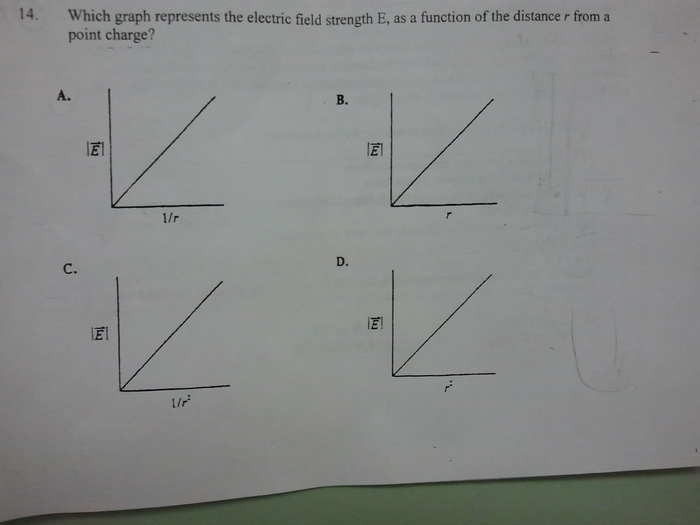
K so looking at the graph, I noticed that there is a inverse-square relationship between the electric field and the radius/distance.
So I considered that there would have to be a curved slope on a 1/r^2 graph, because the x-axis is squared.
Wouldn't any graph have a curved slope when the x-axis is squared?
For example, a simple equation like y = x^2 results in a curved slope, because the y-axis point is always squared of the x-axis point.
Wouldn't that reasoning work with this?
So my answer is A.
But my friend is saying that the graph would be curved with just 1/r.
And straight with 1/r^2. So her answer is C.
Which is right? Other ppl in my class are also saying that the answer is C as well, but i don't see why.
A lot of people are saying I'm thinking too hard and reaching a wrong conclusion, but they don't know how to explain.
What's wrong with my theory and what's right about my friend's?
Please explain T__T
Homework Statement
Homework Equations
E= kq/r^2
The Attempt at a Solution
K so looking at the graph, I noticed that there is a inverse-square relationship between the electric field and the radius/distance.
So I considered that there would have to be a curved slope on a 1/r^2 graph, because the x-axis is squared.
Wouldn't any graph have a curved slope when the x-axis is squared?
For example, a simple equation like y = x^2 results in a curved slope, because the y-axis point is always squared of the x-axis point.
Wouldn't that reasoning work with this?
So my answer is A.
But my friend is saying that the graph would be curved with just 1/r.
And straight with 1/r^2. So her answer is C.
Which is right? Other ppl in my class are also saying that the answer is C as well, but i don't see why.
A lot of people are saying I'm thinking too hard and reaching a wrong conclusion, but they don't know how to explain.
What's wrong with my theory and what's right about my friend's?
Please explain T__T