Googl
- 111
- 1
There is supposed to be a voltmeter. This is a better image.
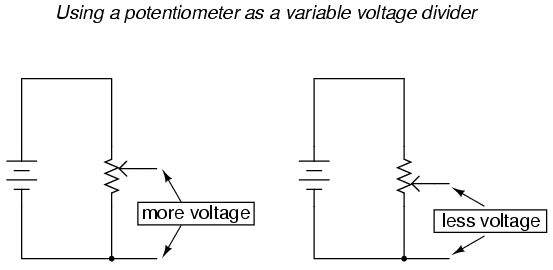

Stop right there. A potentiometer has three terminals: one on one end of the resistor, one on the other end, and a sliding contact that slides along the resistor. If you do not connect a load between the sliding contact and one of the other contacts, the voltage measured from the sliding contact to one end will be proportional to the distance the sliding contact is from that end to the total length of the resistor.Googl said:...In fact here we could use the current formula to find the current at this total, keep it constant then work out what is the voltage as the knob is moved across (from 20KΩ, 18KΩ, 16KΩ, 14KΩ, 12KΩ, 10KΩ, 8KΩ, etc). I hope I have been clear there. I understand this is not current which is what you might think I am assuming here.
Stop right there. A resistor does not provide voltage. A battery provides voltage, which is energy per unit charge. A resistor uses energy. The energy it uses is the potential drop (change in potential energy/unit charge) x charge passing through the resistor. The rate of energy use (power consumption) is the potential drop x current (charge/unit time).The idea that at a 20KΩ resistor will provide a 20V
Andrew Mason said:Stop right there. A resistor does not provide voltage. A battery provides voltage, which is energy per unit charge. A resistor uses energy. The energy it uses is the potential drop (change in potential energy/unit charge) x charge passing through the resistor. The rate of energy use (power consumption) is the potential drop x current (charge/unit time).
AM
This is not correct. An electric potential s applied to the resistor by the voltage source (battery). The amount of resistance placed in the electric field created by the voltage source (ie. the load resistance to which the voltage is applied) does not affect the magnitude of this potential difference. The resistor material provides charges that move in response to the electric field created by the electric potential. The greater the resistance, the fewer charges that flow in response to the electric field. The potential energy of charges present in that field (ie. in the resistor having uniform resistance per unit length) decreases in a linear fashion as one goes from one end of the resistor to the other, from 20 Joules/coulomb at one end down to 0 at the other.Googl said:I understand that I just did not find the right words at the time.
So having DROP at the end of voltage is very significant (voltage drop). A circuit will have 20V across it without a resistor. When a resistor is added a voltage drop will occur across the resistor which will be directly proportional to the size of resistance. So the greater the resistor resistance the greater the voltage drop across the resistor that occurs.
This is correct but somewhat misleading. Voltage (potential difference) is potential energy per unit charge at one point relative to another. Potential difference at a point is always measured relative to some other point. So we can only talk about 5V or 2V in relation to TWO points, not one.I think I did not have enough confidence in what the quantity of voltage actually is, which is the difference of two points electrical potentials. So when a voltmeter is set at two terminals it will measure the potential difference between the two terminals, so the electrical potential at one terminal could be 5V while the other 2V and the voltage would be 5V-2V which is equal to 3V.
Ohm's law: V=IRGoogl said:I am trying to understand the relationship between voltage and resistance.
semih93 said:I think that we can not say r is equal to 20ohm volt will be 20 volt ,because we use wires to connect resistance and battery and these wires's resistance are not zero hence they take voltage,theoretical we say v=I.r and if I has constant value then volt and ohm are proportional but in there we don't condider wires's resistance and you guess that in real this is not like that