Bagwan
- 6
- 0
The unit right now is electrostatics, but this question is really just vectors, nothing to do with charges or anything... anyways here is the info:
1. Homework Statement
Three identical point charges, A, B, and C are located as shown here:
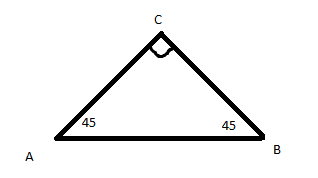
The force A-on-C is the same as the force B-on-C. What is the net force on C?
I think the only equation I need is the superposition of force principle:
FnetC = FAonC + FBonC
[/B]
Breaking into components (not allowed to use cosine law for some reason):
I know X-axis force is 0 as the 2 forces cancel out (since they are both equal and in opposite directions).
FnetCY = FAonC * cos(45) + FBonC * cos(45)
Not sure what else I can do though...
EDIT: I messed around with the 1-1-sqrt(2) triangle and I'm not sure if this is right, but is (2/sqrt(2)) * FAonC the right answer?
EDIT 2: Yes, that's the right answer, but sqrt(2) * FAonC is also right.
Because guess what, 2 divided by squareroot(2) is THE SAME THING AS squareroot(2)...
1. Homework Statement
Three identical point charges, A, B, and C are located as shown here:
The force A-on-C is the same as the force B-on-C. What is the net force on C?
Homework Equations
I think the only equation I need is the superposition of force principle:
FnetC = FAonC + FBonC
The Attempt at a Solution
[/B]
Breaking into components (not allowed to use cosine law for some reason):
I know X-axis force is 0 as the 2 forces cancel out (since they are both equal and in opposite directions).
FnetCY = FAonC * cos(45) + FBonC * cos(45)
Not sure what else I can do though...
EDIT: I messed around with the 1-1-sqrt(2) triangle and I'm not sure if this is right, but is (2/sqrt(2)) * FAonC the right answer?
EDIT 2: Yes, that's the right answer, but sqrt(2) * FAonC is also right.
Because guess what, 2 divided by squareroot(2) is THE SAME THING AS squareroot(2)...
Last edited: