Resistance of a wire around the Earth

  • Context: Engineering 
  • Thread starter Thread starter godiswatching_
  • Start date Start date
  • Tags Tags
    Earth Resistance Wire
Click For Summary
SUMMARY

The discussion centers on calculating the change in resistance of a wire wrapped around the Earth when the radius increases by one meter. The original resistance is calculated using the formula \( R_{0}=\rho\frac{l}{A} \), and the change in length due to the radius increase is determined by \( \Delta L = 2\pi (r_{E}+1) - l \). The final change in resistance is computed as \( \Delta R = R - R_{0} \), yielding a result of \( \Delta R = 3.4 \cdot 10^{-4} \Omega \). Participants confirm the calculations are logically sound despite initial doubts about the simplicity of the problem.

PREREQUISITES
  • Understanding of electrical resistance and the formula \( R=\rho\frac{l}{A} \)
  • Knowledge of basic geometry, specifically the circumference of a circle
  • Familiarity with the concept of linearity in mathematical functions
  • Basic algebra for manipulating equations and solving for variables
NEXT STEPS
  • Explore the implications of resistance changes in electrical circuits
  • Learn about the properties of materials affecting resistivity (\( \rho \))
  • Investigate the effects of geometric changes on electrical properties in practical applications
  • Study the relationship between resistance, voltage, and current using Ohm's Law
USEFUL FOR

This discussion is beneficial for physics students, electrical engineers, and anyone interested in understanding the relationship between geometry and electrical resistance in practical scenarios.

godiswatching_
Messages
12
Reaction score
1
Homework Statement
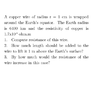
Homework statement in the image.
Relevant Equations
$$R=\rho\frac{l}{A}$$
$$l=2\pi r$$
Hey! I had a question about this problem.

I did (1) Using
$$R_{0}=\rho\frac{l}{A}$$

For (2) I assume the question means that the radius increases by a meter.
So I used $$\bigtriangleup L = 2\pi (r_{E}+1) - l$$
and then I used that L to find the new R. Then I said $$\bigtriangleup R = R-R_{0}$$

Does that seem right? This seems too simple to be right.

My final answer was:
$$\bigtriangleup R = 3.4 \cdot 10^{-4} \Omega$$
 

Attachments

  • Screen Shot 2021-11-28 at 3.26.38 PM.png
    Screen Shot 2021-11-28 at 3.26.38 PM.png
    18.7 KB · Views: 142
Physics news on Phys.org
'Too simple' is not an argument ...
What could possible be wrong ?

##\ ##
 
BvU said:
'Too simple' is not an argument ...
What could possible be wrong ?

##\ ##
I don’t see anything wrong with my steps. I think they are all logically sound. It’s more so that I’m paranoid and don’t want to lose points on homework for no reason really.
 
PF isn't in the business of stamp-approving homework. It wouldn't help anyone. You do your calculation, get a result and check it. Twice if you want, three times if you are paranoid :smile:

Have some faith in your work ... :wink:

##\ ##
 
  • Like
Likes   Reactions: phinds
I find it pretty hard to believe that adding a mere 6.28 m of wire is enough to lift it by 1 meter off the ground all the way around the Earth, but it does indeed.
 
vela said:
I find it pretty hard to believe that adding a mere 6.28 m of wire is enough to lift it by 1 meter off the ground all the way around the Earth, but it does indeed.
It seemed unbelievable when I first heard this one, but the math bears it out.
##C = 2\pi r \Rightarrow \Delta C = 2\pi \Delta r## -- this is an equality due to the linearity of this function.
If ##\Delta r = 1 \text{ meter}##, then ##\Delta C = 2\pi \cdot 1 \approx 6.28 \text{ meters}##
 

Similar threads

Replies
6
Views
2K
  • · Replies 17 ·
Replies
17
Views
3K
Replies
9
Views
2K
Replies
0
Views
2K
  • · Replies 4 ·
Replies
4
Views
815
  • · Replies 6 ·
Replies
6
Views
1K
  • · Replies 5 ·
Replies
5
Views
1K
  • · Replies 2 ·
Replies
2
Views
2K
Replies
19
Views
3K
  • · Replies 1 ·
Replies
1
Views
2K