Resistors - connected in series or in parallel

Click For Summary

Discussion Overview

The discussion revolves around the configuration of resistors in a circuit, specifically whether they are connected in series or in parallel. Participants are exploring how to simplify the circuit and determine the relationships between different resistors, which is relevant for solving a homework problem related to current flow.

Discussion Character

  • Homework-related
  • Technical explanation
  • Conceptual clarification

Main Points Raised

  • One participant identifies that the 40Ω and 20Ω resistors are in series, while the 125Ω and 50Ω resistors are in parallel.
  • Another participant questions whether the 240Ω and 60Ω resistors are also in parallel with the 125Ω and 50Ω, and seeks clarification on any other possible simplifications in the circuit.
  • A suggestion is made to use scrap paper or a whiteboard to redraw the circuit as resistors are combined, which may help visualize the series and parallel connections more clearly.
  • It is noted that if current can flow from one end of a resistor to the other without passing through that resistor, then those resistors are in parallel; otherwise, they are in series.
  • One participant mentions that the 240Ω and 60Ω resistors form part of a parallel path but are not the only components in that path, as they are in series with the 2Ω resistor.

Areas of Agreement / Disagreement

Participants express uncertainty regarding the connections of the 240Ω and 60Ω resistors, and there is no consensus on whether they are in parallel with the 125Ω and 50Ω resistors. The discussion remains unresolved regarding the overall configuration of the circuit.

Contextual Notes

Participants are working with a basic circuit diagram that is not provided, which may limit their ability to visualize the connections accurately. There are also unresolved questions about the simplification of the circuit and the role of the 2Ω resistor.

kandrew
Messages
4
Reaction score
0
Resistors -- connected in series or in parallel

Homework Statement


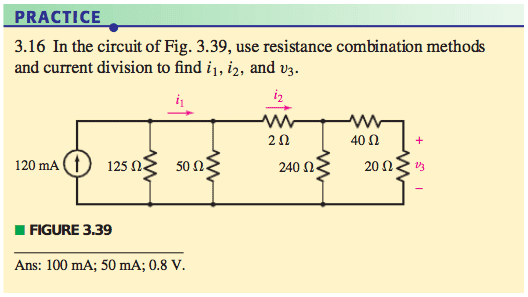
The problem is asking for the currents, but I have a question about the resistors. I've been having trouble determining whether resistors are connected in series or in parallel. I've already looked at another thread in this forum about resistors, but it did not help with this situation. The circuit below is very basic, but I think it would help with more advanced circuitry if I knew about these resistors.
c542df79a5fd2d7b7e492baa742f5c77.png


Homework Equations


NA


The Attempt at a Solution


I know:
• the 40Ω and 20Ω are connected in series, and
• the 125Ω and 50Ω are connected in parallel.

I'm curious as to whether the 240Ω and the 60Ω (equivalent of 40Ω and 20Ω) are also connected in parallel with the 125Ω and 50Ω. And I'd like to know if there are any other resistor connections that can be simplified, or is that 2Ω just a loner?
 
Physics news on Phys.org
kandrew said:

Homework Statement


The problem is asking for the currents, but I have a question about the resistors. I've been having trouble determining whether resistors are connected in series or in parallel. I've already looked at another thread in this forum about resistors, but it did not help with this situation. The circuit below is very basic, but I think it would help with more advanced circuitry if I knew about these resistors.
c542df79a5fd2d7b7e492baa742f5c77.png


Homework Equations


NA


The Attempt at a Solution


I know:
• the 40Ω and 20Ω are connected in series, and
• the 125Ω and 50Ω are connected in parallel.

I'm curious as to whether the 240Ω and the 60Ω (equivalent of 40Ω and 20Ω) are also connected in parallel with the 125Ω and 50Ω. And I'd like to know if there are any other resistor connections that can be simplified, or is that 2Ω just a loner?

Get yourself a whack of scrap paper or a whiteboard, and each time you combine resistors (series or parallel) redraw the circuit replacing the combined resistors with a single resistor. That should help you to see new series/parallel opportunities as you go.

If you are reducing the circuit from right to left (so, starting with the series combination of the 40 and 20 Ohm resistors that you mentioned), clearly the 2Ω resistor will eventually be in series with the "result" of the reduction of the 240-40-20 Ohm cluster. Do the reductions step by step and you'll see.
 
  • Like
Likes   Reactions: 1 person
kandrew said:
I'm curious as to whether the 240Ω and the 60Ω (equivalent of 40Ω and 20Ω) are also connected in parallel with the 125Ω and 50Ω. And I'd like to know if there are any other resistor connections that can be simplified, or is that 2Ω just a loner?
It often is clearer if you think in terms of parallel and series paths. If you can find a route that allows current to flow from one end of a resistor to the [node at the] other end of that resistor, and without passing through that resistor, you have found a parallel path.

If all current that passes through a particular resistor must also pass through another resistor, there being no alternative route, then those two resistors are in series.

As far as the 50Ω is concerned, the 240Ω and the 60Ω form part of a parallel path, but they alone don't comprise that path, there is the 2Ω in series with them.
 
  • Like
Likes   Reactions: 1 person
Get yourself a whack of scrap paper or a whiteboard, and each time you combine resistors (series or parallel) redraw the circuit replacing the combined resistors with a single resistor.

This suggestion gets my vote. Should make things very obvious for you.
 

Similar threads

  • · Replies 3 ·
Replies
3
Views
900
  • · Replies 2 ·
Replies
2
Views
2K
  • · Replies 1 ·
Replies
1
Views
2K
  • · Replies 17 ·
Replies
17
Views
13K
Replies
5
Views
2K
  • · Replies 3 ·
Replies
3
Views
2K
Replies
10
Views
3K
  • · Replies 7 ·
Replies
7
Views
4K
Replies
10
Views
1K
  • · Replies 5 ·
Replies
5
Views
3K