Resolving Forces in 3D - Statics

Click For Summary

Homework Help Overview

The discussion revolves around a statics problem involving the resolution of forces in three dimensions, specifically concerning the tensions in guy wires supporting a pole. The original poster presents a scenario with known forces and distances, seeking assistance in determining the tension in one of the cables.

Discussion Character

  • Exploratory, Assumption checking, Mathematical reasoning

Approaches and Questions Raised

  • The original poster attempts to establish relationships between the forces and their components using vector equations. They express uncertainty about their approach and seek a more practical method. Some participants suggest solving for specific components and substituting values into equations to simplify the problem.

Discussion Status

Participants are actively engaging with the problem, offering guidance on how to approach the equations. There is recognition of the complexity of the problem, with some participants affirming the original poster's method while others emphasize careful consideration of known and unknown variables. Multiple interpretations of the problem's setup are being explored.

Contextual Notes

There is a noted difficulty in distinguishing between known and unknown quantities in the problem, which may affect the approach to solving it. The original poster expresses a desire for further hints without revealing complete solutions.

keximaze
Messages
7
Reaction score
0
1. Three guy wires hold a pole BO as shown. The resultant R of the forces due to the three wires has a magnitude of 1000-N and is directed on the pole BO. Force F2 and F3 have a magnitude of 400-N and 500-N, respectively. The distance from point A to point D is 5-m. Find the tension in cable BD.
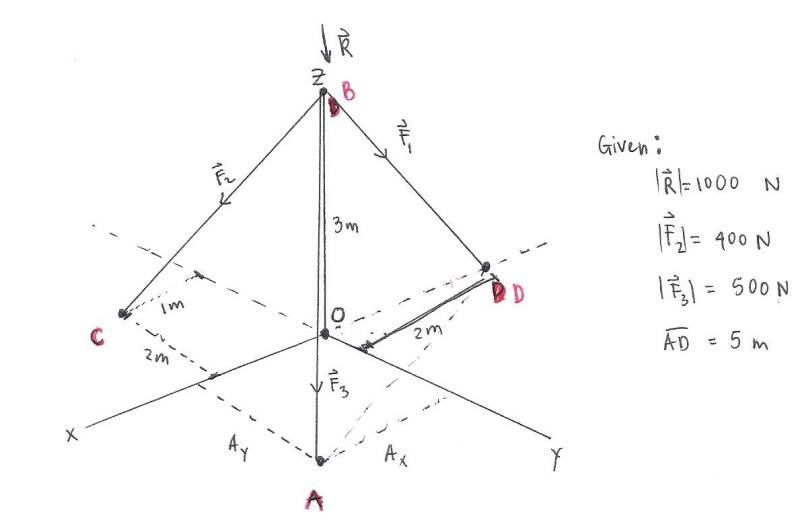


problem.jpg


Homework Equations


Summation of all the forces = 0
F1 + F2 + F3 + R = 0
F = F*(unit vector)

The Attempt at a Solution


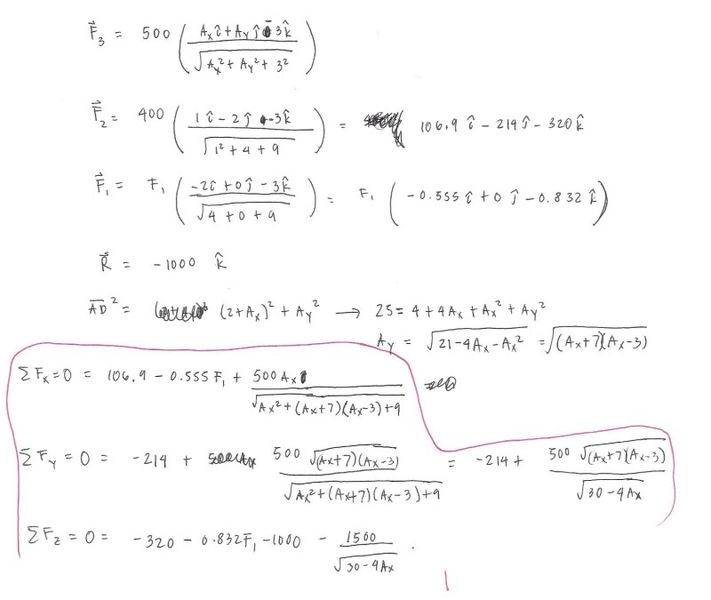
On the solution below, I first established vectors F2 and F3 using the equation F=F*(unit vector). After that, I obtained a relation between Ax and Ay using the length AD.
I ended up with a set of 4 equations and 3 unknowns (the circled part below). I could get an answer but I am not sure if its right. Also, I believe that this is not the most practical way of solving the problem.
a.jpg
Could anyone please help me find a better way of solving this problem? Thanks in advance.
 
Physics news on Phys.org
There is no better way but you are almost there! You have three equations and two unknowns A_x and F_1

Solve Sum F_y=0 equation for A_x and plug into one of the other equations.
 
This question is a little confusing so one must be very careful to understand what is known and what is not known.

Once you are sure about what you know, you need to first find Ay, then Ax, then |F_1|. I won't give too much away, this is a very tough question.
 
vertigo said:
This question is a little confusing so one must be very careful to understand what is known and what is not known.

Once you are sure about what you know, you need to first find Ay, then Ax, then |F_1|. I won't give too much away, this is a very tough question.

Please explain what you mean by "one must be very careful to understand what is known and what is not known"...am I going on the right track or did I make a mistake on the first part?

More hints pleaseeeee.
 
You are doing this problem correctly! Everything looks good.

Now solve your expression "sum forces in Y direction=0" for A_x

Now that you have solved for A_x plug that result into expression for "sum of forces in Z direction = 0). You can solve for F_1

You could have plugged A_x into "Sum forces in x-direction = 0" as well, same result.

This problem is a bit of a bookkeeping nightmare but pretty straight forward in approach.
 

Similar threads

Replies
17
Views
3K
  • · Replies 5 ·
Replies
5
Views
3K
  • · Replies 5 ·
Replies
5
Views
4K
  • · Replies 1 ·
Replies
1
Views
2K
Replies
13
Views
2K
  • · Replies 7 ·
Replies
7
Views
9K
  • · Replies 2 ·
Replies
2
Views
2K
  • · Replies 13 ·
Replies
13
Views
2K
  • · Replies 4 ·
Replies
4
Views
2K
Replies
6
Views
2K