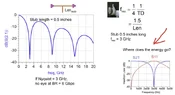
Resonance definition through dip in S-parameters

  • Thread starter Thread starter yefj
  • Start date Start date
yefj
Messages
74
Reaction score
2
Hello , I see things from Electro magnetic point of view thats why I said that energy is traped and goes from electric to magnetic withing the stucture.
I am use to see resosnace as a dip in S11 why in the phot the say that resonance in a dip in S21?
Thanks.
 

Attachments

  • 5.webp
    5.webp
    27.1 KB · Views: 1
Engineering news on Phys.org
An open-ended λ/4 transmission line stub, appears as a short circuit in the network.
λ/4 is halfway around the Smith chart, so the impedance is inverted about Zo.

S11 = 0dB, says at the resonant frequency, all the incident energy is reflected by the virtual short circuit to ground.
S21 = -40dB, says at resonant frequency, energy does not pass through the network, because port 2 is virtually shorted to ground.

Where does the energy go?
It is reflected by the open-ended λ/4 transmission line stub resonator.

If the stub was instead shorted to ground, the network would appear to be an open circuit, which is sometimes called a metal insulator.
 
The basic definition of resonance is "energy trapped within a cavity and it going from electric to magnetic type"
So whenrgy is trapped in a covity and doesnt go back thats why I understand we have a DIP in S11 of one port resonator.

but how can we understand the dip of S21 using same "trapped energy definition of resonance"

or there is some other basic definition of resonance which allows DIP in S11 and another case Dip in S21(as shown in this two port case)?

I have a conflict in definitions regarding what is resonance because a resonator has dip in S11 unline in this case, so why they both considered the same "resonance" where is the trapped energy in the two port case?
Thanks.
 
The "trapped" energy is not relevant. Once a high-Q resonator is oscillating, no more energy is required to keep it oscillating. S-parameters assume a steady state. Maybe it is your concept of trapped energy circulating continuously in the resonator, like an LC tank circuit, that confuses the issue.

Avoid high-Q resonance, and look instead at the length of the stub. The input signal travels along the stub from the junction, then is reflected back to the junction. With an open-ended line, the phase of the incident wave cancels the reflected wave at the junction, making it look like a ground. If the stub were shorted at the end, the phase of the reflected wave would reinforce the incident wave.

The signal only propagates along the stub, once each way. You can see that it is not a high-Q resonator, because the dip is very wide, not narrow, as it would be with a high-Q resonant circuit.
 
yefj said:
the reflected wave cancels the incoming wave at port 2 so why its a standing wave situation?
The cancellation occurs where the stub joins the line between port 1 and port 2. The forward wave in the stub is reflected from the impedance mismatch at the open-end of the stub, to become the reflected wave. The forward and reflected waves propagate independently. The standing wave is formed from the sum of the forward and reflected waves in the stub.
 
  • Like
Likes   Reactions: yefj

Similar threads

Replies
1
Views
2K
Replies
2
Views
2K
  • · Replies 6 ·
Replies
6
Views
8K
  • · Replies 4 ·
Replies
4
Views
4K
  • · Replies 5 ·
Replies
5
Views
2K
Replies
8
Views
2K
  • · Replies 9 ·
Replies
9
Views
2K
  • · Replies 0 ·
Replies
0
Views
1K
  • · Replies 4 ·
Replies
4
Views
3K
Replies
1
Views
7K