Rotating body viewed from its own rotating ref. frame, then perturbed

Click For Summary
The discussion revolves around a thought experiment involving a spinning disk-shaped satellite in a zero-gravity environment, where thrusters are fired while viewed from a rotating reference frame. Participants explore whether the disk should be treated as a gyroscope, necessitating consideration of precession, or if it can be simplified to a moment of inertia acted upon by torque. The impact of inertial forces, such as centrifugal and Coriolis effects, is emphasized due to the rotating frame of reference. Suggestions include placing thrusters directly on the disk to simplify the analysis. The conversation concludes with a participant expressing intent to further investigate the topic through a recommended video.
Swamp Thing
Insights Author
Messages
1,045
Reaction score
775
Pondering over this thought experiment, a question comes to mind -- to which my brain sometimes replies "of course" and sometimes "no way!"A disk shaped satellite ("in zero-G") spins about its axis. There are two thrusters mounted as shown on two axial booms. The thrusters are fired briefly at some moment. We want to try and predict the effect of the thrusters while looking at the system as a co-revolving observer (e.g. we're strapped into a seat on a huge ring or shell that surrounds the disk symmetrically, and is initially rotating at the same angular velocity).

In other words, we want to predict the behavior of the disk, with respect to a rotating reference frame that the disk was stationary in before the thrusters were fired -- and this frame is not affected by the thrusters.

The question is, do we need to consider the disk to be a gyroscope -- and hence, do we need to grapple with some complicated precession stuff?
OR... can we ignore the rotation and just consider the disk as a simple moment of inertia that is acted upon by a torque?
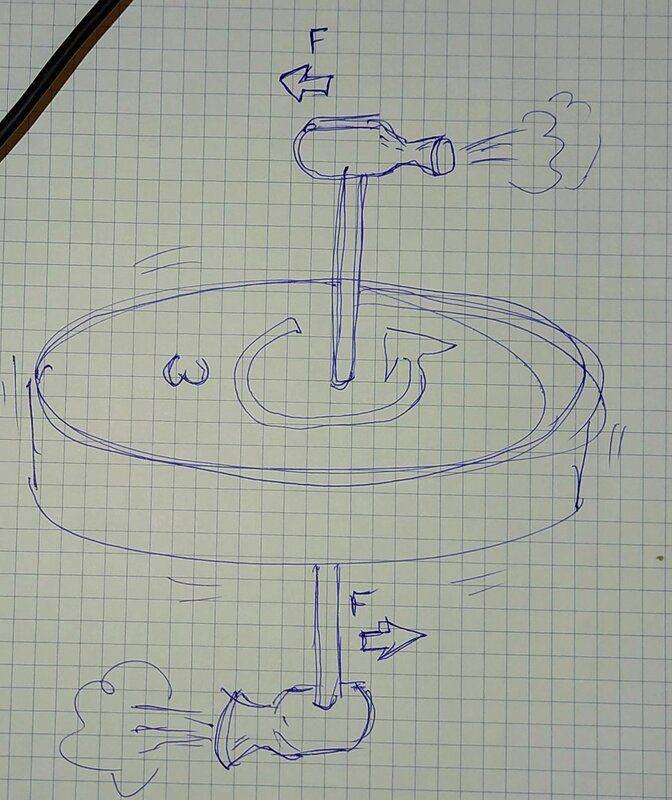
spinningDisk.jpg
 
Last edited:
Physics news on Phys.org
Swamp Thing said:
A disk shaped satellite ("in zero-G") spins about its axis. There are two thrusters mounted as shown on two axial booms.
Are the thrusters initially spinning with the disc or are they fixed in the inertial frame?

Swamp Thing said:
. can we ignore the rotation and just consider the disk as a simple moment of inertia that is
The disc is initially not rotating in your frame. But your frame is, so you have to consider inertial forces (centrifugal and Coriolis).

If the aim is understanding a gyroscope, the below video might help. You could for starters place the thrusters directly on the disc, such they the produce the same torque.

 
The thrusters are fixed to the axis rods, so they are fixed parts of the system.

Yes, I guess fixing them to the periphery would make it less complex looking and would be pretty much equivalent so I'll go with that.

I'll check out the video... Thanks.
 
For simple comparison, I think the same thought process can be followed as a block slides down a hill, - for block down hill, simple starting PE of mgh to final max KE 0.5mv^2 - comparing PE1 to max KE2 would result in finding the work friction did through the process. efficiency is just 100*KE2/PE1. If a mousetrap car travels along a flat surface, a starting PE of 0.5 k th^2 can be measured and maximum velocity of the car can also be measured. If energy efficiency is defined by...

Similar threads

  • · Replies 2 ·
Replies
2
Views
2K
  • · Replies 1 ·
Replies
1
Views
2K
  • · Replies 11 ·
Replies
11
Views
10K
Replies
1
Views
2K
Replies
58
Views
11K
  • · Replies 94 ·
4
Replies
94
Views
12K
  • · Replies 1 ·
Replies
1
Views
4K