Understanding Rotational Acceleration and the Role of Normal Force

  • Thread starter Thread starter goldfish9776
  • Start date Start date
  • Tags Tags
    Axis Rotation
Click For Summary
The discussion clarifies that the moment of inertia (IG) is calculated about an axis perpendicular to the page, focusing solely on tangential force (Ft) and not including normal force (Fn). It emphasizes that the sum of moments about point O involves only the moment due to Ft, as Fn affects rotational accelerations around axes within the plane of the page. The normal force is relevant for rotational acceleration in different orientations but does not contribute to the moment about the specified axis. The total moment about point M is thus considered only for rotational acceleration related to tangential acceleration. Understanding these distinctions is crucial for analyzing rotational dynamics accurately.
goldfish9776
Messages
310
Reaction score
1
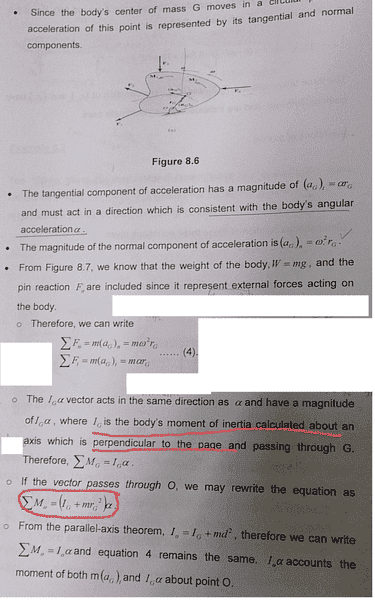
in this notes , the author gave that the IG is the moment of inertia calculated about an axis which is perpendicular to the page ...

moment of inertia calculated about an axis which is perpendicular to the page here means id due to Ft(tangential force) only ? not include Fn ( normal force ) ? So , for the sum of moment about O , it's involve only moment due to Ft only ? Not include Fn ? Why ? can you explain ?
4BArsOH.png
 
Physics news on Phys.org
That is for the rotational acceleration around the axis coming out or the page. The normal force will have an effect on rotational accelerations around other axes which are on the plane of the page.
 
FactChecker said:
That is for the rotational acceleration around the axis coming out or the page. The normal force will have an effect on rotational accelerations around other axes which are on the plane of the page.
So the total moment about M is considering only the rotational acceleration about the axis which is outside of the page(tangential acceleration)?
Why the total moment about O doesn't include the normal acceleration?
 
For simple comparison, I think the same thought process can be followed as a block slides down a hill, - for block down hill, simple starting PE of mgh to final max KE 0.5mv^2 - comparing PE1 to max KE2 would result in finding the work friction did through the process. efficiency is just 100*KE2/PE1. If a mousetrap car travels along a flat surface, a starting PE of 0.5 k th^2 can be measured and maximum velocity of the car can also be measured. If energy efficiency is defined by...

Similar threads

  • · Replies 5 ·
Replies
5
Views
3K
  • · Replies 10 ·
Replies
10
Views
3K
  • · Replies 9 ·
Replies
9
Views
2K
  • · Replies 2 ·
Replies
2
Views
1K
  • · Replies 60 ·
3
Replies
60
Views
5K
  • · Replies 21 ·
Replies
21
Views
4K
  • · Replies 35 ·
2
Replies
35
Views
4K
  • · Replies 3 ·
Replies
3
Views
2K
Replies
2
Views
1K