Rotational inertia: a contradiction?

Join the discussion
Registration is free. Ask a follow-up in this thread, or start your own.
2 replies · 1K views
amjad-sh
Messages
240
Reaction score
13
We know that the rotational inertia I of a certain object is I =∫r∧2 dm where r is the distance between the axis of rotation and the increment of this object that carries a mass dm.

What confuses here is the following:

Take for example a hoop of mass M and radius R.
Integration theory gives that I(hoop)=MR∧2.(where the axis is perpendicular to its center)
Now take a disk of radius R and mass M.
Intuition tells that the rotational inertia of the disk will be larger for the disk as integration will perform more summation here.
But the magical result is that I(disk)=0.5MR∧2 which is even less than I(hoop).

So how that comes?
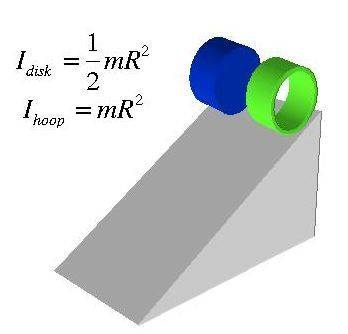
ramproll7-3.jpg
 
Physics news on Phys.org
amjad-sh said:
We know that the rotational inertia I of a certain object is I =∫r∧2 dm where r is the distance between the axis of rotation and the increment of this object that carries a mass dm.

What confuses here is the following:

Take for example a hoop of mass M and radius R.
Integration theory gives that I(hoop)=MR∧2.(where the axis is perpendicular to its center)
Now take a disk of radius R and mass M.
Intuition tells that the rotational inertia of the disk will be larger for the disk as integration will perform more summation here.
But the magical result is that I(disk)=0.5MR∧2 which is even less than I(hoop).

So how that comes?
View attachment 87343

It's only less if the mass of the disk (M) is the same as the mass of the hoop (M). If the two were made of the same material, then the disk would be many times more massive than the hoop.
 
  • Like
Likes   Reactions: Doc Al and amjad-sh
amjad-sh said:
Intuition tells that the rotational inertia of the disk will be larger for the disk as integration will perform more summation here.
Your intuition is a bit off here. Remember that in deriving these general formulas these objects have the same mass. With the hoop, all of the mass is a distance R from the axis, thus the integral is trivial: I = MR^2. With the disk, much of the mass is closer to the axis, thus it must have a smaller rotational inertia.

These general formulas for standard shapes are always given in terms of M, the total mass. The formulas only differ due to the distribution of that mass.
 
  • Like
Likes   Reactions: amjad-sh